
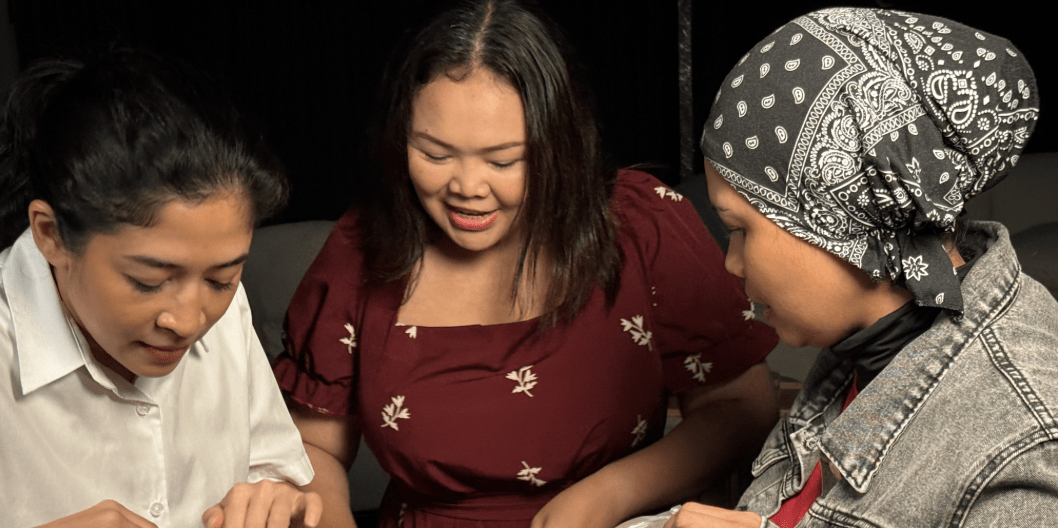
“When you start, you start with yourself,” says actress Munah Bagharib. “And sometimes there’s no way of controlling the levels and layers of the character.”
It is an apt description of how 3 Queens came to life. The Necessary Stage’s newest production may centre on three women: sisters Bedah and Zeina, and their close friend Aida, but the characters audiences will meet onstage did not begin as fully formed figures in a finished script. Instead, they emerged gradually, through improvisation, conversations, exercises, personal experiences and the accumulated discoveries of a creative team working together.
That collaborative approach is characteristic of The Necessary Stage, whose original productions are largely devised works built through research, improvisation before scripting and contributions from the wider production team. For 3 Queens, the process gave Haresh Sharma, who wrote and co-directs the play with Adib Kosnan, an opportunity to return to a form of devising he had not worked with in some time and to bring together three performers he had long wanted to collaborate with.

“I wanted to do something where I could work with all three of them,” Haresh says of Munah, Siti Hajar Gani and Siti Khalijah Zainal. “I wanted to do a devising process that we hadn’t done in a while.”
This was a very intentional team he had assembled. Siti K, a longtime collaborator with TNS, had already gone through the devising process several times, while it was new territory for both Munah and Siti Hajar. Haresh had also worked with Adib over the years in different capacities, whether as an actor, facilitator or through readings, making this an opportunity to work with him as a co-director on a full production for the first time.
For Siti K, considering her long history with TNS, the experience felt like returning to familiar ground. “It feels like coming back to a familiar place,” she says. “The issues are new, but it’s comfortable. It’s fun.”
Munah, on the other hand, was entering a process she had previously only heard and read about. “I was just excited to come into this and work on this process,” she says.
What neither necessarily anticipated was just how much the process would reveal—not only about the characters, but about themselves and one another. “I think Haresh was surprised to see how surprised we can be,” Siti Hajar says with a laugh.
For Adib, seeing the three performers come together was equally illuminating. “The energies coming together for the process was very eye-opening for me,” he says. “I’d never had the three-phase experience before.”
The process involved different stages of development, including exercises such as a card game in which the actresses were given varying percentages of personality traits and asked to build characters around them. Some attributes were familiar; others deliberately pushed them away from themselves. “You play along with a certain percentage of attributes, and sometimes they’re not you,” Siti Hajar explains. “Sometimes we would surprise each other and even ourselves with these fun characters.”
The point went beyond generating eccentric personalities. The improvisations became a way of testing what the performers could inhabit, what they resisted and what unexpected possibilities emerged when they were asked to step outside their usual instincts. “If you’re not improvising in those things, then you won’t be pushed out of your comfort zone,” Siti K says. “Especially age-wise, sometimes you’re forced to go against that.”
As the work developed, the characters began to accumulate histories. The actors were thrown into scenes without necessarily knowing where they would lead, allowing relationships and tensions to emerge organically. By the second phase of development, they were working out backstories, ages, histories and connections, who had grown close, who had drifted apart, and why.
Eventually, the three women at the centre of 3 Queens became amalgamations of all those experiments. “The three main characters are all amalgamations of different characters we created,” Haresh explains. “A lot of it was restarting the conversation and saying, ‘Oh, this argument came from this improvisation.’ That’s what I like about devising. It’s not creating 100 per cent from scratch. You’re giving to each other and giving back.”
That distinction is important. The finished play may carry Haresh’s name as playwright, but the route to the script was not a solitary one. The writing came after the actors had already spent time inhabiting, testing and interrogating the world of the play. “It’s quite rare to work with a finished script versus growing with the character,” Haresh says.
For Siti Hajar, that is precisely what makes the process valuable for an actor. “It makes it easier for us as actors to connect with the characters because we have them beforehand,” she says. “Before the whole script is edited or written, we already know the characters we’re playing.”

That sense of ownership also allowed the performers to bring their own experiences into the work without simply reproducing their lives onstage. Siti K, who plays Aida, grew up with two older sisters, and although her family is not the same as the one portrayed in 3 Queens, she understands the particular intimacy of growing up alongside people and watching those relationships evolve. “I can bring in the understanding of what it’s like to have that connection,” she says.
What interests her about the relationship at the centre of 3 Queens is that its fragility does not necessarily come from a dramatic falling-out. People simply change. They grow older, move away, encounter new responsibilities and enter different phases of life. “Over time, things happen and you grow out, you move away from each other,” she says. “Sometimes it’s not because of fights.”out, you move away from each other,” she says. “Sometimes it’s not because of fights.”
Yet there is something unusually persistent about the friendship between Aida, Bedah and Zeina. “I find the relationship between these three ladies quite special,” Siti K adds. “They try to fight for it one way or another.”
Munah, who also has two older sisters, found a similar point of connection. “We’re four years apart, and we grew up in very different phases,” she says. “Over time, even though we drift apart or might get close again, we hit different points where we understand what it’s like to drift apart and come back together again when we’re much older.”
For Siti Hajar, the point of reference was a different family relationship. She drew on her experiences with her sister-in-law and the misunderstandings that can emerge within extended families. “I have that experience, and I bring in that unresolved element within in-laws,” she says.
Those personal connections matter because 3 Queens is ultimately less interested in presenting a perfect picture of sisterhood than in examining what happens when relationships are tested. The play’s three women have a long history together, but they are also individuals with their own ambitions, disappointments and blind spots.
Haresh is particularly interested in those contradictions. “When I’m writing, I’m always looking for the unexpected things,” he says. “I’m interested in seeing things outside of their character and bringing out more of their complexities and contradictions.”
That can mean allowing a character to behave in ways that are uncomfortable, even darker than an audience might expect. “A character might even go into a darker side, or have a darker realisation or action that might seem negative,” Haresh says. “Your character has to do things, and it’s up to the actors to reconcile that.”

The question then becomes not simply whether a character has done something wrong, but how someone capable of love and loyalty could also be capable of hurting another person. “How are they capable of hurting someone they’re close to, or having that mindset about something?” Haresh asks. “Sometimes we do have thoughts that are negative. And hopefully that’s something people can identify with.”
Siti Hajar sees the same complexity in all three women. “You might see a character who seems perfect, but then you’re surprised by the depth,” she says. “We are all just human. We make mistakes.”
There is no straightforward villain or hero. Someone who initially appears unhinged might prove capable of great compassion; someone who seems deeply family-oriented may have another side that only emerges when pushed.
For Munah, that ambiguity has been one of the most striking discoveries of the rehearsal process. “At some point in the rehearsal, we do see facets of ourselves in each of the characters,” she says. “It’s just such a human story. In all three characters.”
That humanity extends beyond the immediate relationships between the women. Adib has also found himself thinking about the different forms of sisterhood he has witnessed within the theatre industry, particularly among women navigating careers, family and the demands of a profession that does not always make those things easy to reconcile. “It’s interesting to see female relationships within the theatre industry,” he says. “Different milestones, some leave, some stay.”
He speaks with particular admiration for the women who continue to make theatre despite the challenges of the environment. “I’m always in admiration of women, particularly in the theatre scene,” he says. “It’s not always the most conducive work environment when it comes to having a social life and everything else.”
For Adib, directing 3 Queens has also meant learning when to speak and when to allow the women in the room to lead the conversation.“It’s a very unique challenge,” he says. “It’s a story that I know and am familiar with. It’s not my story to tell, but it’s a story that reflects on my community.”
That distinction has stayed with him throughout the process. “When do I say it, or when do I let it be said through other things?” he asks. “That’s always the challenge when co-directing.”
It is a question that speaks to the broader ambitions of 3 Queens. The play is rooted in the realities of Malay-Muslim women, but the creative team has resisted the idea that there is one definitive experience to represent. “We all come from the same industry to a degree, but we also represent very different things,” Adib says. “Minorities are sometimes seen as one category, but there are so many different ways of seeing these minorities.”
Even the seemingly familiar archetype of a “makcik” contains multitudes, as Siti Hajar puts it: “There are so many kinds of makciks.”
That variety is one reason the devising process became so important. Rather than beginning with a predetermined idea of what a contemporary Malay-Muslim woman should look or sound like, the team could ask questions and discover the answers through the people in the room. The result is a play about relationships that is also about time. Haresh says he could not have written 3 Queens a decade ago. “I could not have written this 10 years ago,” he says. “Sometimes you need to be slightly older to look at people from a distance.”
Age, he explains, has allowed him to look back on friendships that have lasted over long periods and recognise how they change. “Now, at this age, I can write a play about friendship that has lasted over a long period because I can look back on these kinds of friendships.”

That perspective seems to have seeped into the rehearsal room as well. At the time of the interview, the company was only on the second day of its third phase of rehearsals, moving from discovery towards the careful translation and fine-tuning of the material.
Siti K describes the room as open and collaborative, a space where everyone feels safe enough to express what they think. Now, she says, the work is about making sure those discoveries translate convincingly into the final characters. “We’re going through the careful translations and fine-tuning and making sure it is believable for our characters to say,” she says.
For Haresh, that final process is another form of collaboration. He recalls working on Model Citizens, where the team had to navigate different forms of language and translation, sometimes adjusting the Malay so that it felt more natural for a particular character or background.
He is accustomed to the idea that a line written on the page may still need to change once it enters the actor’s mouth. And perhaps that is the essence of 3 Queens: nothing remains completely fixed. Not the script, not the characters, and certainly not the relationships.
For Adib, there is a privilege in watching these three fictional women move through theirs. He describes it simply: “You never know who is going to be with you throughout the journey and which parts of the journey. It’s a privilege to see these characters go through the journey.”
The same might be said of the audience. Munah hopes viewers will leave the theatre thinking about the people who have accompanied them through their own lives: the family member they have lost touch with, or the person who has been there through several different versions of who they are. “I want them to think: Who is the one family member you haven’t been in contact with?” she says. “Or the one who’s seen you through so much of that journey?”
Siti Hajar has a more mischievous version of the question: “Who is the person who always drives you crazy and disappoints you, and who is that person you will still love at the end?”
And Siti K, playing the friend who stands outside the blood relationship at the heart of the story, has found herself asking a question of her own: “Have I been a good friend?”
It is perhaps the most revealing question to take away from 3 Queens. Because sisterhood, friendship and family are rarely sustained by grand gestures alone. They are maintained through the ordinary, difficult work of showing up, listening, forgiving, changing, and deciding, again and again, to remain part of one another’s lives.
Photo Credit: The Necessary Stage
3 Queens runs from 3rd to 13th September 2026 at The Ngee Ann Kongsi Theatre, Wild Rice @ Funan. Tickets available from BookMyShow

