
High-concept musical strips away the myth of the last days of Jesus Christ to tell a powerful story of fame, faith, betrayal and human fallibility.
Duration: 120min, including a 20min intermission
Jesus Christ Superstar is the kind of musical that sounds almost impossible to pitch. Take one of the most familiar religious stories in Western culture, recast its central figures as rock stars, and tell the entire thing through music. Throw in the risk of offending conservative audiences, a score that demands serious vocal and physical stamina, and the sheer scale required to make the Passion feel suitably epic on stage, and it is no surprise that the musical initially struggled to make the leap to the stage, finding its breakthrough instead as a concept album before producers finally took the gamble. Yet that gamble is precisely what makes Jesus Christ Superstar so exciting: this is Andrew Lloyd Webber and Tim Rice at their most audacious, turning a familiar Biblical story into something closer to a rock opera about fame, faith, betrayal and the human cost of becoming an icon.
Presented by Base Entertainment Asia, the Regent’s Park Open Air Theatre production, directed by Timothy Sheader, takes on the final days of Jesus Christ, from Judas Iscariot’s growing concern over his friend’s influence through the Last Supper, betrayal, trial and crucifixion, and reframes the Passion through the language of rock music and celebrity. Jesus is no longer an untouchable religious icon, but as a young man who becomes increasingly overwhelmed by the expectations placed upon him. Judas is not a simple villain, but someone who believes he is acting out of concern for his friend and becomes increasingly trapped by the consequences of his own decisions. The crowds who adore Jesus can just as quickly turn against him, while the religious and political authorities are themselves motivated by fear, pressure and self-preservation. The result is a story that feels surprisingly contemporary, particularly in its parallels between sainthood and celebrity: Jesus is increasingly loved not necessarily for who he is, but for what his followers believe he can do for them.

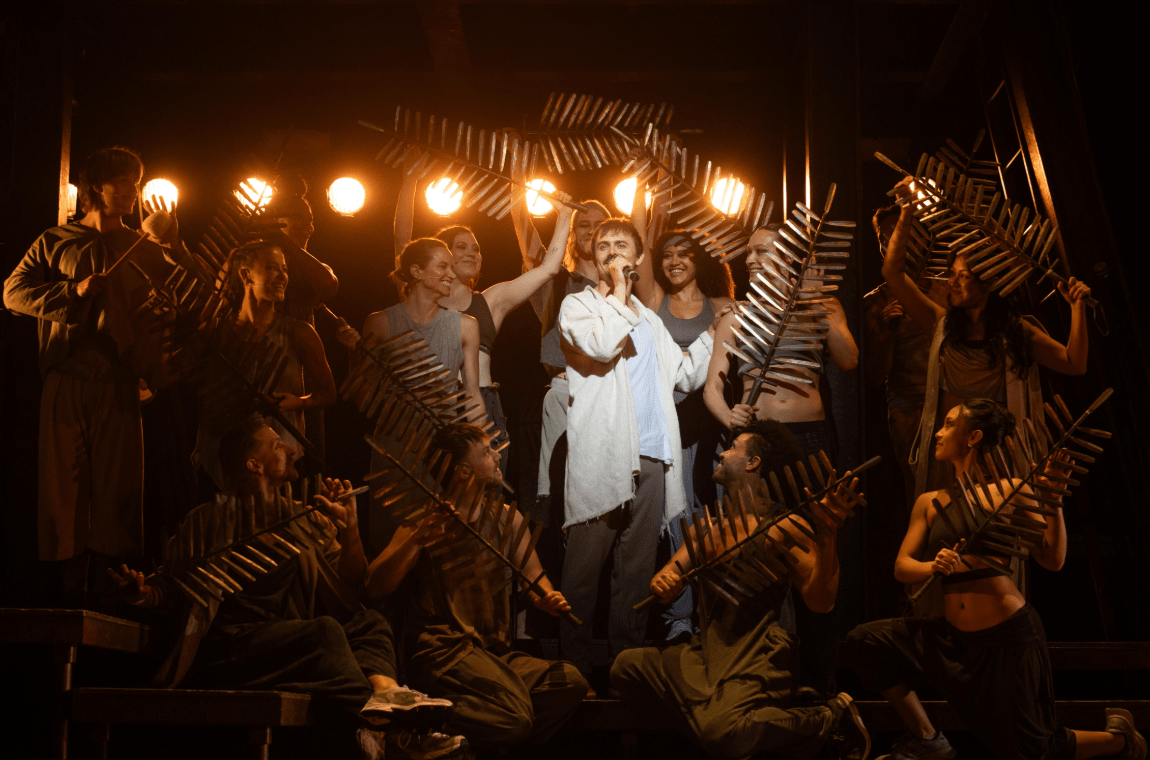
This production fully commits to Jesus Christ Superstar as a rock opera, treating the Passion like an enormous live concert. Tom Scutt’s set and costume design gives the production an immediately striking visual identity, with a large cross-shaped platform dominating the stage and another cross formed through negative space in the backdrop. Rows of lights stretch across the stage, while Lee Curran’s lighting design uses them to create the atmosphere of a live concert, moving from bright bursts of excitement to darker, more ominous sequences. Even the opening reveal is impressive, with the blood-red safety curtain depicting two angels connected by a ring before giving way to a stage that looks ready for a major rock show.
The production also finds a satisfying balance between historical and contemporary references, particularly through Tom Scutt’s costume design. The cast are dressed largely in loose, modern streetwear with a vaguely hippie sensibility, making the disciples and followers look less like figures from Biblical history than a contemporary community of devotees. At the same time, Roman and Biblical imagery is retained in unexpected ways. The soldiers’ helmets, for instance, incorporate sculptural faces reminiscent of Roman statues in place of conventional visors, making them feel anonymous and imposing while giving their armour an almost surreal quality. Elsewhere, the High Priests appear in loose robes and sunglasses, an irreverent combination that makes them feel less like conventional religious figures and more like a strange, self-assured counterculture of their own. Even Herod’s flamboyant gold costume contributes to the production’s deliberate theatricality, allowing him to emerge as both a larger-than-life celebrity and a grotesque figure of power. It is a good example of how the production updates the material without trying to disguise what it is: this is neither a literal historical reconstruction nor a generic contemporary retelling, instead, it is a deliberately hybrid, anachronistic interpretation that understands the Passion as a story that can be reframed through different cultural languages.

Drew McOnie’s choreography is equally important in establishing that world, and the ensemble proves remarkably strong and adaptable in bringing it to life. There is an impressive physical discipline to the company, from the precision of their repeated movements and coordinated gestures to the sheer stamina required to sustain the production’s relentless energy. Yet what stands out most is how readily they can shift between different functions within the story: they can be exuberant followers, adoring fans, a seething mob or an almost threatening physical force around Jesus, often within the space of a single number. Numbers such as “The Temple”, “Simon Zealotes / Poor Jerusalem” and “The Last Supper” are particularly well served by this physicality, with simple movements accumulating into increasingly complex and hypnotic ensemble sequences. Their reaching hands around Jesus can feel almost consumptive, as though everyone wants a piece of him, and their ability to turn that adoration into hostility makes the production’s exploration of mob mentality particularly unsettling. It is a testament to the ensemble that they can make the crowd feel like a character in itself, constantly changing, always exerting pressure on the people at the centre of the story.
The live music also deserves credit for maintaining the production’s energy. The score is performed with a good balance between orchestral textures and the force of a live rock band, with the sound design allowing the music to become expansive when the production calls for spectacle while pulling back enough for the vocals and quieter dramatic moments to register. The performers also feel convincing when playing instruments themselves, reinforcing the concert aesthetic rather than making it feel like a theatrical conceit imposed on the material. More broadly, it is impressive how Webber’s score accommodates such distinct vocal personalities across the cast. Jesus, Judas, Mary and the supporting performers all have different approaches to their material, but the score brings those contrasting styles together into a cohesive whole, much as the characters themselves are constantly colliding with one another.

Javon King’s Judas is one of the clearest examples of this. Opening number “Heaven on Their Minds” immediately establishes the role as both vocally and physically demanding, and King attacks the song with an urgency that continues throughout the performance. His Judas is restless, constantly moving and seemingly unable to settle, which makes his internal conflict visible even before the character explicitly articulates it. King is a veteran performer in the role, and brings a strong sense of command and confidence to the material. Yet, he still manages to maintain and capture a feeling of danger and uncertainty underneath it. His Judas is not simply trying to undermine Jesus; he genuinely believes that the movement surrounding his friend is becoming dangerous, and that makes the eventual betrayal considerably more complicated than a backstab.
The production also benefits from the strength of the Jesus-Judas relationship. Luke Street and King have an easy chemistry that makes their eventual confrontation feel personal rather than merely functional to the plot, an initial fracture between friends that only widens as the story continues. “The Last Supper” is particularly effective because both characters seem increasingly aware that they are moving towards an outcome neither can prevent. Judas knows what he has to do, while Jesus knows what Judas is about to do, and the tension comes from watching them confront that knowledge and inevitability. “Judas’ Death” then gives King the opportunity to reveal the consequences of that decision, particularly through the mini-reprise of “I Don’t Know How to Love Him”, which becomes an affecting expression of regret and lingering love, before his dramatic end.

Street’s Jesus undergoes perhaps the most substantial transformation across the production. When he first appears with a guitar, there is something youthful and almost carefree about him, like a young preacher or musician who genuinely believes he can spread a message of love and goodness. As his following grows, however, that confidence gradually gives way to exhaustion and uncertainty. Street is particularly good at showing the psychological effect of being constantly surrounded by people who want something from him. The more famous Jesus becomes, the more isolated he appears, physically present yet psychologically distant, and Street’s expressions become increasingly burdened as he realises that the people around him may not understand him as well as they think they do.
That makes the eventual performance of “Gethsemane” an especially effective showcase for Street. The song is obviously a considerable vocal challenge, but what makes his performance compelling is that he does not treat it purely as an opportunity to demonstrate vocal range. The intensity builds gradually as Jesus moves through fear, anger, doubt and exhaustion, with Street allowing the character’s vulnerability to remain visible throughout. By the climax, there is a genuine sense of someone reaching the limits of what he can bear. The performance is powerful because it feels like a continuation and climax of the character’s emotional journey rather than a break from it for a big showstopper.

The supporting cast also contributes to the production’s strong sense of character. Grant Hodges gives Caiaphas a commanding presence, particularly through his deep vocal register, while Kodiak Thompson brings a more wiry quality to Annas. Their open robes, sunglasses and contemporary styling make the High Priests feel less like conventional Biblical figures and more like an established power structure, which fits neatly with the production’s wider interest in authority and celebrity. Ethan Hardy Benson’s Pilate is similarly effective, particularly in “Trial Before Pilate”, where his black leather jacket and restrained performance give him the appearance of a modern authority figure who is visibly conflicted by the situation unfolding in front of him. Watching him gradually give in to the pressure of the crowd makes the eventual punishment of Jesus all the more uncomfortable.
Erich W. Schleck’s Herod, meanwhile, provides one of the production’s most entertaining yet disturbing changes of pace. “King Herod’s Song” is flamboyant and camp without losing its menace, with Schleck clearly enjoying every opportunity to play up the character’s theatricality. His swagger, costume and physicality make the scene almost comic at first, but there is something increasingly disturbing about watching Herod treat Jesus’ suffering as entertainment. The scene captures one of the production’s recurring tensions particularly well: the audience is being entertained by a theatrical spectacle while simultaneously being asked to recognise the cruelty taking place within it.

The two Singaporean Mary Magdalene performers, who take turns playing the role on different nights, Tabitha Nauser and Frances Lee, also bring noticeably different qualities to the character. Having had the privilege of watching both Marys, Nauser comes across as a particularly experienced, polished and assured musical performer, with crisp, clear vocals, a confident stage presence and an effortless command of the song. Her Mary feels composed even in moments of uncertainty, allowing the strength of her voice to carry much of the character’s emotional weight. Lee, meanwhile, leans more heavily into the acting, bringing a greater sense of visible vulnerability and emotional conflict to Mary’s journey. In “I Don’t Know How to Love Him”, you can see the character wrestling with feelings she does not quite know how to process, with Lee allowing that uncertainty to colour each lyric and gesture. It makes her performance feel particularly intimate, as though Mary is discovering her own feelings at the same time as the audience.
Their respective approaches are especially interesting in a song that has accumulated decades of audience expectations. Neither performer seems interested in simply reproducing what has come before; instead, they find different ways into Mary’s perspective, proving how much room there is within the same melody and lyrics for a performer to make the character her own. Both also hold their own within the production’s demanding ensemble work, matching the physicality and chemistry of the larger company rather than simply stepping out for Mary’s solo moments. It is immensely gratifying to see two Singaporean performers taking on such prominent roles within an international touring production, and the fact that their interpretations can be so distinct while both remaining compelling is a testament to the depth of local talent, representing Singapore on this stage and making the role their own.
The production is at its strongest when these performances and design elements come together. “Everything’s Alright” and its reprise, for instance, take on different meanings as the story progresses, with the reassurance of the original song eventually sounding more like a hollow promise. “Could We Start Again Please” offers another welcome moment of quiet amid the escalating intensity, while the second half increasingly strips away the concert-like excitement and focuses on the consequences of what has happened. The crucifixion is consequently difficult to watch, particularly after the production has spent so much time establishing Jesus as a charismatic, larger-than-life presence. Seeing Street’s transformation from a confident young man into someone physically broken and bloodied gives the final scenes considerable weight.

It is here that that the production’s conflicting impulses of spectacle and suffering come together most completely in “Superstar”. The number initially feels almost celebratory, with the three female voices leading the chorus in a rich, gospel-like refrain of “Jesus Christ, Superstar”. The music is infectious, the performers are exhilarating, and the sheer theatricality makes it difficult not to be swept up in the moment. Yet the audience is also being asked to process the fact that the now bloodied Jesus has just been tortured and killed. That tension makes the number unexpectedly unsettling: there is something almost uncomfortable about being entertained by such an ecstatic piece of music immediately after witnessing so much violence. Rather than softening the horror of the crucifixion, the exuberance of “Superstar” makes it linger. The production understands that spectacle can coexist with suffering, and that we can be simultaneously thrilled by what we are seeing and disturbed by what it represents. It is perhaps the clearest distillation of the entire production’s approach to the Passion: the music is joyful, the staging is spectacular, the talent on stage is extraordinary, and yet underneath all of it is an image of profound human suffering.
The ending is perhaps the production’s most effective decision. After the noise, movement and spectacle of “Superstar” and the crucifixion, everything becomes quiet. The crowd has disappeared, Judas returns, and Jesus is removed from the cross. The lighting suggests the beginning of a new day, but there is no attempt to provide an easy resolution. Instead, there is simply a moment to acknowledge what has happened. After two hours of music, movement, confrontation and escalating spectacle, that stillness feels necessary, giving both the characters and the audience a moment to process what they have witnessed. For a musical that has spent so much time stripping away the divinity and mythology surrounding its characters, it is a final respite, where once the spectacle is gone, what remains are people who have made choices, suffered the consequences and played their part in a tragedy that seems inevitable from the beginning.

One may come into Jesus Christ Superstar without a particularly strong emotional connection to the story of Jesus, and it may take some time to settle into the production’s unusual combination of rock concert, Biblical epic and contemporary spectacle. But by the end, one will almost indubitably find themselves affected. Knowing the brutal, tragic outcome does little to diminish the impact of watching these characters reach it, and there were several moments when the combination of the music, performances and physical staging becomes genuinely overwhelming. There is something compelling about being swept up in that energy and then sitting with the viscerally depicted suffering alongside it.
That is precisely what makes this production of Jesus Christ Superstar so successful and timeless. It is ambitious without losing sight of its characters, visually spectacular without becoming empty spectacle, and contemporary without losing the essential shape of the story. More importantly, it demonstrates why this musical remains such a significant work of musical theatre. By removing the myth and focusing on fame, faith, betrayal, pressure and human fallibility, it turns a story many audiences already know into something immediate and emotionally resonant. It is also the kind of production that deserves to be seen beyond its obvious audience: you do not need to be religious, or even particularly familiar with the Biblical story, to appreciate what it is doing and feel its ability to make the Passion feel immediate and human.

At a time when musical theatre can sometimes lean heavily on familiar titles and established songs, Jesus Christ Superstar is a reminder of what the form can achieve when it takes a genuinely ambitious idea and commits to it completely. More people should see it, not simply because it is an entertaining night at the theatre, but because it is an important example of musical theatre using music, movement, design and performance to make us reconsider a story we think we already know. For a production that is ostensibly about a superstar, its greatest achievement is reminding us of the vulnerable human being underneath the icon, and leaving us with a story that feels universal.
Photo Credit: Zeus Martinez Photography
Jesus Christ Superstar plays from 19th August to 6th September 2026 at the Sands Theatre at Marina Bay Sands. Tickets available here

