
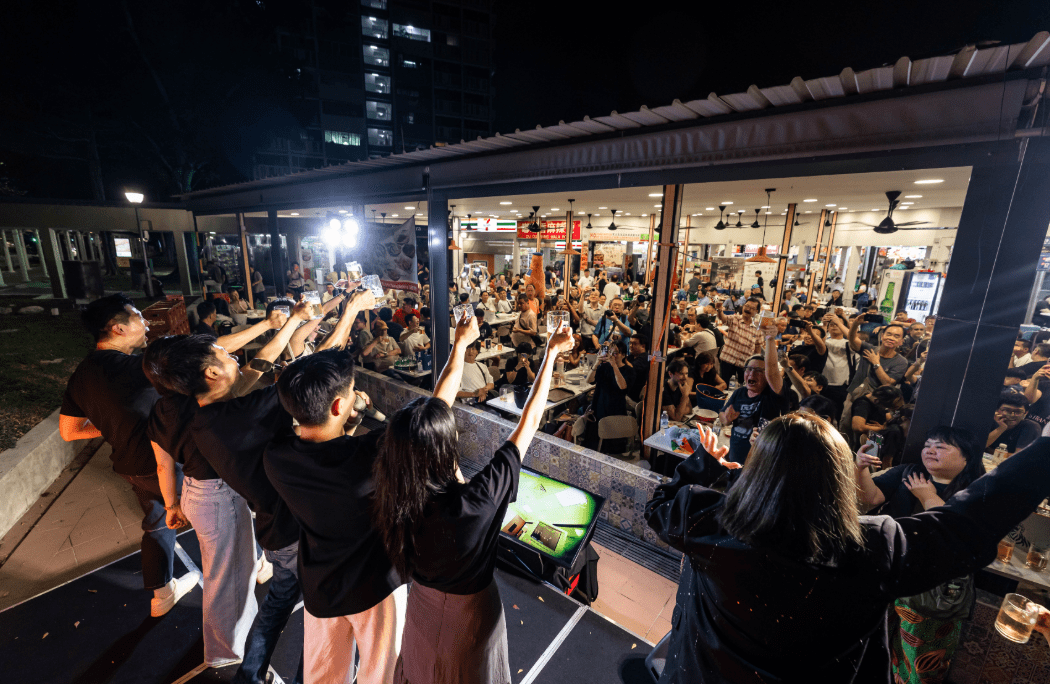
After travelling from Singapore to international film festivals in Berlin, Hong Kong, Italy, Australia, Shanghai and New Zealand, We Are All Strangers finally came home last week, and appropriately, celebrated the homecoming at a coffeeshop, one of the most iconic settings in both the film and Singapore itself.
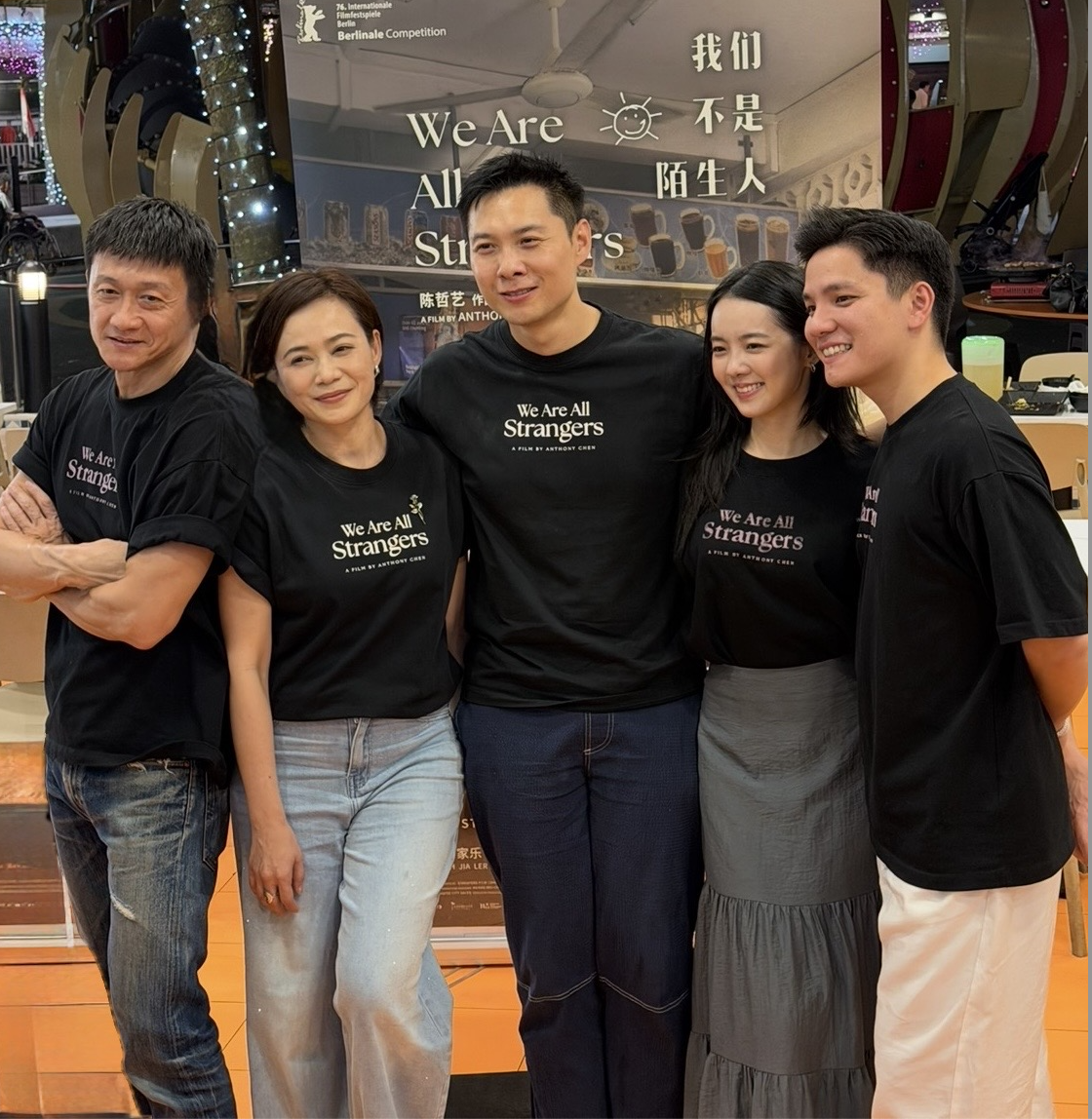
Just a day after Anthony Chen’s latest film opened in Singapore cinemas, Tiger Beer brought Chen and cast members Yeo Yann Yann, Koh Jia Ler, Andi Lim and Regene Lim together with more than 500 fans at S11 Ang Mo Kio for the film’s first-ever coffeeshop meet-and-greet. Over karaoke, games, photographs, autographs and a celebratory yum seng, the evening felt less like a traditional film promotion and more like an extension of the world Chen has spent years putting on screen: familiar tables, cold beers, neighbourhood conversations and the easy intimacy of Singapore’s heartlands.
For Chen, that was precisely the point. “The film is about the heartland, so we really wanted to go deep in the heartland,” he explains, adding that Tiger was familiar with the different coffeeshops around Singapore. There was an added coincidence here too: this was one of the places Yeo Yann Yann had spent time observing while preparing for her role. “She spent weeks just observing Tiger beer ladies,” Chen says. “She can even tell you this kopitiam is all China girls, the other one is all Malaysian girls.” In that sense, bringing the film back to a coffeeshop was not just a promotional decision, but another way of recreating the world of We Are All Strangers outside the cinema.
And that homecoming matters to Chen. After the film’s unprecedented run on the international festival circuit, including its historic Berlinale competition selection, he is now watching to see how Singaporeans respond to a story that is, above all, made for them. “The world now is that we’re all in our own echo chambers,” he says. “All of us liking each other’s stuff, so you keep getting fed the same things. So my anxieties nag at me and I’m wondering, do people out there really know about the film?” With the film opening widely across Singapore, however, he sees little reason for audiences not to make the trip. “We’re on like 18 cinemas around the island. Literally, there are screenings from 11am in the morning until midnight. I can’t fault the exhibitors for not having slots. People just have to come out and see it.”

For the cast, the response has been particularly meaningful because the film’s emotional world is so recognisably Singaporean. Yeo Yann Yann hopes audiences will not simply watch the film, but recognise the value in its ordinary lives and relationships. “I really hope that many people just go and hear these stories and how these stories have value,” she says. “It makes you laugh and cry, and I wanted to show you all this lovely group of human beings in this world, sometimes difficult, sometimes happy, sometimes amazing, to relate to as a Singaporean.” She recalls the reaction of a junior from Malaysia who had been living here for only three years. “She watched it and went, ‘Wow, I really enjoyed it.’ To hear that it had resonance with a fellow Malaysian was so encouraging.”
That ability to find emotion in the everyday is central to Chen’s filmmaking, and nowhere is it more evident than in the film’s quieter scenes. Yann Yann and Andi Lim’s bus sequence, for instance, contains little dialogue, yet communicates an entire relationship through glances, silences and the simple decision to take the long way home. Andi explains that his character is not the expressive type, so the bus becomes a way of prolonging time together. “They have no courage to say it out loud, so why take a bus? The journey is long. They met each other in a crowded coffeeshop, so they take a long route so they have a lot more alone time.”
For Yann Yann, those moments are where cinema can be particularly powerful. “The film has the magic of close-ups and sense of place,” she says. “When we see the eyes, it really captures whatever is in your mind, especially scenes with no language. It makes you think about how this human being affects you.” She laughs as she remembers filming the sequence, describing how difficult it was to actually shoot the bus journey while dealing with sunlight, traffic and traffic lights. But beneath the technical challenges was something much more intimate: “Sometimes I keep thinking, ‘Love me, love me, love me’ to Andi when filming the scene, and I believe it gets conveyed in our eyes. Our eyes are practically sparkling.”
For Andi, the lesson of those quiet scenes is perhaps even simpler. “Don’t take things for granted,” he says. “Everything is there. Just look, and tell yourself to be kind to someone.” It is a sentiment that could almost serve as a quiet thesis for the film itself, and for Chen’s broader portrait of Singapore.

That sense of observation extends to the actors’ own preparation. Andi, for example, lost around five kilograms of muscle in three weeks for his role, going on a full vegetarian diet to make his character more convincing. Yann Yann, meanwhile, spent weeks studying the women working in coffeeshops, observing their routines and personalities. It is the sort of meticulous attention to everyday life that has long characterised Chen’s work, but here it also makes the coffeeshop around us feel like another scene from the film.
For Koh Jia Ler, meanwhile, We Are All Strangers represents something much more personal: the point at which acting finally became a craft rather than something he simply happened to be doing. Jia Ler has been part of Chen’s Growing Up trilogy since the beginning in Ilo Ilo, when he was just a child. He admits that back then, he did not really know what it meant to be an actor. “Since Ilo Ilo, I didn’t train, didn’t have classes, was just there to have fun,” he says. “I didn’t know how an actor should behave or prepare for a role.” Chen, however, gradually taught him through each film, and by the time they reached We Are All Strangers, the expectations had changed. This time, Jia Ler was no longer playing a child who could simply inhabit something close to himself. He was portraying a young father and was expected to take responsibility for the role.
“Anthony said, ‘This is not a film like the previous ones. It’s going to be hard work. You’re going to be portraying a young father, not just a lazy 18-year-old. You need to step up for this,’” Jia Ler recalls. At first, he resisted. “I told him, ‘Anthony, I don’t want to be an actor. You can find someone else.’ But somehow during filming I ended up developing that love and passion.”
That transformation is reflected in his relationship with Yeo Yann Yann too. After Ilo Ilo, Jia Ler continued affectionately calling her “Mummy” through the film’s promotional period and into Wet Season. But Yann Yann eventually pulled him aside and told him it had to stop. “She’s a professional actor and told me we have to be serious and can’t keep calling her Mummy because it affects the character relationship,” he says. “I got scolded and she said, ‘Just call me by my name.’”

Years later, their relationship has evolved again. “She’s still family, but now more like a big sister,” Jia Ler says. “She will take me through a scene when I’m finding difficulty, and we work through it together.” His relationship with Chen has similarly changed while retaining the same affection underneath the nagging. “He’s still a father figure, always scolding and nagging me, but always wants the best for me,” he says. Chen has even encouraged him to think beyond the dramatic roles he has played so far. “He told me about how the world had no more action stars, and since I have some craft for acting and background in martial arts, why not try?”
For Jia Ler, the completion of the trilogy therefore feels less like an ending than a beginning. “From this trilogy, it’s just the beginning,” he says. “From listening to all these pieces of advice, it’s time for me to get out of my comfort zone and on my own.” And while he is still balancing acting with his family business, he is trying to stay ready for whatever comes next. “I always loved acting. But I didn’t like the fame that comes with it. I guess I’ll have to overcome that.” These days, he is even keeping fit and trying to maintain his weight. “I always put on weight so fast,” he laughs. “I try to maintain but always stay ready for whatever comes my way.”
Regene Lim, meanwhile, is the newcomer to working with Chen, and that offered a different kind of initiation. Having auditioned after binge watching his previous films to understand “the vibe he’s going for”, she quickly discovered just how exacting his process could be. “I initially struggled with the way Anthony likes to direct, where he pays attention to even the sound and pace of your breathing,” she says. “It’s not something anyone I worked with brought up before, and it really impressed me how he’s so detail-oriented.”
There were days when that level of scrutiny left her wondering whether she was capable of meeting his expectations. “Many days I might feel dejected and nervous. Am I able to do this, to do him proud and myself proud?” she recalls. Ultimately, however, she came to see that the pressure came from Chen’s belief in her. “He doesn’t let me get away with anything he doesn’t like. But he believes in me. What an amazing director, I really learnt a lot.”

Her character, Lydia, also resonated with her precisely because she is not simply the sheltered young woman she initially appears to be. “I love that she will do whatever she believes strongly in regardless of what others think,” Regene says. “Despite her age, she’s very responsible and does whatever she wants.” Regene admits she is not as brave as Lydia in real life, but understands the impulse behind her choices. “Who has never been madly in love and thought, ‘Okay, I’ll do anything for love’? Just that Lydia has the courage to say, ‘I’ll do it,’ and do whatever it takes.”
For her, that sense of agency also feels increasingly relevant to Singapore’s younger generation. “It’s not such a linear Singaporean journey now,” she says. “University and education are still the standard goal, but because we believe a lot more in individuality and doing what makes us happy, what happens after is a lot more varied now.”
Perhaps that is why the four actors feel like such a natural extension of Chen’s larger portrait of Singapore: people at different stages of life, all negotiating responsibility, love, work, family and the expectations placed upon them. And behind them is a director who has spent much of his career observing exactly these small negotiations.
As the trilogy comes to an end, Jia Ler is particularly conscious of how much he will miss that dynamic. “Anthony will be the one guy who knows my limit and stops me from making mistakes,” he says. “I think he even knows me more than I know myself sometimes.” Regene echoes the sentiment from her own perspective. “There’s something so incredible about working with this cast, a chemistry so hard to replicate. It’s hard to find people who really understand each other. Anthony pushes us to our limit and knows how we can be pushed to the breaking point, but in a comfortable, safe environment. It’s once in a lifetime to have had this opportunity.”

That feeling of family, constructed both on screen and behind it, is fitting for a film whose title suggests strangers becoming something else through shared experiences. And it is also what made the Tiger Beer collaboration feel so natural. Tiger, itself a Singapore-born brand that has since grown into an international presence across more than 60 markets, appears in the film subtly, woven into its coffeeshop world rather than treated as an overt product placement.
For Chen, that connection between the film and the brand is meaningful precisely because both are rooted in the same place. “Our lifestyle, our Hokkien mee, our kopitiams, you want something close to home,” he says. “There’s something very special about showing a Singapore film to the bigger world out there, and it’s a chance to really show and create a sense of what it means to be Singaporean.” The word “coffeeshop” itself can be misleading to someone unfamiliar with Singapore, he points out. “No one understands what a kopitiam is. We use the word coffeeshop and people think Starbucks. You have to witness it for yourself to see what kopitiam culture is like.”
For all its international acclaim, We Are All Strangers ultimately depends on the specificity of its Singaporean world, the food, language, spaces, routines and relationships that might seem mundane to those who live here but become windows into another culture for those watching from elsewhere. Chen has felt that distance himself during the film’s international journey, but says coming home has been especially encouraging. “The first stop is home in Singapore, right? So we get a good response. I’m very encouraged by the feedback. It’s quite infectious to watch a Singaporean film.” He has also been struck by the way audiences respond to the film’s emotional weight. Over the past 20 months, he says, conversations with relatives and audiences have repeatedly returned to the fragility of life and the things we tend to take for granted. “There’s a certain fragility to life,” he muses. “As I get older, I appreciate the beauty of life. It’s not just the positive things, but the whole concoction of melancholia, bitter, sour, heartache, all this that makes you cherish the special moments even more.”
He pauses on the idea of those special moments, and shares perhaps the most personal reason he has found to keep making films. His young son has only seen We Are All Strangers, watching it with Chen at the Berlin Film Festival. To his surprise, he sat through the entire 157-minute film and afterwards told his father, “Daddy, I want to watch it again.” It reminded Chen of another moment, years earlier, when his son was five and accompanied him to Melbourne. After sitting through one of his father’s Q&As, the boy was asked what he liked about it. His answer was disarmingly simple: “I like to see my daddy go up onstage, and I like when people clap for my daddy.”
“For so long, there was so much anxiety and doubt, so painful to think whether I should continue making films,” Chen says. “In the past I thought, ‘Oh, I want to make art and make amazing films.’ But now, something as simple as just going onstage and for my son to be proud of me is my reason for carrying on.”
It is perhaps the most fitting note on which to end the film’s Singapore homecoming. Because beneath the festival premieres, international accolades and the years of filmmaking, We Are All Strangers has always been concerned with something much smaller: the people we love, the places we return to, and the ordinary moments we do not realise are precious until they are gone.
And that is also what Tiger’s coffeeshop celebration captured so well. As the cast joined fans for karaoke and raised their bottles for a final yum seng, the boundary between film and real life briefly disappeared. There was no red carpet, no grand auditorium, just a neighbourhood coffeeshop, a Singaporean film, a local brand and hundreds of people coming together.
As Tiger Beer Marketing Manager Tanya Lubis put it, the film is “unmistakably quintessentially Singaporean”, with its coffeeshops and pockets of everyday life. For the brand, supporting it was a natural fit. “I wish that Tiger Beer could be more prominent,” she jokes, “but it was done in a very subtle manner, where if you know, you know; if you don’t know, you don’t know.”
But perhaps subtlety is exactly right. Because the evening was never really about a beer, or even a film. It was about the stories we recognise as ours, and the reminder that local stories deserve to be told, seen and celebrated. As Andi puts it simply: “It’s a story that deserves to be seen.” Yann Yann agrees. “If we don’t tell the story, no one would,” she says. “I think not every Singaporean film needs to be about millionaires or crazy rich people. It’s more important to celebrate the ordinary people and stories, and I hope people see and support that.”
We Are All Strangers is now open in Singapore cinemas such as Golden Village. Read our review here
Read our interview with Anthony Chen here

