
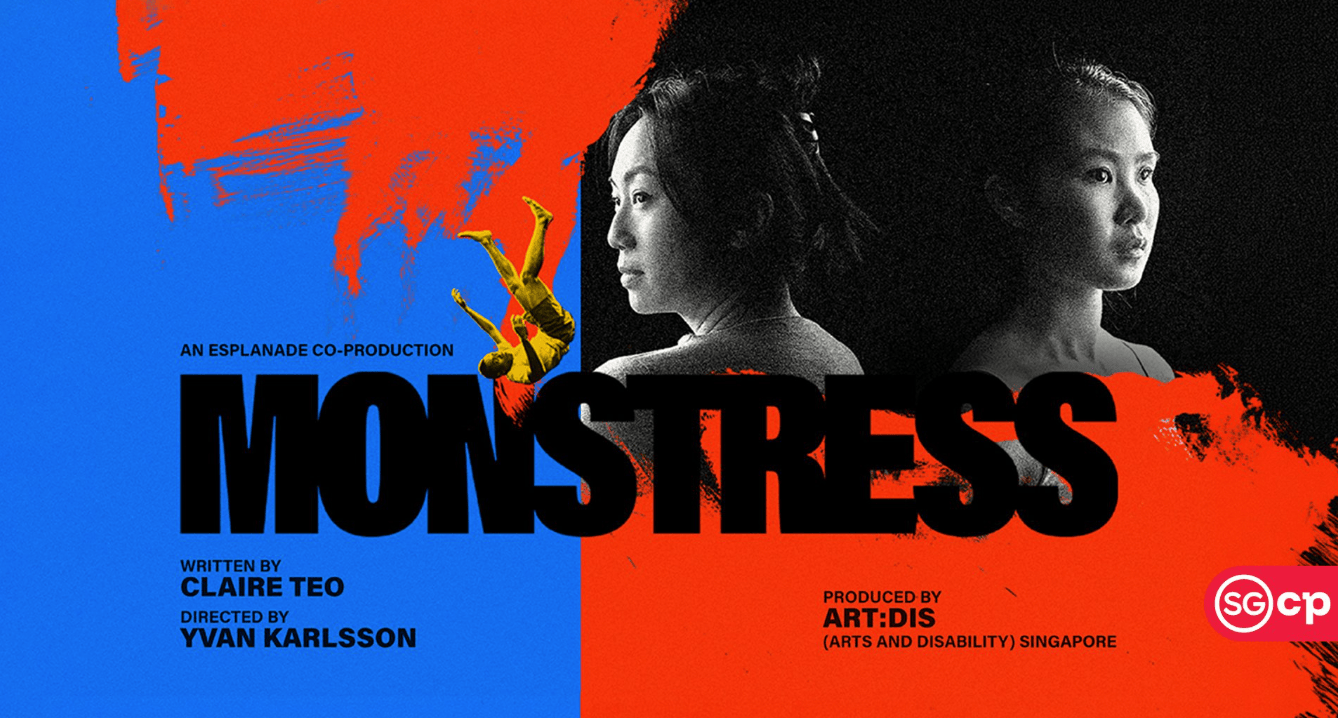
What does it mean to truly see another person? Not simply to look at them, but to recognise their struggles, question our assumptions and notice the quiet ways people can slip through the cracks. These are the questions surrounding MONSTRESS, a new work by visually impaired theatre-maker Claire Teo and ART:DIS that examines disability, caregiving and the everyday systems that shape who is heard, believed and supported.
Blending text, movement, sound and creative captioning, the production follows a blind girl, an autistic boy and his struggling single mother as their lives become intertwined behind the walls of neighbouring HDB flats. Rather than presenting easy villains or simple answers, MONSTRESS asks audiences to confront the silences, biases and structures that allow harm to take root long before it becomes visible. Ahead of its premiere, playwright and performer Claire Teo and actor Oon Shu An speak about creating the work, challenging assumptions, and why seeing differently might be the first step towards building a more compassionate community.

Bakchormeeboy: MONSTRESS asks audiences, “What do you see? What do you choose to see?” What first compelled each of you to be part of telling this story?
Claire: At the core of this work is the need to confront our own ways of seeing and not seeing. Our experiences have shaped our perspectives and choices and I think it’s important to acknowledge our biases, ableism, and relook at these stories through fresh eyes. What have we missed or ignored? Have we been blind-sided?
If we can reimagine a different way of connecting and relating to the world around us, perhaps we can too imagine a different ending for those that come after.
Shu An: Funny story. I had watched Claire in a participatory performance, Performing Normal, and was particularly blown away by how she facilitated part of the Q&A with such care and sensitivity, as well as the way she advocated for the community. I thought, “I need to talk to this person, she’s amazing.”
We had a great conversation, and then she suddenly asked me to be part of her project. I was like, “YES. I don’t care what it is, I just want to work with you!” I’m really glad I did.
Bakchormeeboy: The play centres on people navigating schools, transport, neighbourhoods and family life, many of which aren’t designed with everyone’s realities in mind. What conversations were you hoping to spark by placing these everyday experiences on stage?
Claire: Every one of us is a neighbour, a friend and a passenger on public transport. We can choose to be passive witnesses or we can choose to see that we have the power to influence an outcome. Very often, inaction comes from uncertainty. We are not sure. We do not want to interfere. We do not want to confront. We are afraid of making things worse, so we wait for confirmation. But sometimes, that means someone else continues to fall through the cracks.
The play isn’t encouraging heroism. It is challenging us to be responsible in small, practical ways: noticing, listening, clarifying, following up and not immediately dismissing what doesn’t make sense to us.
Shu An: One of the things would be perhaps to start looking for where we see this in our everyday lives. Because caregiving and disability tend to be invisible to a lot of people, myself included. Caregiving is incredibly difficult, expected—especially of women—and it is often unpaid. Why do we accept this? How do we even out the burden of care?
Access is often an afterthought, if it even becomes a thought, but yet we rarely consider how no one forgets to turn the light on for sighted people to be able to see. How do we shift the idea of “special needs” to just necessary needs for the community and caregivers in terms of resources, funding, schools, job opportunities and dignity of life?

Bakchormeeboy: Claire, as both the playwright and a performer in MONSTRESS, you draw from lived experience as a visually impaired theatre-maker. How did you navigate balancing the personal with creating a story that resonates beyond your own experience?
Claire: MONSTRESS is not my story. It is not an individual’s story. It is a story shaped by people we have lost, dismissed and overlooked in everyday life. The work was devised with a team of creatives, and supported by conversations and research with special needs educators, law enforcement, caregivers and autistic individuals, allowing the story to move across many lived realities.
I am one of the faces of the work because I am part of this community, and I feel a responsibility to make sure the characters are portrayed with as much respect, care and authenticity as possible. My lived experience as a blind artist informs the work, but it does not make me the authority on every story represented. It makes me accountable.
My perspective also comes in through how I experience theatre as a blind person in the audience. As we developed the language of access in the play, one of the first questions was: “Claire, how do you want to experience this work?” My answer was: I want to experience movement that I can hear.
That became our starting point. The aim is not for every audience member to have the same experience, but for everyone to have a full experience. Maybe that is what art does. We notice different things, and those differences can open up different conversations.
Bakchormeeboy: Shu An, Melissa is a character many people might recognise—a parent trying her best while struggling in ways others don’t see. How did you find the humanity in someone whose actions may at times make audiences uncomfortable?
Shu An: It was so important for us to hold these characters with compassion even as we examine the conditions around them. I had assisted Kok Heng Leun from Drama Box on Hold Me Now last year, and part of that involved talking to caregivers and care receivers. The strength of love and the human spirit is truly incredible, but it is also an unbelievably difficult thing that can be quite relentless.
I honestly think we, as a society, ask too much of caregivers. This shouldn’t be something people do alone. One of the things that drove Claire to create this work was noticing that in cases where children with disabilities lost their lives at the hands of caregivers, there was often tremendous sympathy for the caregivers, while the children themselves became almost invisible. This is very different from when non-disabled children die at the hands of caregivers.
Why does this difference exist? Are not all lives equally worthy of grief? We don’t have the answers, but we hope the play moves away from simply indicting one individual, because the issue is so much bigger than that—and much closer to all of us than we think.

Bakchormeeboy: One of the most unsettling ideas in the play is that “not all monsters arrive fully formed; some are made.” What does that line mean to each of you?
Claire: Monstrosity can be shaped by environment, neglect and survival. Hurt people, hurt people. Life is already difficult. But when the environment, infrastructure and relationships around a person repeatedly tell them that they are unwanted, unsafe or unheard, something in them changes. What helped create the conditions for this to happen?
That does not excuse the harm caused, and the play aims to hold all involved accountable—including the people who look away, and the systems that normalise harmful behaviours until it’s too late.
Shu An: I do believe there are some truly evil people in the world. But I also think the world and the way it runs can be so cruel to some people that they behave in ways that can be unfathomable to most.
When we talk about accountability—which we must—are we also holding these systems accountable? Are we asking ourselves what we could have done, and what we can still do, to make the world less cruel instead of simply making monsters out of human beings reacting to cruel circumstances?
Bakchormeeboy: Claire, the play challenges not only what we fail to see, but also the behaviours and silences we normalise. Was there a particular moment in writing the play that made you confront your own assumptions or blind spots?
Claire: Too many to count. Working on this play made me much more aware of how language shapes perception. A word, a pause, or the structure of a scene can influence what the audience notices, who they sympathise with, and what conversations happen after.

Bakchormeeboy: Shu An, you’ve often spoken about storytelling as a form of advocacy. What responsibility did you feel in portraying Melissa without reducing her to a stereotype?
Shu An: This started as a devised process, so at the beginning the character of Melissa didn’t even exist. We conducted interviews with people from social work, psychiatry, caregiving, education and law enforcement, and many of the same themes kept coming up: caregiver burnout, lack of understanding from the public, not enough resources—schools, care programmes, support networks.
As we continued developing the show after its first staging, the responsibility was always there. We kept asking ourselves: What questions are we asking ourselves and our audience? Creating these characters meant allowing audiences to see both their humanity and the systems they function within.
Bakchormeeboy: In a Studios season centred on Precarious Bodies, what do you hope audiences take away from your piece about how we relate to one another?
Shu An: Perhaps audiences will see how precarious all bodies are in a world that values us according to what we can produce. How have we internalised those value systems ourselves? And how does that affect how we relate to our own bodies—and to people whose bodies we have deemed more or less precarious than our own?
Claire: We are all different. Yet, we fear being different. We fear the labels that come with communicating, appearing or engaging with the world differently: stupid, retard, weird, troublemaker. Perhaps this comes from an inherent need to be the most superior? I hope audiences leave more aware of their own biases and the narratives they may have inherited about neurodivergent and disabled people, caregivers, survivors and those who do not fit neatly into what society considers “normal”.
We have been reaching out. Have you heard us? Have you seen us? Perhaps our differences don’t have to be what separates us. If acknowledged from a place of care, humility and curiosity, they could become our starting point for connection.
Photos are taken from a work-in-progress presentation from March 2025
MONSTRESS plays from 4th to 6th September 2026 at the Esplanade Theatre Studio. Tickets available here
The Studios 2026 – Precarious Bodies runs from July to September 2026 at the Esplanade. Full programme and tickets available here

