
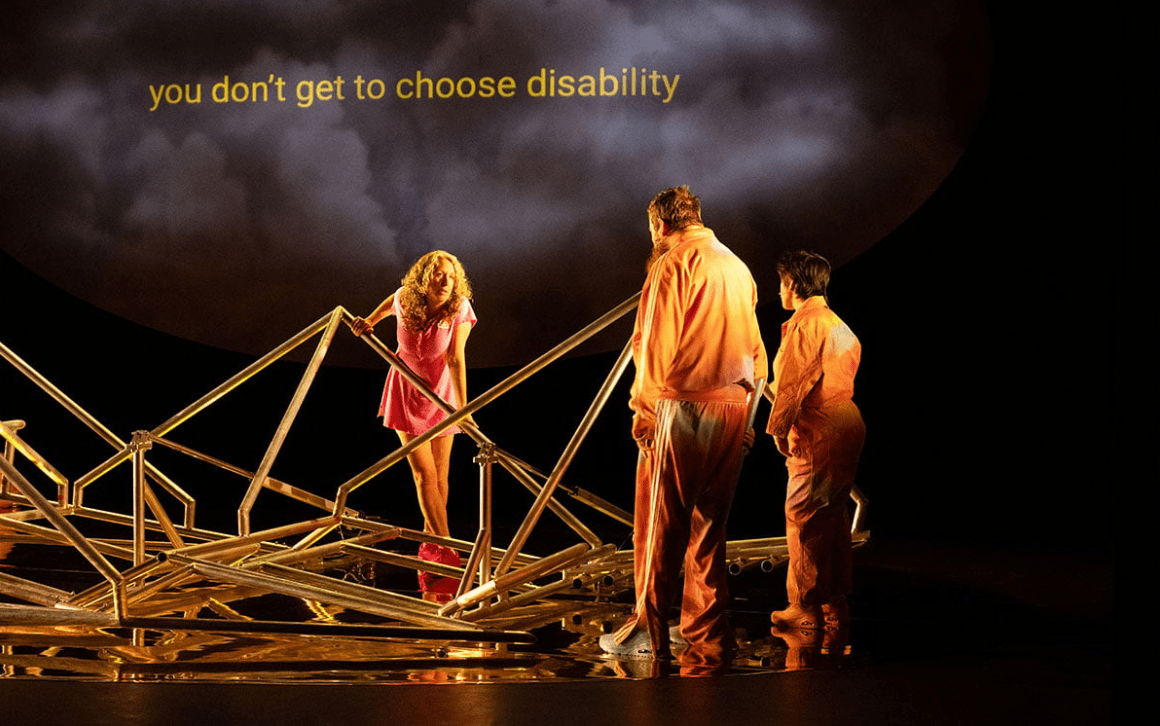

Nightmarish fever dream of a devised theatre work problematises and interrogates the complications of disability and accessibility today.
From its title alone, Multiple Bad Things possesses a distinctly ominous quality. What are these bad things? A series of terrible events waiting to happen, or the accumulation of smaller cruelties that eventually become something much more sinister? The production’s visual material might initially suggest something whimsical and playful, but the work itself is anything but.
Created through a devising process involving its ensemble of performers and directed by Tamara Searle and Ingrid Voorendt, Multiple Bad Things places four workers in an increasingly hostile environment, examining power, exclusion, identity, disability and the systems that supposedly exist to support vulnerable people. It is a production that is clearly interested in the ways apparently ordinary structures can become oppressive, and in how language designed to protect can be turned into another means of exercising power.
Yet for all its intellectual and political ambition, the production’s central tension is that it is exceptionally effective at creating the sensation of being trapped inside an ominous, inaccessible system, but less effective at translating that sensation into a sufficiently coherent theatrical argument.
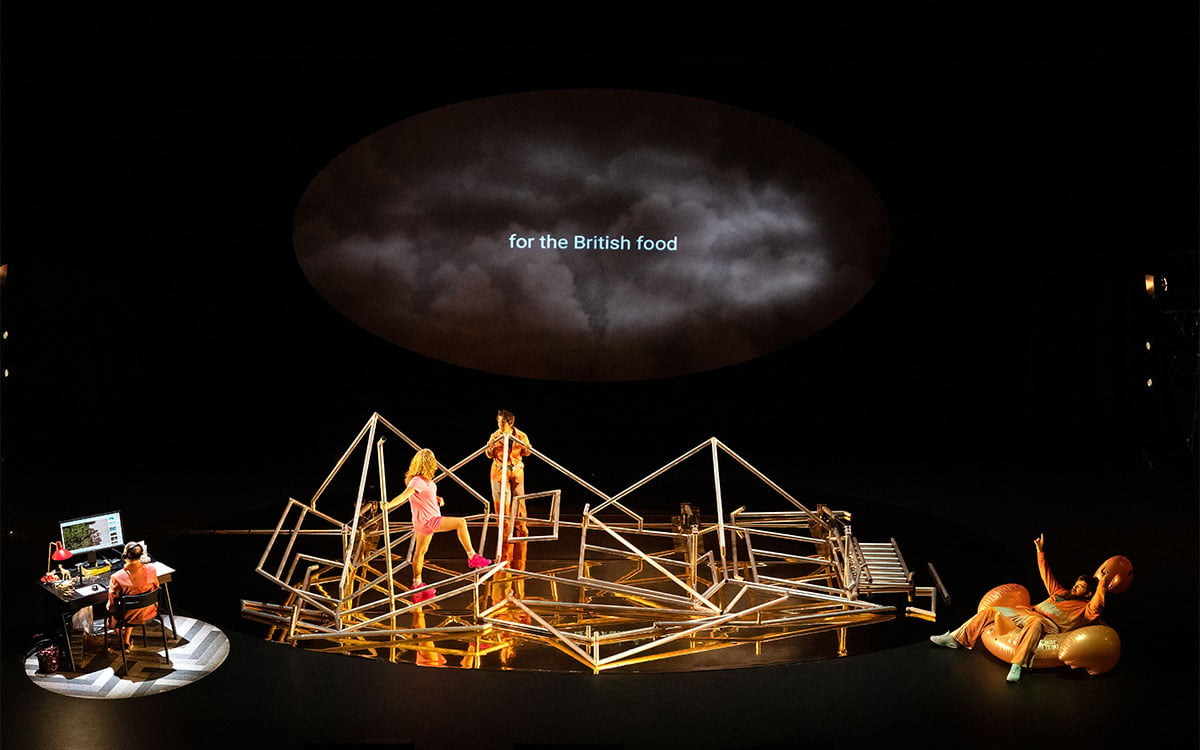
That tension is established almost immediately through Anna Cordingley’s set and costume design. The Singtel Waterfront Theatre stage is a large, cavernous space, and the production initially seems almost swallowed by it. In the centre is a large, angular structure of poles and beams whose purpose is difficult to discern; to one side sits a pink inflatable flamingo, while another part of the stage contains a desktop computer with a game of solitaire underway. Behind it all is an oval screen filled with dark clouds, later used for surtitles and projections. Each object is visually distinct and seems deliberately chosen, but their relationship to one another is initially opaque. The effect is dissonant rather than conventionally picturesque: this is a workplace, perhaps, but one that looks as though it has been assembled from fragments of a world that no longer quite functions. The production is immediately asking us to interpret its environment, but provides few instructions for doing so.
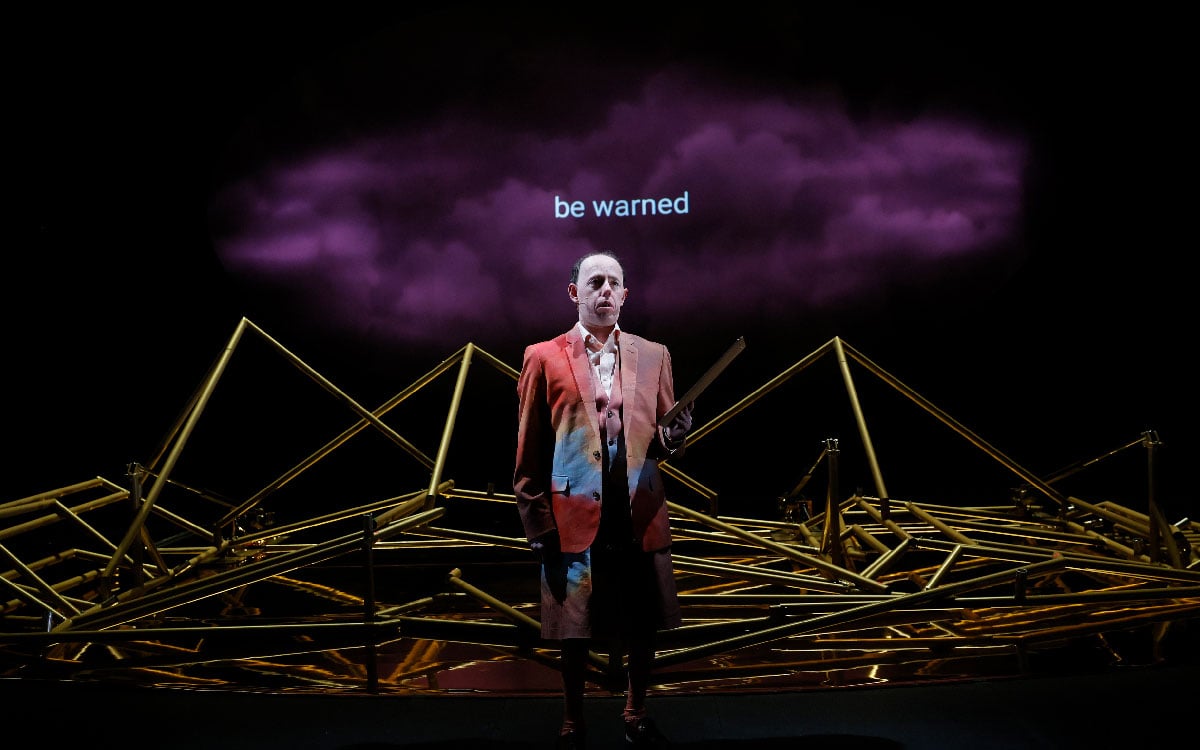
Simon Laherty is the first performer to enter. He walks into the centre of the stage and delivers a series of warnings about the performance, including adult language, sexual references, partial nudity and insults to women. Rather than functioning as a conventional recorded trigger warning, he becomes a presence within the world of the performance. He then retreats to the desk, where he appears to play solitaire and watch videos, periodically returning to the action without ever seeming particularly concerned by what is happening around him.
This is one of the production’s most interesting devices because Laherty remains remarkably nonchalant even as the world around him becomes increasingly violent and absurd. He does not seem to experience the strangeness that we do. When he later crosses the stage apparently as though he might intervene, only to return with a bottle of Coke or a packet of Cheezels, the comedy comes from the fact that he treats this bizarre environment as perfectly ordinary. Even when he eventually comforts Sarah, he does so without abandoning that peculiar detachment. He remains in character, rather than suddenly becoming a conventional source of emotional reassurance. Whether he is a bystander, an observer, an audience surrogate, an institutional presence or simply another isolated person inhabiting the same world is never resolved. But perhaps that uncertainty is part of the point: if the world is absurd, the people living inside it may be the least likely to recognise its absurdity.
The other three performers gradually give the workplace its human tensions. Scott Price initially appears almost comically disengaged, lounging on the flamingo while Sarah Mainwaring and Bron Batten begin working on the central structure. Sarah is more obviously distressed by the situation, repeatedly struggling with the physical task and looking for assistance, which makes her the easiest figure for the audience to sympathise with. She becomes, in many respects, the audience surrogate: like us, she often appears to be trying to understand what is happening while everyone else seems to have accepted the rules of this strange environment. Scott, meanwhile, changes perceptibly as the performance progresses.

What begins as a relatively calm and disengaged presence becomes increasingly agitated as he feels targeted and provoked, and the transformation makes his eventual anger feel less like an arbitrary eruption than a response to sustained pressure. Bron is perhaps the most unsettling of the three precisely because she initially looks the most conventionally composed. Her behaviour, however, becomes increasingly menacing. She taunts and teases Scott, punctures his flamingo and moves around the central structure with an almost sensual familiarity, leaning against it, touching and groping its beams as though she possesses the space. The physical relationship between Bron and the structure is striking, although once again the production leaves its significance largely to the audience to determine. Is she demonstrating ownership of the system? Is she comfortable within a structure that constrains the others? Is she simply playing with an object that has become another participant in the conflict? The image is compelling precisely because it suggests something without settling on what that something is.
The conflict between Bron and Scott eventually exposes the production’s clearest political concern. Bron begins to appropriate the language of diversity and victimhood in order to justify her treatment of Scott, while Scott responds by accusing her of targeting him because of his autism. Their argument deteriorates into insults and threats, with Sarah caught between them and largely unable to stop what is happening. What emerges is a critique of the ways that systems ostensibly designed around inclusion can still reproduce exclusion, particularly when the language of identity and oppression becomes a tool for asserting one’s own position rather than understanding another person’s vulnerability.
The production knows who is being oppressed, and takes things one step further, as it examines how quickly people can turn vulnerability into a hierarchy, using their own grievances to justify cruelty towards someone else. There is something recognisably contemporary about this, particularly in the suggestion that a society can become increasingly fluent in the language of inclusion while remaining profoundly bad at the practice of empathy. Instead of responding to vulnerability with care, people retreat into tribalism, self-preservation and moral certainty, finding someone else to push down in order to secure their own position.
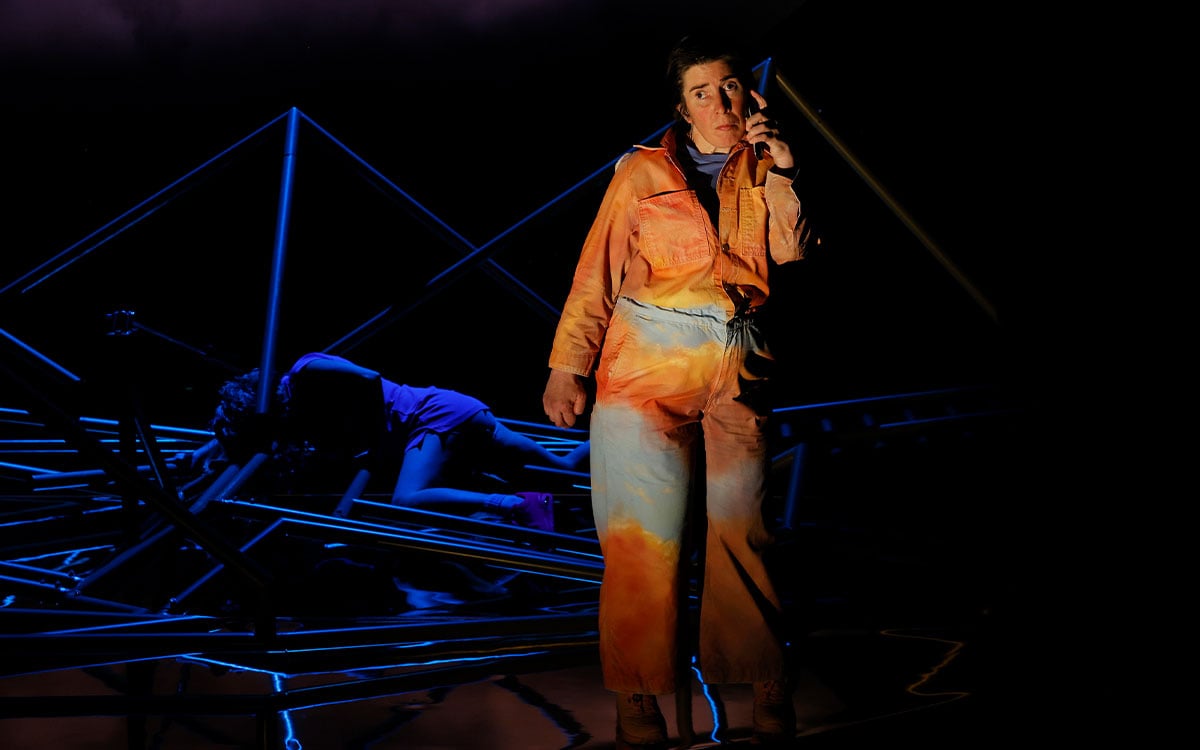
One of the production’s most memorable sequences makes this idea considerably clearer. Sarah, at a loss and seemingly unable to navigate the situation around her, calls a helpline for assistance. What begins as a banal automated service gradually becomes nightmarish, with the language of customer support mutating into something increasingly absurd and menacing. The survey becomes longer, the instructions more convoluted, and when Sarah finally reaches the point where she can speak, she struggles to articulate herself. Her distressed, almost incoherent response is met with an indifferent “sorry, I didn’t catch that”, before the system returns her to the beginning of the loop. It is one of the rare moments in Multiple Bad Things where the production’s symbolism, humour and politics align perfectly. The supposedly accessible system becomes the obstacle; the person who most needs assistance is given the least meaningful opportunity to communicate; and the circularity of the process ensures that nothing changes. The scene is absurd, but the absurdity is immediately legible because it is grounded in an experience that needs very little explanation.
Elsewhere, however, the production’s refusal to explain becomes more problematic. There are so many images that appear loaded with symbolic potential that the audience is constantly trying to work out how they connect. The flamingo begins as Scott’s place of retreat, evoking beach holidays, before being punctured and eventually carried around like a deflated carcass. The huge central structure initially seems to be an arbitrary workplace task before eventually rising into something resembling the outline of a house. Simon’s computer periodically projects strange videos onto the large screen, sometimes apparently visible to Bron but not to the other workers.
None of these images are meaningless; on the contrary, they are so conspicuous that it is difficult not to search for their meanings. The problem is that the production does not always give those meanings enough dramaturgical weight to accumulate into a larger idea. The structure could represent labour, bureaucracy, social order, the construction of safety or the fragile structures built around inclusion; the flamingo could suggest leisure, escape, privilege or a precarious territory; the house could signify home or refuge. These possibilities are all available, but too many remain possibilities.
This is where the production’s dream logic becomes both its greatest strength and its greatest weakness. It does not seem interested in conventional realism, and the characters themselves rarely react to the absurdity in the way an audience member might. They simply continue operating within its strange rules. That creates an intriguing inversion: perhaps the world is not absurd to them because our own world is similarly absurd, filled with arbitrary systems and behaviours that we have learned to treat as normal. The audience is the one positioned outside the system, looking in and wondering why everyone is behaving this way. If that is the intended effect, it is a clever one. Yet the production does not always distinguish between productive disorientation and simple lack of development. At times, the audience is not being invited to question a system so much as being left to guess what system the production is actually talking about.
The technical elements are much more assured. Richard Vabre’s lighting keeps the stage predominantly dark, illuminating particular bodies, objects and sections of the structure as the action changes, while Zoë Barry’s score maintains an almost continuous sense of unease. The music rarely settles into anything comforting; even when it appears to become more harmonious, a discordant or threatening element seems to lurk underneath. Together with Rhian Hinkley’s AV design, these elements create an atmosphere that is consistently unsettling without relying on conventional horror. The production feels like a nightmare that has been running for some time before the audience arrived. There is even something slightly soporific about the experience: the darkness, repetition and slow accumulation of discomfort create the feeling of being submerged in someone else’s subconscious. It is highly effective at establishing a mood of helplessness, and the audience is made to feel that something is wrong long before it becomes possible to say precisely what is wrong.
The final sequence brings these tensions together without entirely resolving them. The chaos eventually leaves Sarah alone, while Simon remains at his desk before eventually offering her comfort. His discussion of solitaire becomes a metaphor for playing within a system whose rules cannot simply be overturned: sometimes you win, sometimes you lose, and you have to continue playing. The central structure then rises and forms what looks like a makeshift house, an impressive transformation that is difficult not to read as an image of shelter or home after everything that has happened. But again, the production stops short of developing the image beyond its immediate theatrical power. Is this a home they have constructed? A structure of safety? A new system? A fragile illusion of refuge? Or simply another image within the nightmare? The uncertainty is intriguing, but by this point there have been so many such images that the cumulative effect is less revelation than exhaustion.
This is ultimately why Multiple Bad Things feels caught between a powerful theatrical experience and a dramatic work reaching for clarity. Its refusal to provide a singular interpretation is not itself a problem, but ambiguity needs enough structure for the audience to push against. Too often, the script introduces an intriguing idea, from a passing discussion of death, morality and who is considered deserving of sympathy, for instance, only to move on before it has gathered enough weight. The same is true of many of its visual motifs: evocative in isolation, but less convincing when considered as parts of a larger argument. That tension is especially pertinent to The Studios’ season of Precarious Bodies, as a work concerned with accessibility and the systems that fail vulnerable people occasionally leaves its own audience without many interpretive handholds.
There is still much to admire: the committed and often harrowing performances, Anna Cordingley’s starkly arresting design, and the lighting, sound and AV that sustain an atmosphere of mounting dread. Multiple Bad Things is at its best when its ideas are embodied rather than explained, as in Sarah’s brilliant nightmarish helpline call, where a supposedly supportive system becomes an obstacle in itself. Elsewhere, however, the production feels like a collection of vivid, dream-like fragments that have not yet found their final shape. It captures the feeling of a nightmare remarkably well; what it lacks is the dramatic and dramaturgical substance to make that all cohere.
MULTIPLE BAD THINGS played from 21st to 22nd August 2026 at the Singtel Waterfront Theatre. More information available here
The Studios 2026 – Precarious Bodies runs from July to September 2026 at the Esplanade. Full programme and tickets available here
Production Credits
| Devisors Bron Batten, Breanna Deleo, Natasha Jynel, Simon Laherty, Sarah Mainwaring, Ben Oakes, Scott Price, Tamara Searle, Ingrid Voorendt Directors Tamara Searle, Ingrid Voorendt Performers Bron Batten, Simon Laherty, Sarah Mainwaring, Scott Price Set & Costume Design Anna Cordingley Composer & Sound Design Zoë Barry AV Design Rhian Hinkley Lighting Design Richard Vabre Helpline Voiceover Rachel Griffiths Script Consultant Melissa Reeves Creative Development Michael Chan, Mark Deans, Alana Hoggart, Francesca Neri, Tamika Simpson Stage Manager Alana Hoggart Production Associate Jordi Edwards Sound Engineer Thomas “Soup” Campbell Company Manager Erin Watson Production Manager Bao Ngouansavanh Producer David Miller Executive Producer Tanya Bennett Artistic Director Bruce Gladwin |

