
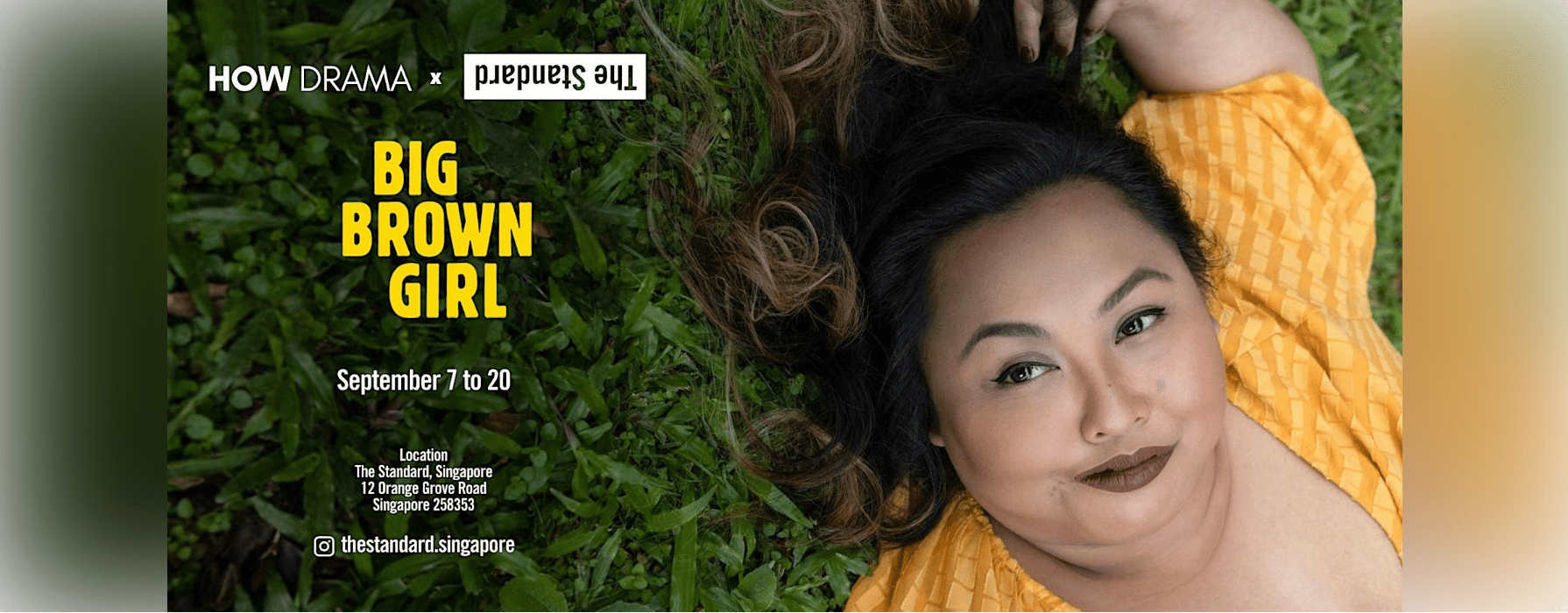

When Big Brown Girl was first staged, its premise was already an unusual one: a one-woman show about a Singaporean woman getting back into dating, with the audience deciding which men she meets along the way. Now, several years and iterations later, Ruby is returning to Singapore, but this time, audiences won’t simply be watching her dates from a theatre seat.
The latest version of the How Drama production takes place at The Standard, Singapore, where the hotel’s intimate spaces become different chapters in Ruby’s dating journey. Audiences will physically move through the hotel as they follow Ruby, a self-proclaimed “big brown girl from Singapore”, through encounters with men from Singapore, Malaysia, Washington D.C. and Paris. There are 12 men to choose from, but only six will appear in any one performance, with the audience’s choices determining which version of Ruby’s story unfolds.
For creator and performer Ross Nasir, the production’s evolution is inseparable from her own. “The show has evolved because I have evolved,” she says. “Every time we’ve brought it back, I’ve had new life experiences, new relationships, and a different understanding of myself. Those changes naturally find their way into Ruby.”
It is a fitting development for a show about dating, relationships and self-discovery. Ruby has always been partly grounded in Roz’s own experiences, as well as those of people around her, but returning to the character now means looking back at those experiences from a different place.
“In the last iteration in Hong Kong, there are moments when I realise how reckless Ruby is or how trusting she was and I love her more for it,” Ross says. “But at the same time a more mature me wants to scold her for letting herself be so easily hurt. It’s an interesting mix of emotions.”
That distance has also changed the way Ross sees the character. When we first spoke to her about Big Brown Girl, she described Ruby as a vehicle for stories and experiences that were rarely centred onstage: a woman who is big, brown, single and unapologetically looking for romance. The years since have given Roz more perspective on both the character and the cultural conversation surrounding her.
“Audiences have changed too,” she says. “Since the pandemic, people seem much more willing to talk openly about loneliness, mental health, dating, and the need for connection. The conversations around the show have become just as important as the performance itself.”
Those conversations will now happen at much closer range. Rather than taking place in a conventional theatre, Big Brown Girl unfolds across different spaces within The Standard. Each room represents another chapter of Ruby’s dating life, creating a physical journey that mirrors the emotional one. “It’s a more intimate setting, so the treatment of the audience is also different,” Ross explains. “Previously, we imagined that Ruby was speaking to her friends in the audience, but they were still a faceless group. In this iteration, they are up close with her.”
The distinction may sound subtle, but for a one-woman show built around direct audience interaction, it changes the relationship considerably. Instead of performing towards an anonymous crowd under theatre lights, Ross will be able to see the people Ruby is supposedly confiding in.
“It’s like she’s really having a chat with friends over a glass of wine and she gets to react to their reactions,” she says. “As an actor, this is so precious to me. Often, we are just performing blind under the theatre lights, and we only get to hear audience reactions.”
The hotel setting also happens to make practical and dramaturgical sense for Ruby’s story. Her dates have always taken place across different cities and private spaces, and a hotel can evoke the temporary, intimate quality of those encounters, somewhere people arrive, meet and leave, sometimes knowing very little about one another. “The location is perfect because many of these dates do occur in hotel rooms or the homes of the various men,” Ross says.
The new environment also allows the production to rely less on theatrical suggestion and more on physical discovery. “For example, it now makes sense for her to grab items out of her bedroom or wardrobe, when she would have previously just had it preset on stage,” she says. “So overall, there is a lot more show than tell in this version, which is so exciting.”
In other words, the audience is now being directly invited into this world, something that has always been central to Big Brown Girl. From its beginnings, the production has played with the mechanics of dating apps, the quick judgements, the endless possibilities, and the illusion that choosing the right person is simply a matter of making the right selection.
The new staging simply pushes that idea further. Audiences aren’t just choosing which man Ruby should meet; they are physically moving from one encounter to another, with every room holding the possibility of a different outcome.
“We can’t wait to have the audience go on this physical journey with her,” says Ross. “We hope approaching a room and not knowing what is inside kind of simulates what it might feel like to meet someone for the first time.”

There is anticipation in that movement, but also uncertainty, something Ross hopes will make the audience feel more invested in Ruby’s choices. “The tension, the anticipation, we hope the walk from room to room helps build that and in a way increases the stakes for the audience as well.”
And that makes the interactive element more than a gimmick. The audience is being asked to participate in the same uncertainty that defines Ruby’s dating life: you make a choice, walk through the door and discover what you have chosen.
The show features dates with men from Singapore, Malaysia, Washington D.C. and Paris, and each performance will feature only six of the 12 possible men. The result is that no two audiences necessarily experience exactly the same Ruby, and wholly appropriate for a character whose story has always been about putting herself out there despite not knowing what will happen next.
When they played in Hong Kong, the team had the rare experience of seeing what happens when Ruby’s story enters another cultural context. “When we were in Hong Kong, we loved that the audience chose differently for Ruby,” Ross says. “They were more interested in her Singapore connections, and they took a few more risks with the men.”
That response is revealing. The same choices that might feel obvious to a Singaporean audience can look different from another city’s perspective, and the interactive format allows those differences to become part of the performance itself.
But Hong Kong also confirmed something Ross had hoped would be true from the beginning: while Ruby’s identity is distinctly rooted in Singapore, her search for connection isn’t. “Ultimately, the story is not solely a Singaporean one,” she says. “It is a universal search for connection, and I think that too resonated with the Hong Kong audience.”
That universality is what allows Big Brown Girl to travel without abandoning the things that make it specific. Ruby remains a “big brown girl from Singapore”, and the story continues to engage with race, body image, identity and the peculiarities of dating in a particular cultural context. But the emotional question underneath all of that travels easily: “how do you find connection, and what are you willing to risk to get it?”
The production is also willing to change with the place it visits. “We changed a few lines for Hong Kong,” Ross says. “But yes, if the show gets to travel more, we are hoping to write more songs for it and write in the city we are performing in.”
That could make future iterations increasingly site-specific in their own right. “People love seeing their city being portrayed on stage and we hope to be able to do that,” she adds.
It is a natural extension of the show’s new approach in Singapore: if the physical environment can change how Ruby’s story is told, the city itself can become part of the story. That willingness to evolve also brings the production back to the reason Big Brown Girl existed in the first place.
When Ross and Melissa Sim first created the show, there was still a noticeable lack of stories in which women like Ruby were allowed to occupy the centre of a romantic narrative. She wasn’t a supporting best friend, a comic side character or someone whose body was treated as an obstacle to overcome before she could be desirable. She was now the protagonist: funny, vulnerable, messy and looking for love.
“When we first created Big Brown Girl, it felt like there weren’t enough stories on our stages that reflected experiences like Ruby’s,” Ross says. “We wanted to create space for a perspective that isn’t often centred.”
The landscape has changed since then. Ross points to the growth of more diverse stories on streaming platforms and greater awareness through social media. But she doesn’t think representation has reached the point where the problem can be considered solved.
“There is definitely more representation now,” she says. “There are more diverse stories on Netflix and on social media there is more awareness. But you still have to put some effort into finding stories that represent the minority viewpoint.”
That makes Ruby’s continued journey, and her movement from Singapore to Hong Kong and back again, significant in another way. A story that was once conceived as a relatively specific Singaporean experience is now being seen by audiences elsewhere, without losing the identity that made it worth telling in the first place.
Ross is hopeful that the production’s journey might encourage other artists to take the same risk. “I’m really proud that the show adds to the diversity of stories being told in Singapore, and now, on the international stage as well,” she says. “The hope is to encourage more artists to tell their own stories, especially the ones they’ve been told are too niche, too different, or not important enough.”
“Because those are often the stories that resonate the most.”
In that sense, Big Brown Girl has grown into something slightly larger than its original dating-app conceit. Ruby is still swiping, choosing and hoping. The audience is still deciding which man she meets next. There are still awkward encounters, humour, heartbreak and the possibility, however remote, that one of these dates might actually lead somewhere.
But the production itself has become a story about evolution: Ross growing alongside Ruby; the show changing with its audiences; a theatre production leaving the theatre for hotel rooms; and a distinctly Singaporean character discovering that her search for love can resonate far beyond Singapore, and perhaps, find it at home once more.
Photo Credit: How Drama
Big Brown Girl runs from 7th to 20th September 2026 at The Standard, Singapore, 12 Orange Grove Road. Tickets available from Eventbrite

