
A hotter, more assured battle of tradition and reinvention, as Dick Lee himself helms this deliciously chaotic dinner-theatre adaptation of his classic musical.
There is something wonderfully appropriate about Fried Rice Paradise never staying the same. Dick Lee wrote the song in 1973 as his first attempt at a Singaporean pop song, only to see it banned from airplay for its use of Singlish. More than fifty years on, that same song has gone through multiple incarnations, including the 1991 musical, the 2010 musical and subsequent television series, and now returns in Fried Rice Paradise: The Makan Party.
Returning after a successful run in 2025, this time around, Dick Lee himself has taken to the director’s chair, as the show acts as a sequel to the 1991 musical: Bee Lean (Serene Chen), owner of the titular restaurant chain, is ready to retire and must decide which of her two daughters should inherit the business. Fancy wants to take Fried Rice Paradise into the future; Nancy wants to preserve what has made it special. The difference this time is that we get to eat the argument, and decide who gets to inherit the brand.

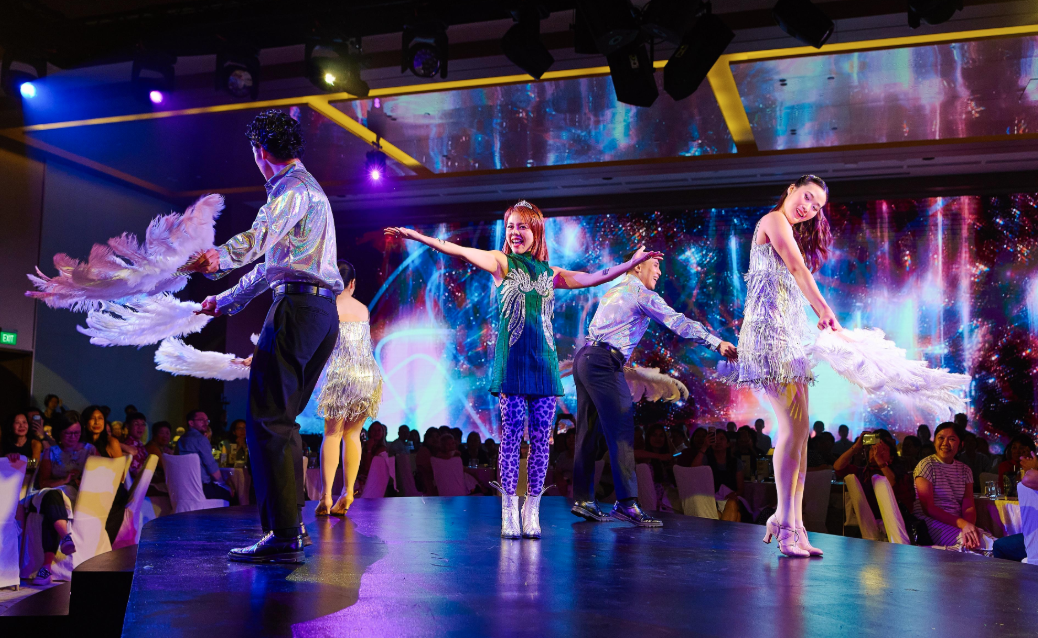
Presented as a dinner-theatre experience, The Makan Party remains part musical, part cooking competition, part family drama and part reality-TV spectacle. Dinner tables become viewing platforms, two fully equipped kitchens sit at opposite corners of the ballroom, and cameras beam the cooking action onto screens around the room. The audience is an active participant in both the food and the competition, voting for their preferred dishes throughout the evening before ultimately helping determine which sister becomes the new Boss Lady. Couple that with all the action, musical numbers and drama taking place, it is an unusually ambitious format.
But what SRT understands is that in a dinner theatre show, the food cannot simply be a gimmick, and is instead, both integral and part of the experience. The battle begins with satay, and immediately the sisters’ opposing philosophies are laid bare. Nancy’s version is reassuringly familiar: chicken, peanut sauce, rice cake, cucumber and onion, while Fancy turns the same dish into something considerably more elaborate, with crispy kunafa, peanut emulsion, caramelised onion and pickled cucumber.

This establishes the show’s central conflict: Nancy asks why you would change something that already works; Fancy asks why you wouldn’t. That tension carries through the laksa round, where Nancy stays close to the traditional combination of noodles, spicy coconut gravy, tofu puff and protein, while Fancy transforms hers into a chawanmushi-style creation with spicy coconut custard, noodles, bean sprouts and tofu puff. On paper, Fancy’s approach may sound more inventive, but Nancy’s food has the advantage of familiarity, and, more importantly, memory. At this point in time, both Fancy and Nancy’s dishes are comparable, and the audience who gets to enjoy samples of each, the ultimate winners.

That sense of memory gives Nancy’s character much of her emotional weight. Natalie Yeap plays her as a woman of few words, but there is nothing passive about her quietness. She knows what her grandmother’s recipes mean and understands that preserving a dish is also preserving the people and memories attached to it. The laksa round brings this particularly close to the surface as Nancy cooks in her kitchen and rekindles her connection with Mustapha (now played by Ebi Shankara), their childhood friend. Their chemistry gives the evening a welcome tenderness amid all the competition, and when Mustapha breaks into “Bunga Sayang”, the production gets one of its more heartfelt musical moments. It is a reminder that the competition is never really just about food: beneath the recipes are questions of family, inheritance, belonging and what exactly it means to carry something forward.

Cheang Ying Er, meanwhile, brings an appealingly petulant energy to Fancy, having stepped up from the ensemble into the role. She gives the younger daughter a sense of vulnerability beneath the ambition, so that her desire to reinvent Fried Rice Paradise never feels like simple rejection of tradition. Fancy genuinely wants to prove that her ideas have value, even if that means challenging everything Nancy holds dear. The sisters’ rivalry consequently becomes more interesting as the night progresses, particularly when the competition stops being playful and old family resentments begin bubbling to the surface. The eventual squabbling feels genuinely built up to; the inevitable consequence of two very different ideas about what their mother’s legacy should look like.

The fried rice round is where the production really starts to catch fire. Nancy’s version sticks to rice, mushrooms and mixed vegetables, while Fancy once again takes the opportunity to move away from the expected. But the pleasure here is not only in comparing what is on the plate; it is in watching how each woman presents her food according to her personality. Nancy’s cooking feels instinctive and inherited, while Fancy’s feels almost like a pitch for a new restaurant concept. Even the running joke about wok hei gets folded into the competition: what is fried rice without fire, after all? As the sisters retreat into their individual kitchens and the feud intensifies, the show starts to resemble a particularly chaotic live cooking programme, complete with scores, quizzes, cameras and increasingly exasperated family members.

The multimedia work from Genevieve Peck is especially effective here, and has received a considerable glow up from last year. Rather than treating the cameras as a novelty, the production uses them to expand the theatrical space. With a full screen, we can watch what is happening in the kitchens, catch reactions that might otherwise be lost across a large ballroom, and even follow the action through CCTV-style perspectives. It gives The Makan Party a genuinely different rhythm from conventional theatre, while still allowing the live performers to remain at the centre of the experience. The audience participation is similarly well judged. Moments involving audience members could easily become awkward interruptions, but the cast handles them with enough spontaneity to make them feel organic, even though keeping a live show on track while responding to unpredictable participants requires considerable skill.

There is a noticeable polish to the production’s visual world this time around. The costumes and makeup feel more considered, helping each character’s personality register even from across the ballroom, and giving the show the heightened glamour its larger-than-life characters deserve. Serene Chen, in particular, leans fully into Bee Lean’s status as the wealthy matriarch of the Fried Rice Paradise empire. Rather than playing her simply as a formidable chef, Chen gives Bee Lean the bearing of a woman who has built a successful business and expects her family to understand the weight of what she has created. There is a delightful richness to the performance in the clothes, the mannerisms and the sheer authority she brings into a room, but Chen never lets Bee Lean become merely a caricature of a rich Singaporean matriarch. She finds the warmth and weariness beneath the imperious exterior, elevating what could easily have been a stock mother role into the emotional centre of the sisters’ rivalry.

And then there is Audrey Luo, who increasingly feels like the production’s secret weapon. As Helen, she has the unenviable job of keeping the room energised between courses, musical numbers and dramatic developments, but she turns what could have been a functional hosting role into one of the evening’s most memorable performances. Luo has impeccable comic timing and an infectious stage presence, throwing herself wholeheartedly into Helen’s larger-than-life personality while still finding moments of sincerity underneath the showmanship. Her musical performances are equally assured, and she has the rare ability to make a supposedly spontaneous interaction feel completely effortless. Every time she appears, the room seems to lift. In a production already full of food, music and spectacle, Luo somehow manages to be another course entirely.

The supporting cast keeps the momentum going, with Rafaat Haji Hamzah’s Azhar providing a grounding presence as the family drama becomes increasingly heated. Ebi Shankara brings Mustapha an appealing combination of charm and warmth, while the ensemble gives the production the sense of a bustling community rather than a show taking place on a distant stage. The refreshed musical arrangements by Bang Wenfu and Xavier Lim also help the familiar Dick Lee repertoire sit naturally within this new format, while Gaby Rae’s choreography gives the musical numbers enough exuberance to match the production’s party atmosphere without losing their connection to the story.

By the final round, however, the competition has shifted. The ondeh-ondeh challenge, Fancy’s coconut chantilly, glutinous chiffon and gula melaka gelato against Nancy’s dough balls, gula melaka and coconut, is still ostensibly about taste, but the larger question has become who is actually ready to inherit Bee Lean’s legacy. The final decision is therefore less about which dish is objectively better than about which daughter has the qualities to become the next Boss Lady. When the Choo Bee Lian apron and Fried Rice Paradise ladle are finally handed over, the result feels like the culmination of a family story rather than simply the final score of a cooking contest.

And that there, is the real joy of Fried Rice Paradise: The Makan Party. Beneath the feuds, the flamboyant dishes, the audience votes and the sheer entertainment of it all, SRT is preserving a piece of Singaporean theatre history by refusing to let it sit still. Dick Lee’s songs, the food, the Singlish and the stories of family and inheritance all come together in a show that feels deeply rooted in where we come from, while still making room for what comes next. When “Rasa Sayang” brings the room together at the end, it’s not a curtain call for the cast; it’s a communal embrace and a reminder that tradition survives by being shared, remembered, reinvented and passed on. For all its delicious chaos, Fried Rice Paradise leaves you with something warmer: the feeling that Singapore’s stories are worth keeping alive, especially when we can do so with a full belly, a song in our hearts and a room full of people eating and singing along.
Photo Credit: Singapore Repertory Theatre
Fried Rice Paradise – The Makan Party runs till 11th September 2026 at Paradox Singapore Hotel. Tickets available here
Production Credits
| Writer Thomas Lim Director Dick Lee Cast Rafaat Haji Hamzah, Serene Chen, Shu Yi Ching, Audrey Luo, Ebi Shankara, Natalie Yeap, Pat Jon Gregory, Faye Foong, Joel Gay Han, Cheang Ying Er, Aqil Fitri (Cover) Arranger Bang Wenfu, Xavier Lim Music Director Jane Foo Choreographer Gaby Rae Set Designer Teddy Setiawan Kho Costume Designer Yvette Ng Lighting & Multimedia Designer Genevieve Peck Associate Lighting Designer Tan Yi Kai Associate Multimedia Designer Yatee Sound Designer Ng Jing Props Designer Rainie C |


Attended last night show and was highly disappointed overall. The dishes like satay is just par, laksa not lemak at all and one cooked by Fancy is tasteless, fried rice can be better and Nancy ondeh ondeh will kill the diabetic on the spot. The show also nothing to shout about. Strongly not recommended
LikeLike