
What does home mean when the world outside suddenly becomes uncertain? For Malaysian artist Justin Lim, the answer began taking shape during the long, strange months of the Covid-19 pandemic. Confined to domestic spaces and surrounded by the familiar, he turned his attention towards the rooms, objects and quiet corners of everyday life. What might once have seemed mundane became charged with new meaning, places of refuge, memory and reflection, but also stages on which the experience of living itself could unfold.
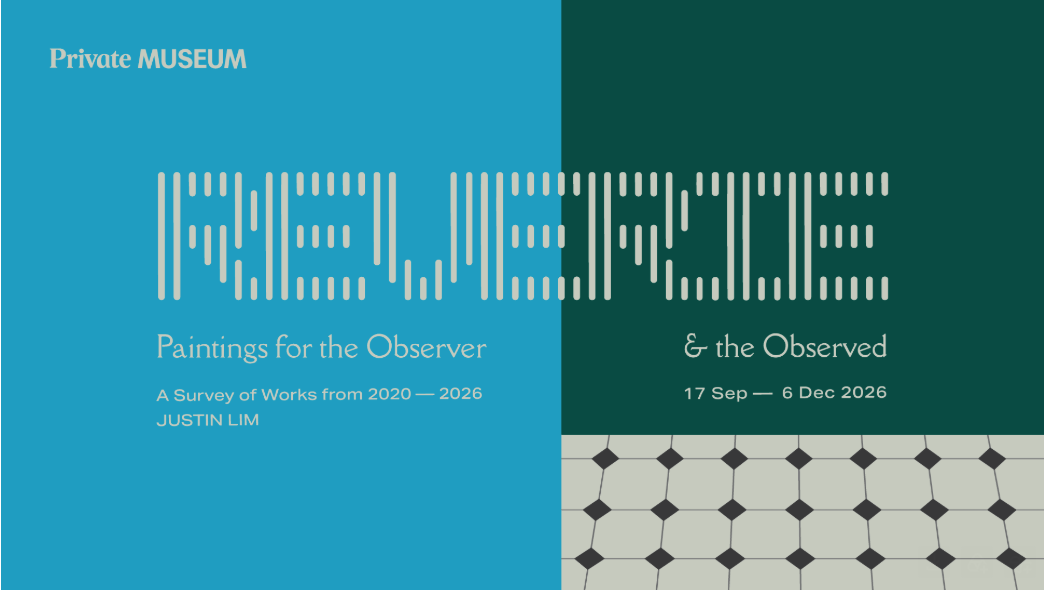
Those paintings now come together in Reverie: Paintings for the Observer and the Observed – A Survey of Works from 2020–2026 by Justin Lim, presented by The Private Museum from 17 September to 6 December 2026.
Marking Lim’s first museum survey showcase, the exhibition brings together more than 50 paintings from a pivotal six-year period, with works drawn from private collections in Singapore, Malaysia and beyond. Presented together for the first time, they offer an expansive look at a period in which Lim returned to the fundamentals of painting and found renewed possibilities in the most familiar of subjects.
Rather than grand historical scenes or spectacular landscapes, Lim gives us interiors. A room. A chair. A table. Objects that might barely register in daily life. Yet through his meticulous compositions and cinematic framing, these ordinary surroundings become quietly compelling.
“Our living spaces mirror who we are; they are vessels for memory and the human experience,” Lim says. It is an idea that runs through Reverie: that to look closely at the spaces we inhabit is, in some ways, to look closely at ourselves.

The pandemic changed the meaning of home for millions of people. A place that had previously been associated with rest and retreat suddenly became an office, classroom, restaurant, cinema and social space, sometimes all within the same day.
For Lim, this period of prolonged confinement became a catalyst for looking inward, both literally and artistically. The works in Reverie emerged from that atmosphere of isolation and uncertainty. Domestic interiors became subjects in their own right, allowing the artist to examine the emotional weight carried by familiar spaces and objects.
There is something almost cinematic about the way he approaches them. His compositions can feel like stills taken from a film in which the story has momentarily paused. A carefully positioned object, a particular shaft of light or an empty room suggests that something has happened, or is about to.
Yet the paintings resist offering a single narrative. That ambiguity is part of their appeal. Viewers can bring their own experiences into the spaces Lim depicts, recognising something of their own homes, memories or routines in his carefully observed scenes. These are paintings that ask you to slow down rather than simply glance and move on.
The title Reverie: Paintings for the Observer and the Observed points towards this exchange between looking and being looked at. In the exhibition text, Deborah Lim describes the relationship between the viewer and Lim’s paintings as something that is never entirely one-directional: “The observer and the observed are never entirely separate.”
What we choose to notice, and what stays with us afterwards, can reveal something about ourselves. A painting of an interior may trigger memories of a childhood home; an everyday object may suddenly recall a person, a period of life or a place that has long since disappeared.
Lim’s paintings leave room for those associations. Rather than directing viewers towards a fixed interpretation, Reverie encourages the simple pleasure of looking. There is space to daydream, remember or simply sit with an image. And in an age of constant movement and distraction, that invitation to pause feels particularly resonant.
One of the most striking qualities of Lim’s work is how he transforms stillness into drama. His interiors are meticulously rendered, but they are not merely exercises in realism. Through cinematic framing and careful attention to detail, he gives ordinary spaces a sense of atmosphere and psychological depth.
A familiar room can suddenly feel mysterious. An everyday object can become symbolic. An empty space can suggest the presence of someone who is no longer there. The paintings are recognisable enough to feel close to home, yet composed in ways that encourage viewers to look again. They remind us that the spaces we move through every day are full of details we have trained ourselves to overlook. In this sense, Reverie is not only about the pandemic, even though that period provided its initial context. It is about what happens when we pay attention.
Presented as a survey, the exhibition traces the continuity and evolution of Lim’s visual language between 2020 and 2026. The works remain rooted in his interest in domestic environments, but the six-year span reveals how that interest has developed. Across the paintings, interiors become repositories for memory, identity and lived experience, while everyday objects take on an emotional charge beyond their practical function.
The exhibition also suggests a broader question about how people construct meaning through the environments they create around themselves. A home is never simply a collection of furniture and objects. It accumulates traces of the people who live there, their habits, choices, memories and relationships. Over time, even the most commonplace possessions can become deeply personal.
That idea is reflected in one of the exhibition’s featured works, A Home Is a Universe (2023), while Your True Home Is in the Here and Now (2024) turns the idea of home towards something more philosophical. Together, the works encourage viewers to consider what makes a space feel like ours, and how much of ourselves we leave behind in the places we inhabit.

Although the paintings were shaped by a period of separation, Reverie ultimately moves towards connection. In There Comes a Point in Every Person’s Life When They Realise That There Are No Superheroes Coming to Save Them (2020), Lim reflects on the limits of individual resilience and the importance of community.
“At the end of the day, we still need one another,” he says. “We need connection, we need community. It is part of what makes us human, and I think this is something worth celebrating.”
That sentiment provides an important counterpoint to the solitary interiors that dominate much of the exhibition. The paintings may often depict spaces without people, but they are not necessarily paintings about loneliness. Instead, they are about the traces people leave behind and the emotional connections embedded in their surroundings. Even still life becomes an act of looking.
“Painting a still life is an act of defiance,” he says. It is a fitting statement for an artist who has spent years finding reasons to look carefully at things that might otherwise be dismissed as ordinary.
Born in Kuala Lumpur in 1983, Lim has exhibited widely across Southeast Asia and internationally, with residencies including the Vermont Studio Center in the United States, Red Gate Gallery in Beijing, the Tasmanian College of the Arts in Australia and Kates-Ferri Projects in New York. His work has also appeared in exhibitions in Taiwan, Singapore, South Korea and Norway.
But Reverie brings the focus back to a more intimate scale. Focusing on attention, Reverie asks what happens when we stop rushing through our surroundings and begin to notice them again, the way light falls across a room, the objects that have remained with us for years, the spaces that have witnessed the quieter parts of our lives.
The pandemic may have forced many of us to look at home differently. Lim’s paintings suggest that perhaps we never stopped seeing it that way. We simply had to learn how to look.
Reverie: Paintings for the Observer and the Observed – A Survey of Works from 2020–2026 by Justin Lim runs from 17th September to 6th December 2026 at The Private Museum, 11 Upper Wilkie Road, Singapore. More information available here

