
A precise, unsettling dissection of what happens when rules become more important than the people they are meant to serve.
Duration: 90 minutes
The Radicalisation of Mrs. Mary Lim-Rodrigues at times feels like a paradox: it is a play about the consequences of failing to see another person fully, yet it deliberately keeps its audience at a certain remove and emotional distance from its characters. Staged by Wild Rice, Michelle Tan’s dense, meticulously constructed script does not so much plunge into tragedy as take it apart piece by piece, examining how language, rules, institutions and personal convictions can converge to produce an outcome that nobody quite intended. It hits, and at times hits hard, but it does so with the cool precision of a dissection rather than the emotional excess of melodrama.
Directed by Edith Podesta, the play introduces us to Mrs Mary Lim-Rodrigues (Janice Koh), an exemplary school principal whose carefully ordered professional life is increasingly at odds with the disorder of her private one. When a student from her past re-enters her life, an apparently straightforward question of school rules begins to expose the limits of that order. What follows is a tragedy shaped not by one spectacular act of cruelty, but by a series of decisions that each seem, in isolation, defensible. Tan is less interested in asking who is to blame than in examining what happens when a system designed to protect everyone becomes incapable of recognising the person standing in front of it.
We first encountered the play at Singapore International Festival of Arts’ Tomorrow and Tomorrow series of dramatised readings in 2024, where it struck us almost as “prose as drama”: dense, wordy and intellectually intriguing, but difficult to imagine fully staged. It is therefore particularly satisfying to see Wild Rice give the work a proper production, because Edith Podesta finds considerable theatre within Tan’s formidable text. Rather than simplifying the writing, she gives it bodies, spatial relationships, rhythm and repetition.
Mary (Janice Koh) is introduced as the sort of teacher an institution could hardly ask for more. She knows her stuff, upholds school rules, maintains professional decorum and rises quickly through the ranks, becoming a principal at 45. Her professional identity is built around precision and control, but her private life tells another story: multiple miscarriages, a husband who blames her for them and for prioritising her career, and eventually the collapse of her marriage. The distinction between these two selves is important because Mary has become extremely good at keeping them separate. Even her name, Mrs Lim-Rodrigues, evolved from the more cheeky and mysterious Mrs M, feels like part of the armour.
Then there is Shan (Suhaili Safari), whom Mary first encounters as an 11-year-old repeatedly arriving late to school. On one occasion, Shan explains that she had stopped to count an astonishing number of pigeons. Mary finds the explanation ludicrous enough to suppress a laugh, but the rules are the rules. The incident is filed away, apparently insignificant, only to return years later when Mary becomes principal of Shan’s school.
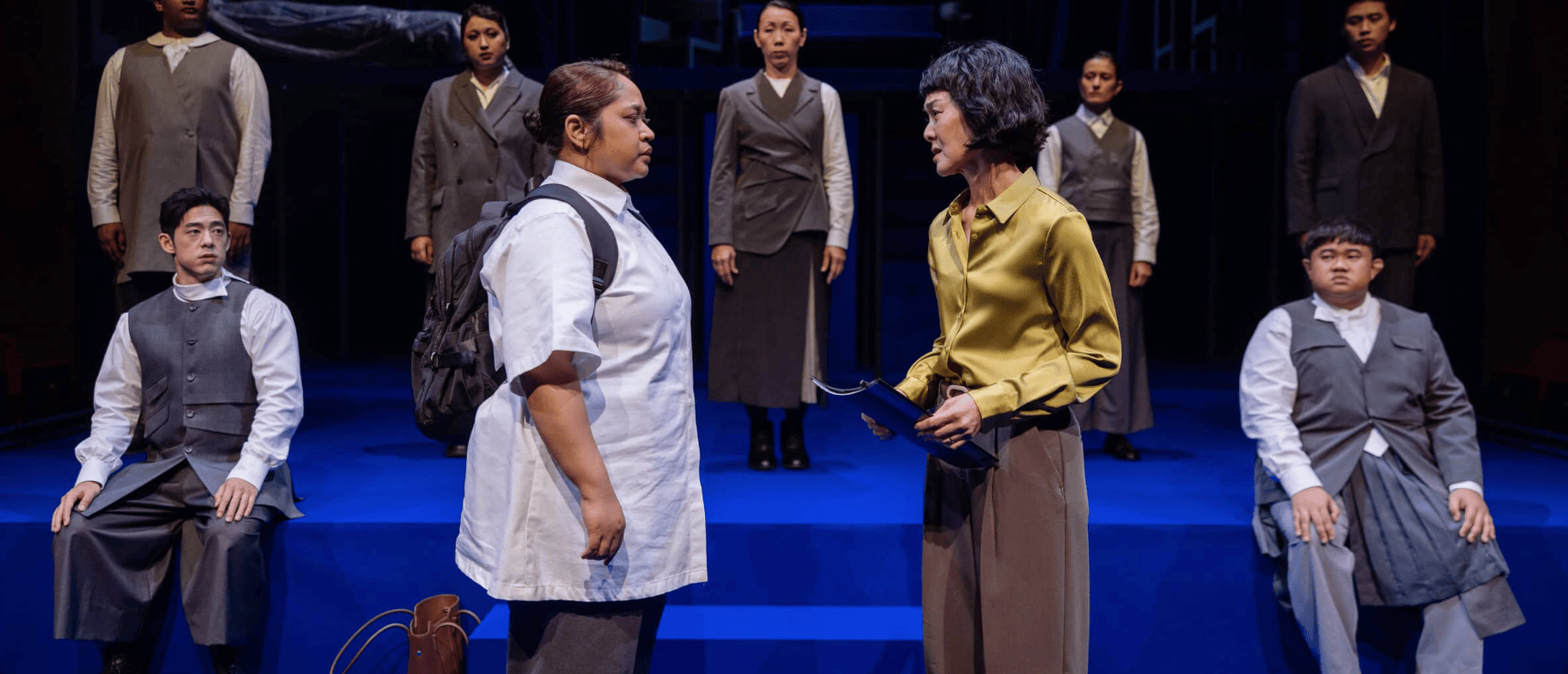
By then Shan is a teenager struggling with questions of gender and identity, and the conflict that emerges is deceptively small: a pair of trousers from the boys’ uniform, facilitated by best friend Liyana (Qilah Rose). For Shan, the trousers offer a sense of comfort and recognition that she has struggled to find elsewhere. For Mary, they are a deviation from the established system, something that may be uncomfortable but cannot simply be allowed because one student needs it, and making Shan an issue to be solved rather than one to be understood. The distinction between those two perspectives becomes the heart of the tragedy.

Tan is careful not to make Mary malicious. In fact, one of the play’s most compelling choices is to make her recognisably human. She has moments of humour, grief, irritation and uncertainty. She is capable of empathy, but her empathy has been trained to operate within boundaries. She has learnt that being professional means keeping feelings contained, that consistency matters, and that rules exist for a reason. When Shan asks for something outside those rules, Mary can see that she is uncomfortable, but cannot quite make the leap from recognising discomfort to allowing the rules to bend.
This is where the play’s critique becomes more unsettling. Mary is not simply enforcing a system from the outside; she is, in fact, a product of it. The institution has shaped her identity and her understanding of what a “good” teacher and principal should be. The tragedy therefore does not come down to a single bad person making a bad decision. It comes from an iron system in which everyone is attempting to do the proper thing, even when the proper thing is no longer humane.
Podesta’s staging makes this idea physical. Mary’s room sits above the rest of the action, literally placing her in a position of authority and giving her a vantage point over the school, while also suggesting the blind spots that come with being elevated above everyone else. A pit below becomes almost a battle ground where questions of institutional procedure are fought out, whether between Mary and Shan, or Mary and her staff. Movable staircases create another layer of visual meaning, carrying the physical association of Shan’s movement upwards while also allowing the production to shift rapidly between different spaces and perspectives. There are unfortunately some sightline problems with the two-storey design from certain seats, but conceptually the verticality is strong: Mary is above, Shan is below, and the physical distance between them mirrors the emotional and institutional distance the play keeps returning to.
The production also replaces the single narrator of the earlier reading with an ensemble. This is one of the clearest signs of how much more theatrical the work has become. The ensemble narrates with a degree of neutrality but periodically erupts into more expressive formations. When Mary prays, multiple voices speak at once, turning an individual act of faith into something almost choral. Elsewhere, Tan’s repetitions are allowed to accumulate visually and aurally. After Mary’s cat dies, the script lingers on the image of her holding him over and over, as long as she can; much later, the same language returns when Liyana holds their classmate Marcus. These echoes make the play feel carefully engineered, with seemingly incidental details acquiring significance as the tragedy unfolds.
The cat is perhaps the most effective of these details, as a parallel to how Mary’s unbreakable loyalty to rules plays out. Mary refuses to let him onto her bed because of the hair he might leave on her work clothes. Even after her husband leaves, the plastic sheet remains over the bed, preserving a sense of normalcy and order. As the cat grows old and can no longer jump onto the bed, he sleeps underneath it. When he dies, Mary’s regret is not simply that she has lost him, but that she never allowed herself the intimacy of holding him when she had the chance. The detail is devastating because it forecasts the larger tragedy: Mary repeatedly chooses order over comfort, only to discover the cost of that choice when it is too late to reverse.
Jing Ng’s sound design is similarly subtle but effective in bringing an emotional texture to the production. The delicate tinkle of the cat’s bell gives the animal an almost ghostly presence even before its significance fully settles in, while the voiceovers of Mary and her husband resonate around her in ways that make the voices of her private life feel less like ordinary conversations than thoughts she cannot escape. Most unsettling are the faint, staticky sounds that surface during Shan’s darker moments, creating an unease that words alone cannot quite articulate. None of these effects call attention to themselves, but together they give the production an emotional undercurrent that the deliberately restrained staging otherwise keeps at a distance. If the script often asks the audience to understand the tragedy intellectually, Jing Ng’s sound design is one of the few elements that allows us to feel it.

The costumes make a similar argument. Leonard Augustine Choo dresses the ensemble in deliberately awkward, mismatched school uniforms, with blazers, skirts and trousers distributed across bodies in ways that resist a neat gender binary, with missing sleeves and ill-fitting layers. They look uncomfortable, even ugly, and that discomfort is precisely the point. A school uniform is meant to erase difference through standardisation, but for a student whose gender identity does not fit the assumptions built into that uniform, the very thing intended to create belonging can become alienating. Mary, meanwhile, is the only character who continually changes her attire. Her skirts ending just below the knee, sensible heels and immaculate grooming always seem appropriate to the situation. She has the privilege of deciding how she presents herself; Shan does not, particularly ironic when Mary’s encounter with Shan regarding her uniform sees her wearing pants herself.
Throughout the play, Michelle Tan’s language is extraordinary in its precision. The script is rife with wordplay and cheeky appropriations of institutional and MOE language, while distinctions between apparently similar phrases become increasingly important. Even after tragedy strikes, the characters remain trapped in language: what can be said, what cannot be said, whether “sorry” implies culpability, whether something is a systematic “rebuttal” or merely an addressing of concerns. The play understands that institutions often protect themselves through words, and that language can simultaneously clarify and obscure. This density, however, is also a double-edged sword. Tan writes with extraordinary linguistic richness, and Podesta has clearly understood how to make that richness theatrical, but the sheer precision can also feel clinical. The subject matter is inherently emotional and deeply important, yet the play rarely becomes a melodrama of tragedy. It is instead a dissection of one. The tragedy is opened up and examined: how a person was shaped, how rules were interpreted, how language was deployed, how warnings were understood, and how every individual decision contributed to an outcome that nobody wanted.
That approach is intellectually satisfying, but it creates the central reservation with the production: the cogs remain visible. As such, the play makes it possible to understand exactly what it wants to say about empathy, conformity and institutional failure. It also makes it possible to admire exactly how it says it. Yet there remains a pane of glass between the audience and the emotional core. Shan’s perspective, in particular, remains frustratingly elusive. The play is fundamentally Mary’s story, and that is necessary to its argument, but Shan is also framed as a gifted young writer who observes the world with extraordinary precision and feels herself perpetually “late” in life, always a step behind everyone else. There is an understandable desire to know more of what happens inside her rather than encountering her primarily through Mary’s failure to understand her.
The Christian imagery complicates Mary further. Her faith initially seems to offer a vocabulary for vulnerability, suffering and the promise of care for the weak, but Shan’s death ruptures that certainty. There is a particularly interesting parallel in how Mary sees Christian ideas of God entering the world in human form and Shan’s own struggle with the body she has been given. More importantly, Mary’s faith seems to offer her the conceptual tools for radical empathy, yet she cannot quite extend that empathy across a difference she has been trained to understand as a problem to be managed.
The title ultimately becomes resonant in an unexpectedly quiet way. “Radicalisation” usually evokes extremism, but here the radical act is almost the opposite: bending a rule, closing one eye, allowing another person’s comfort to matter more than institutional consistency. “The rules are the rules are the rules” is repeated like an incantation, revealing how deeply Mary has absorbed the logic of the system. Her eventual realisation is that rules were meant to serve people, not the other way around.

The final image brings the play’s various strands together. Mary is suddenly confronted with the memory of young Shan, and finally understands what she had failed to see in their initial meeting six years ago. The pigeons that once seemed like an amusing excuse for lateness acquire an entirely different meaning; an image of Shan amidst a field of reeds connects back to the play’s earlier religious imagery; and the emotional significance of the cat’s death becomes clearer. Mary has spent the play learning, always too late, that keeping people at a safe distance does not prevent loss. It merely ensures that there will be more things to regret when the loss comes.
There is much to admire here. Wild Rice has transformed a work that once seemed almost impossible to stage into something spatially, visually and rhythmically compelling. Edith Podesta is clearly in her element with such dense material, and the production finds theatrical possibilities in Tan’s repetitions, wordplay, ensemble narration and carefully planted images. The performances serve the production’s larger theatrical construction rather than dominating it, with leads Janice Koh communicating Mary’s tightly controlled interior life through restraint and physical detail, and Suhaili Safari giving Shan the necessary vulnerability and melancholy.
The Radicalisation of Mrs. Mary Lim-Rodrigues remains precise, intelligent, unsettling and important, succeeding remarkably well as a study of how systems shape the people who uphold them. It hits hard without becoming sentimental, because it is less interested in making an audience cry than in making an audience examine the machinery that produced the tragedy. The construction is so visible that it is impossible not to admire it, but there are moments when the audience is admiring the architecture of the tragedy rather than inhabiting it. The emotional distance never quite disappears, even at its end, when Mary finally lets go of the tension and decorum she’d been holding on to for all those years.
Yet perhaps that distance is not what lingers most. What remains is the uncomfortable question at the centre of the play: what happens when a system designed to create order becomes so committed to consistency that it can no longer recognise the person standing in front of it? When does following the rules cease to be responsible behaviour and become an abdication of responsibility? The most radical thing the play asks is not whether the rules should be broken, but whether we are willing to remember who the rules were made for.
Photo Credit: Wild Rice
The Radicalisation of Mrs. Mary Lim-Rodrigues runs from 24th September to 10th October 2026 at Wild Rice @ Funan. Tickets available here
Production Credits
| Playwright Michelle Tan Director Edith Podesta Cast Janice Koh, Suhaili Safari, Ryan Ang, Izzul Irfan, Koh Wan Ching, Manisha Joshi (MJ), Nishanth Kumar, Benjamin Poh, Qilah Rose Voice Artists Benjamin Lye, Shane Mardjuki Assistant Director Benjamin Lye Script Dramaturg Juliet Chia Set Designer A. Syadiq Lighting Designer Tai Zi Feng Sound Designer Jing Ng Associate Sound Designer Daniel Wong Assistant Sound Designer Leeyau Shi Min Costume Designer L.A.C. Hair Designer Ashley Lim Make-Up Designer Bobbie Ng |


Bars. Sad I’m missing this because it is sold out but you gave such a wonderful description of the play.
LikeLike