
“Maybe because the world is burning and I might as well do the things I want to do.” That’s a statement that feels integral to Singaporean playwright Benedict Lim’s reason for making art. There is humour in the line, but also a sense of practicality: if the circumstances are already uncertain, there is little point waiting for the perfect moment to make the work you care about.
For Lim, that has meant moving between writing, performance, dramaturgy and producing, and between Singapore and the UK, rather than settling neatly into one role. His work has taken him from theatre and film to live performance and producing at the Edinburgh Fringe. He seems less interested in being easily categorised than in finding different ways of making things happen. Part of that comes from necessity; independent artists often have to be several people at once, but part of it is deliberate. Lim wants to find his own way of working rather than simply reproduce what he sees other artists doing.
In Beans that is made clear. This is a play that has taken several forms since Lim first began developing it, going through several readings, feedback sessions and changes in scale and setting, gradually becoming the production that audiences will see next. Along the way, Lim has tested the script with other artists and performers, including through development at C42, and allowed the piece to be challenged rather than treating the first draft as sacred.

The journey matters because Beans is not an especially conventional premise. Two Lance Corporals are tasked with decommissioning a military ration bunker 20 metres underneath London as the world is ending. They become stuck in the old office they have been clearing out, with only one can of beans left.
It is a deliberately contained situation: there is the bunker, the two men and the dwindling supply of food. But Lim doesn’t want to break down the mechanics of the apocalypse. Instead, he wants to explore what happens to people when the structures around them begin to break down, and, more specifically, what happens when people with different ideas about money, fairness and survival are forced to depend on one another.
The play takes place in an alternate version of the United Kingdom that won the Second World War using advanced technology and consequently became a major global power. That history makes Britain a potential target in a nuclear conflict, giving the play its speculative end-of-the-world backdrop. But the closer Lim looks at the characters, the more recognisable the conflict becomes.

At its centre is class. Lim has been thinking about class beyond who is rich and who is poor, and instead, something that shapes what people consider normal. He talks about friends in corporate jobs who can make decisions that seem almost invisible to him: taking a spontaneous trip, booking a holiday, spending money without having to think too hard about what that expenditure means for everything else.
The point is more these people’s relationship with money that gives them a freedom than their actual wealth. “There’s a difference between flying to London because you want to build a career and flying to Japan because you feel like going to Japan,” he says.
That distinction has become one of the ways into Beans for Lim. Scarcity is not only about having nothing. It is also about having to think about every choice. It is about knowing that a decision that feels small to one person may have consequences for another. And it is about the discomfort that emerges when people who occupy different financial realities suddenly have to negotiate with one another.

This is where Lim’s interest in what might be called intra-class conflict comes through. The play takes the smaller differences between people, be it security, opportunity, upbringing and access, and what happens when those differences become impossible to ignore. “I think a lot of it is about navigating systems and navigating constraints,” Lim says. “And listening to each other.”
That emphasis on listening is important to how the play has developed, too. Lim has allowed Beans to exist in conversation with other artists. The play’s development has also been part of Lim’s wider attempt to understand what kind of artist he wants to be. Rather than committing himself to a single discipline, he has moved between roles. His work includes performing in projects such as PACE, Park Life, The Critic and Brain Things, while his producing work has included The Asian Comedy Showcase and Off With Your Head at the Edinburgh Fringe, both with Bowtie Productions. He has also worked as a dramaturg, including on Sam See’s And I Can’t Feel At Home In This World Any More.
There is also a practical dimension to wearing so many hats. Producing gives him an understanding of the machinery behind a show; performing gives him a sense of what it means to stand inside the work; writing gives him control over the questions he wants to ask. Moving between those roles means that Beans is a script he is actively involved in the development of from multiple angles.

The current production is being presented under Bowtie Productions, the Singapore-founded company established in 2021 and expanded into the UK in 2024. The company has worked across a deliberately broad range of live entertainment, from smaller bar shows to theatre productions and comedy festival work. For Beans, Lim is joined by performers including Benjamin Soon, whose background spans dance, acting and circus. Soon brings another physical dimension to a play that is, on paper, intensely contained: two people trapped underground, with very little space and even fewer resources.
For Lim, that casting is part of the work’s wider evolution from an idea on the page into something lived and performed. Lim has also crossed paths professionally with Bowtie founder Sam See, including through work in the UK. But the more significant story here is the network of artists around Beans: the people who have read it, performed it, questioned it and helped Lim work out what the play actually wants to be.
That process matters because the finished play is dealing with a subject that could very easily become didactic. Class is one of those topics that can invite broad statements about inequality without necessarily forcing anyone to examine their own assumptions. Lim’s approach is more uncomfortable. Rather than presenting scarcity as an abstract social issue, he puts two people in a room and takes away almost everything they have.
Then he gives them one can of beans. The absurdity of the premise is part of its appeal. The world is ending, but the immediate problem is still food. Who gets it? Who decides? What constitutes a fair share? And what happens when two people have completely different ideas about what fairness means?

For Lim, those questions connect back to everyday life. The extreme situation of Beans allows him to magnify the calculations people make constantly but often do not talk about: what they can afford, what they have access to, what they can risk, and how much room they have to make a mistake.
That is also why the play feels connected to his own decision to make it. Lim estimates that he has put around $20,000 (SGD) of his own money into the project. It is a significant personal investment, particularly for an independent artist, and it gives the production an interesting relationship with its own subject matter. Beans is a play about scarcity being made under the financial constraints of real-world theatre.
The contradiction is not lost on Lim. If anything, it seems to reinforce the reason he wants to make the work. He is not suggesting that artistic risk is easy, or that money does not matter. Quite the opposite: the fact that money matters is precisely why the decision carries weight. Making the work means accepting a degree of uncertainty and deciding that the uncertainty is worth it.

Lim wants Beans to reflect that discomfort of wanting freedom when one’s resources are limited. He is not interested in offering an easy answer about who is right. Nor does he seem particularly interested in turning the characters into representatives of competing political positions. What matters is what happens when people who have different circumstances have to listen to one another, negotiate and survive the same set of constraints.
That is essentially what makes the play’s tiny premise feel larger than its bunker. The world of Beans may be ending, but its questions are familiar: who gets to choose, who has to compromise, and how much of what we call fairness is determined by the circumstances we happen to start with?
For Lim, making the play is another version of the same negotiation. He is trying to distinguish himself as an artist while working across disciplines, building projects without the certainty of institutional support, and putting his own money behind a piece that asks audiences to think about exactly what it means to have, or not have, room to make choices.
The world may be burning. There may be only one can of beans left. But Lim has decided that this is exactly the time to make the work he wants to make.
Photo Credit: Benedict Lim
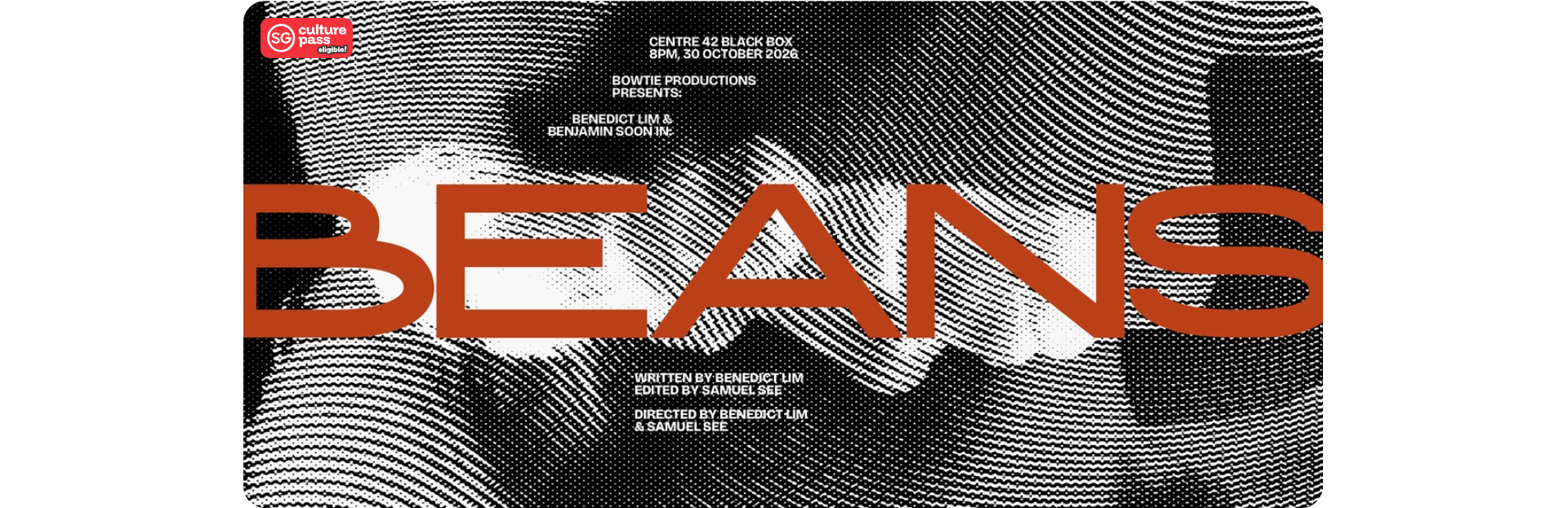
Beans plays at 42 Waterloo Street on 30th October 2026. Tickets available from SISTIC

