
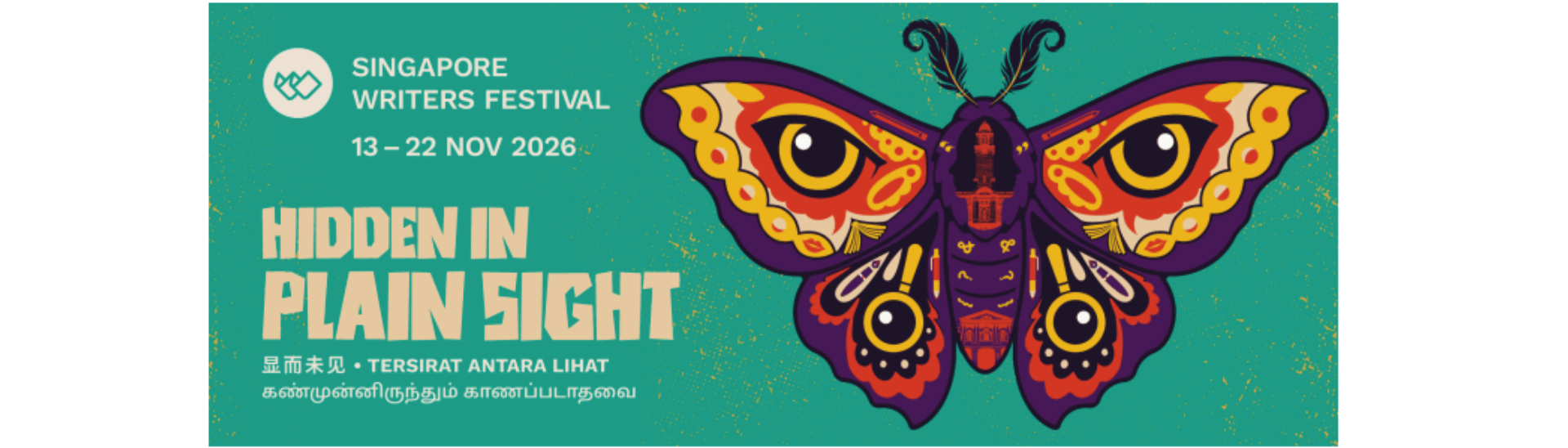
With more than 300 writers and speakers and over 200 programmes, the 29th Singapore Writers Festival turns “Hidden in Plain Sight” into a sprawling investigation of crime, memory, translation, technology and reading between the lines.
A literary festival themed around things hidden in plain sight could hardly arrive at a more appropriate moment. The 29th Singapore Writers Festival, running from 13 to 22 November, takes “Hidden in Plain Sight” as its theme, inviting writers and audiences to look beyond the obvious, at the histories buried beneath familiar narratives, the assumptions that shape what we believe, and the stories that can be concealed by language, technology, family and even the places we think we know well.
There is plenty to look at. As with each year’s massive festival, this year’s edition brings together more than 300 writers, speakers and moderators across over 200 programmes, ranging from fiction, memoir and poetry to journalism, documentary film and literary translation. The international line-up includes Amitav Ghosh, Tan Twan Eng, Silvia Moreno-Garcia, Ruha Benjamin, Rachel Smythe, Robin Stevens and Shuang Xuetao, alongside Singaporean and Southeast Asian writers including Jemimah Wei, Yuvan Chandrasekar and others.

But the sheer size of SWF 2026 is also the first thing festivalgoers will have to contend with. This is not really a festival that can be “done”. The trick will be to find the threads running through it and follow the ones that catch your attention.
One of the clearest is the festival’s new Crime & Mystery Spotlight, which takes the year’s theme almost literally. Crime fiction is, after all, an art form built around the gap between what appears to have happened and what actually happened. Its writers work with clues, omissions, assumptions and revelations — all of which make the genre an unusually natural fit for this year’s festival.

The new spotlight brings together writers from Singapore and around the world to examine not only how mysteries are constructed, but what crime fiction can reveal about memory, history and contemporary life. In The Making of a Serial Killer, South Korean crime writer Seo Mi-ae joins Singaporean writers Rueben Dass and Jocelyn Suarez to discuss the research and creative decisions involved in constructing fictional killers. Faridah Àbíké-Íyímídé, meanwhile, explores socially charged mysteries and complex villains in Writing Bold Stories That Bite, drawing on her breakout thriller Ace of Spades and her latest murder mystery, The Heirs.
There is also a distinctly Korean conversation in Two Ways of Writing a Korean Mystery (and Killing It), where Seo Mi-ae and YA mystery writer June Hur compare their approaches to psychological and historical mystery, including the question of how cultural details change when stories cross into English-language readerships. For readers interested in the history of the genre, Still Killing It: Agatha Christie’s Enduring Legacy brings Robin Stevens and Louise Hegarty together 50 years after Christie’s death to consider why the Queen of Crime continues to shape mystery writing.

The crime strand becomes more interesting still when it stops being simply about solving crimes. In Old Crimes, Fresh Takes, Silvia Moreno-Garcia, Jean Tay and Ovidia Yu discuss the process of excavating archives and real histories for fiction, including the transformation of historical violence into stories for contemporary readers. And in Crime, Memory and Moral Ambiguity, Shuang Xuetao and his English-language translator Jeremy Tiang look at a form of crime and thriller writing in which suspense does not necessarily lead to the comforting restoration of order. Instead, crime becomes a way of exploring memory, precarity and the moral uncertainties of ordinary life.
That last distinction gets to the heart of what makes the 2026 programme broader than a conventional genre festival. The question is not simply who committed the crime, but what we decide to remember, what we leave out and what happens when the stories we have inherited are examined from another angle.

That concern runs through one of the festival’s major conversations, What the Family Doesn’t Say, where Amitav Ghosh, Jemimah Wei and Balli Kaur Jaswal consider the silences, secrets and sacrifices carried across generations. Migration, family ambition and inherited history become forms of evidence in their own right, the things that are often not recorded, but which nevertheless shape people’s lives.
Ghosh will also deliver one of the festival’s major keynote talks on 14 November, asking what societies’ stories about the future of the planet tell us about the present. In A Writer’s Reimagining of Our Planetary Future, he looks at the increasingly common idea that environmental catastrophe requires preparation for escape rather than collective efforts to prevent it, and considers what such catastrophic imaginings mean for the Global South.

Other keynotes take the theme into the technological present. Ruha Benjamin will examine the hidden biases shaping technology and society, while writer Stephen Witt will look at Nvidia and the making of an AI powerhouse. In the context of a festival whose director explicitly connects “Hidden in Plain Sight” to the rise of AI and scams, these conversations give the theme a particularly contemporary edge: what happens when the systems through which we encounter information become increasingly difficult to read?
If the crime strand asks audiences to look for clues, the festival’s emphasis on literary translation asks a different but related question: what becomes visible when a story moves into another language? Singapore is unusual in having a major literary festival that operates across all four of its official languages, and SWF is leaning more heavily into that identity this year. There will be more Chinese, Malay and Tamil programming, with guest curators Chan Cheow Thia, Muhammad Ilyia Kamsani and Neelakandan Sivanantham bringing together writers and literary practices from Singapore and the wider region. Selected sessions will also have live interpretation or digital translation, opening more of these conversations to audiences who might otherwise find them inaccessible.

Anchoring that is SWF Homage, whose 2026 focus is literary translation. The programme traces the movement of Singapore literature across languages and borders, from the 18th and early 19th centuries to the present, while looking at the writers and translators helping Sing Lit reach audiences beyond Singapore. It will extend into an interactive microsite and a public installation travelling to libraries and community spaces, making translation something audiences can encounter rather than simply a subject discussed on stage.
The individual programmes make that multilingual landscape concrete. In Writing Fiction to Remember and Heal, Teoh Hee La, Wang Zhanhei and Hon Lai Chu consider how fiction can preserve memory and offer comfort during periods of upheaval. Royal Syair and Journalism in the Malay World puts classical Malay poetic traditions into conversation with contemporary journalism and reportage, while Echoes in Art and Ink: Rediscovering Little India’s Hidden Stories turns to the communities and histories of Little India through Tamil-language writers Uma Kathir and Krishnasamy Subramaniam. Yuvan Chandrasekar’s Yuvan – The Essence of Poetry takes an even wider view, exploring poetry’s ability to resonate across languages, countries and generations.
This is also where the practical side of planning SWF becomes important. If you are attending a programme with AI-assisted live translation, for instance, the festival recommends bringing your own earphones. And if you want to explore the multilingual programme, it is worth checking the individual session information rather than assuming that every non-English event is inaccessible to non-speakers. The festival is increasingly building translation into the experience itself.

The same principle applies to SEA xChange, which brings Southeast Asian perspectives into conversations about literature, architecture, folklore, migration and everyday life. Among its participants are Thai architect and writer Chatchavan Suwansawat and Filipino author Caris Avendaño Cruz. The strand is another indication that the festival’s internationalism is not simply about flying in famous authors; it is also about placing Singapore’s literary culture in conversation with its immediate region.
And then there are the programmes that ask audiences to leave the festival venues altogether. Some of the most distinctive experiences in this year’s programme are literary walks, which turn the physical city and its landscapes into texts to be read. Islands of Memories: Stories from the Southern Sea, for example, takes audiences through the living memory of Singapore’s Orang Laut and Orang Pulau communities, combining coastal walking, oral storytelling and a shared meal prepared by the community. The programme is led by Firdaus Sani of Orang Laut SG, with artist and storyteller Asnida Daud or author Jamal Ismail appearing on different dates.

The Yunnan Garden literary walks take another approach to the relationship between place and memory. One route traces the surviving traces of Nanyang University, while another explores the contemporary landmarks of NTU. The interesting proposition is that the same landscape can hold entirely different meanings depending on who is looking at it and which history they carry with them. On 15 November, travel writer Yap Seow Choong leads another literary journey to St John’s Island, including an exclusive visit to the island’s marine research facility.
These are not programmes to squeeze casually between two panel discussions. They involve transport, fixed meeting points and several hours of your day. The same is true of some of the festival’s more unusual experiences: In The Last Mansion Standing: Uncovering the House of Tan Yeok Nee, led by architectural historian Yeo Kang Shua, uses a restored Teochew mansion to uncover the people and stories embedded in its history, while The Salon with Pooja Nansi pairs literary conversation with food at COMO Cuisine. Other Salon programmes include The Salon with Malaysian author Tan Twan Eng (The Garden of Evening Mists) at Capella Singapore, and The Salon with local author Jemimah Wei (The Original Daughter) at Kotuwa at New Bahru.

The sheer variety is one reason the best way to approach SWF may be to resist building a schedule entirely around famous names. With more than 200 programmes, clashes are inevitable. A sensible strategy is to choose one or two “anchor” events each day, perhaps a keynote, a single-ticket performance or a literary walk, and then build shorter Festival Pass sessions around them. Geography matters too: Victoria Theatre, The Arts House, National Gallery Singapore and Asian Civilisations Museum may all feature prominently, but off-site programmes can take you to NTU, West Coast Park or St John’s Island. A day that looks leisurely on the programme page can become surprisingly ambitious once travel time is included.
It is also worth leaving some empty space. SWF has always been more than a sequence of panels, and the 2026 edition deliberately expands into public spaces, bookstores, libraries and other parts of the city. Undercurrents, at the Funan Underground Pedestrian Link, brings illustrators Tang Yau Hoong and Quek Hong Shin into a public setting to reflect on how people process thoughts and navigate everyday life, while SWF Encounters extends the festival spirit through book clubs, Book Doctor sessions and pop-up activities.

For younger audiences, the festival has its own routes through the programme. SWF Playground includes Robin Stevens and Jessica Townsend discussing rebellious heroines in Girls Who Don’t Follow the Rules, while families can make illustrated stories with Quek Hong Shin or take part in Treasure Hunting in Dunhuang, a parent-child activity presented with the Asian Civilisations Museum. Young people aged 13 to 25 can take part in Youth Fringe, which gives participants opportunities to develop skills in curation, moderation and marketing. Meanwhile, SWF Classroom takes the mystery theme into schools with The Ending Is Yours, asking students aged 10 to 18 to devise their own endings to a mystery before the public gets to vote in The Verdict Is Yours.
There are also some wild cards for those who want their literary festival to be a little less predictable. Firasat: A Dikir Performance explores the tension between heritage and the pressure to choose financial stability, using dikir barat-inflected performance to bring to the surface the passions that can be buried beneath a polished professional life. Rhyme Off: Shared DNA of Poetry and Rap brings poets and rappers together to examine their shared roots in rhythm, metaphor and oral storytelling, while also questioning the boundaries of literary legitimacy and cultural canon.

And on the final evening, the festival turns its own theme into a debate. This House Believes that the Better Strategy is Hide but Not Seek asks whether, in a world that demands constant visibility, survival might sometimes depend on disappearing instead. It is playful, but it also neatly captures the question that has been running underneath the festival all along: what should be revealed, what should remain concealed, and who gets to decide?
There is one final layer to SWF 2026. This will be Yong Shu Hoong’s final edition as Festival Director, concluding his tenure with a programme that brings together many of the literary traditions, voices and perspectives that have shaped the festival over the years. Yet the programme does not feel designed simply as a retrospective. Its attention is directed towards translation, regional exchange, technology, younger audiences and new ways of bringing literature into the city.

That makes this year’s festival less about discovering a single definitive story than about learning how to look differently. A crime novel can become a way of examining history. A translation can change the visibility of an entire literary tradition. A familiar landscape can contain several competing memories. A family silence can be as consequential as a documented event. Even a technology marketed as a tool for seeing more can introduce new things that remain invisible.
With so much happening across ten days, the challenge for festivalgoers is not to see everything. It is to notice what you might otherwise have overlooked. Because if the festival has one lesson to offer before it even begins, it is perhaps that the obvious story is rarely the whole story.
Singapore Writers Festival 2026: Hidden In Plain Sight runs from 13th to 22nd November 2026. Tickets and more information available here, with Early Bird savings of 20 per cent available from 29 September to 18 October. Festivalgoers can also use SG Culture Pass credits, while free programmes offer another way into the festival. Festival Pass programmes are first-come, first-served.


The Singapore Writers Festival sounds like an exciting place for readers and writers who enjoy crime and mystery. I like seeing literary events explore familiar genres from different perspectives and encourage people to look beyond what they normally expect from a story. https://www.davidthomasthegordianknot.com/
LikeLike