
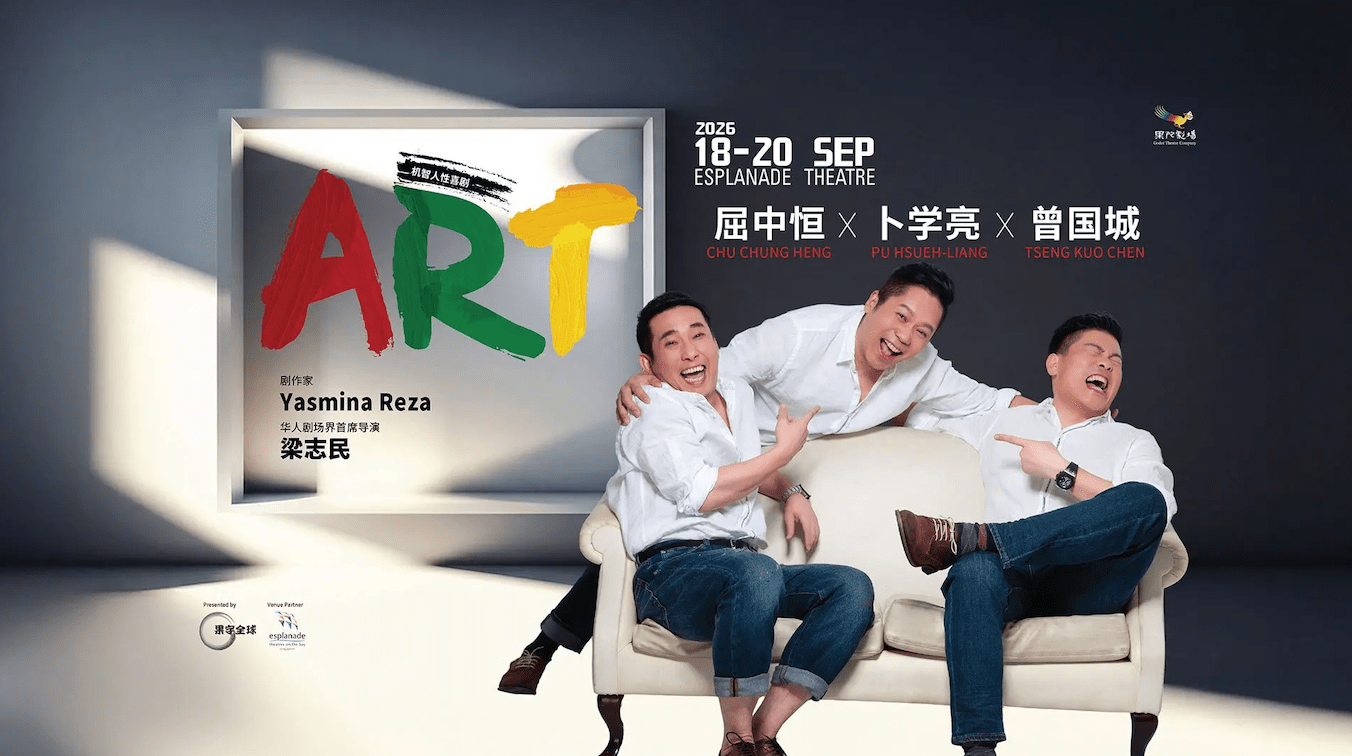

Godot Theatre’s take on Yasmina Reza’s beloved classic reminds us how art reveals uncomfortable truths about ourselves and how we live in a world of myriad perspectives.
Duration: 135 minutes
John Berger, in Ways of Seeing, famously writes that “the relation between what we see and what we know is never settled”. It is an idea that applies directly to Yasmina Reza’s ART, a play in which three old friends can look at the exact same white canvas and somehow arrive at completely different realities. One sees an work of genius, another sees an expensive joke, while the third is mostly concerned with keeping everyone from killing each other. Yet the longer the argument continues, the clearer it becomes that the painting itself is almost beside the point. What matters is what each man needs to see in it, and what the painting forces them to see in themselves.

Returning to Singapore three years after their last appearance at the Esplanade’s 2023 edition Huayi – Chinese Festival of Arts, Taiwan’s Godot Theatre Company brings back its Mandarin-language production of ART, directed by Liang Chi-Ming and once again featuring Taiwanese stars Pu Hsueh-Liang as Sun Liangqun, Chu Chung Heng as Zhao Zhongjie and Tseng Kuo Chen as Qian Guoming. The premise remains: Zhao has spent an extraordinary sum on a large white painting by the fictitious artist Antrios, sending his longtime friend Sun into disbelief and fury, while their mutual friend Qian attempts, increasingly desperately, to keep the peace. Reza’s play, which premiered in Paris in 1995 and has since become an international theatrical staple, uses this absurdly small provocation to prise open something much larger: the ways people defend their identities, the values they think they possess, and the fragile assumptions that allow friendships to survive.
Seen again now, the production has never been designed as a dig about the value of modern art, rather, it instead serves as a demonstration of the power of art to make people uncomfortable. Art is often dismissed as frivolous, decorative or somehow unnecessary beside the supposedly more practical concerns of everyday life. Yet that is precisely where ART finds its teeth. The white painting does not need to be objectively beautiful, nor does it need to possess some secret meaning that the audience must decipher. Its power comes from the fact that it refuses to settle into one meaning. Like Berger’s proposition that our perception is shaped by what we already know and believe, the painting becomes a mirror for the three men looking at it: Zhao sees taste, aspiration and intellectual legitimacy; Sun sees pretension, betrayal and the abandonment of principles; Qian sees a problem that needs solving before it destroys a friendship. Their disagreement is ultimately not about the painting at all, but about the selves they have built around their own ways of seeing.

Liang’s direction understands exactly how funny that can be. ART is laugh out loud, with a comic rhythm that feels even more assured this time around. There is a comfort to the three actors’ performance that comes from having lived with these characters and with each other for years, yet that is also underpinned by astonishing precision. There are little touches that feel almost throwaway, a high five here, an irritated gesture there, even the moment of care following one particularly vicious blow, but these details make the friendship feel lived-in rather than merely scripted. They are the sorts of tiny behaviours that become possible when performers know exactly how long they can hold a look, when to interrupt, when to let silence breathe and when to push a joke just a little further. It is especially telling that the funniest moments do not feel like actors waiting for a laugh; they feel like three men genuinely trapped in the ridiculousness of their own argument.
That chemistry is the production’s greatest strength. Pu, Chu and Tseng have known one another for decades, and there is an almost uncanny ease to the way they inhabit the stage together. Yet ART requires something more difficult than simply appearing comfortable in one another’s company: they have to make us believe that these three friends can spend years loving each other, only to suddenly find themselves capable of saying some astonishingly cruel things. The trigger is absurdly small, but the emotional consequences are enormous, and the actors never allow the premise to become merely a sitcom conceit. They fill the vastness of the Esplanade Theatre with only three bodies, their voices crisp and confident as they ricochet dialogue across the stage, each man seeming to know instinctively where the other two are even when they are not looking at them.

That spatial awareness is one of the things Liang handles particularly well. For a play that is so relentlessly dialogue-heavy, there is a surprising amount of physical storytelling in the production. Distance becomes an emotional language: the men move towards one another, retreat, turn away, occupy separate corners, and at times seem to measure the space between them as carefully as they measure each other’s words. Even seemingly tiny directorial choices land with precision. Early on, when Sun freezes, Zhao turns his face towards the audience, allowing us to catch that flash of condescension before the scene moves on. It is a small gesture, but it tells us exactly where Zhao is mentally in that moment, and it demonstrates how much information Liang manages to squeeze out of the spaces between the lines.
The actors are also constantly shifting registers, and that makes the performance considerably more demanding than it initially appears. They can break the fourth wall to address us directly, then snap immediately back into the emotional reality of the scene; a joke can become an accusation, an accusation can become a genuine wound, and a moment of apparent reconciliation can suddenly expose another layer of resentment. Maintaining that elasticity across the full length of ART requires remarkable stamina, particularly because the production never allows the energy to simply dissipate. Even when the men appear exhausted by their argument, there is always another grievance waiting to surface.

Of the three, Tseng Kuo Chen remains the great comic revelation, but this time his performance feels even richer because of the sheer range he gets to traverse. Qian is ostensibly the mediator, the man who wants everyone to calm down and somehow make everything okay, but Tseng gradually reveals just how unstable that position is. He plays Qian’s desperation almost as physical comedy, allowing his expressions and movements to become increasingly exaggerated as he is pulled between the two sides. Yet when the script finally gives him the space for his longer monologues, particularly as his own personal frustrations begin spilling out, the clowning gives way to something much more vulnerable. His melodrama is enormous, sometimes deliberately overplayed in voice, expression and physicality, but that is precisely what makes the eventual breakdown so affecting. We watch a man who has spent so long trying to manage everyone else finally lose his grip on himself. It is a full journey from comic clown to wounded friend, and Tseng takes us through every inch of it.
Pu and Chu, meanwhile, maintain an increasingly taut tension between Sun and Zhao. Their scenes have the dangerous quality of two people who know precisely where to hurt one another because they have known each other for so long. Their characters are not simply debating whether a white painting is worth the money; they are attacking one another’s taste, values, relationships and identities, dredging up old versions of each other and insisting that those versions are somehow more authentic than the people standing in front of them. What makes the exchanges so effective is the sense that neither man is entirely performing for the other. They are trying to force the other person to see what they see, and failing spectacularly, resulting in both tension and humour.

That failure is the heart of ART. We often assume that knowing someone for twenty or thirty years should mean knowing them completely. But perhaps the opposite is true: the longer we know someone, the more confidently we can believe that we understand them, and therefore the more violently we react when they suddenly reveal a side of themselves that does not fit our understanding. Zhao, Sun and Qian have changed and so have their friendship. The painting merely gives those changes somewhere to collide, and it genuinely feels like a risk when we see what they are about to lose, without having to know every detail of their decades of friendship – it is plain to see in their interactions.
The production’s visual design complements this idea beautifully. The set once again makes excellent use of the Esplanade Theatre’s considerable scale, with its stark white surfaces and bold red, yellow and green elements giving the otherwise minimalist stage a striking graphic quality. The colours, corresponding to the three men, could easily have become an overly obvious visual metaphor, but they work because the rest of the production is so restrained. White dominates the space, leaving the characters and their increasingly heated interactions to provide the movement and texture. The lighting adds another subtle layer: washes of red accompany heightened emotion, yellow can suggest unease, while cooler blue tones provide moments of calm. None of this demands attention from the audience, which is precisely why it works. When so much of our concentration is occupied by Reza’s rapid-fire dialogue, the lighting quietly nudges our emotional response without competing with the performers.
The visual language extends into the costumes, which subtly reflect both character and colour. Zhao’s suit and yellow tie give him a polished, slightly self-conscious air, while Sun’s green vest and checked shirt feel more practical and grounded, fitting his identity as an aerospace engineer. Qian’s red-lined pullover, meanwhile, complements his warmer, more openly emotional temperament. It is a neat continuation of the red, yellow and green motif, while the comfortable, lived-in clothing helps make these three feel like longtime friends with entire lives beyond the room. The soundscape is similarly restrained, with music appearing only when needed. Its piano-driven score is evocative without becoming sentimental, gently shifting the emotional temperature of certain scenes and transitions. It never competes with the dialogue, instead giving us just enough space to register when something has changed beneath the surface of all those arguments. Altogether, these design elements are what forge a fully-realised, professional theatre production where every detail has been considered.

The painting itself looks blissfully blank, no matter how close you get, underscoring the absurdity of the premise. It also is integral to the most satisfying theatrical trick of the production, where the supposedly permanent ‘damage’ to the canvas is dealt with through a deceptively simple piece of stage magic. Watching the marker drawing disappear is almost absurdly satisfying. The erasure is fast, clean and professional, but there is something strangely powerful about seeing the evidence of the entire argument vanish before our eyes and starting it all on a clean slate again as they enter their ‘probational friendship’. After all the shouting, the insults, the wounded pride and the desperate attempts at reconciliation, the physical traces of the conflict can simply be erased. But the people who made those marks cannot be reset quite so easily.
That is where ART finds its enduring power. The white canvas is a disruptor, but it is also a revelator. It forces these men to confront how much of their identities depend on being right, being recognised, being understood and having their way of seeing validated by the people closest to them. Art does not necessarily give us answers; sometimes its greater power lies in refusing to let us settle for the answers we already have. The painting remains white, but our perception of it changes depending on who is looking, what they know, what they believe and what they are afraid of admitting.

This particular production feels resonant on its return to Singapore. The three actors have themselves lived several more years together since we last saw them, and the warmth between them is palpable precisely because it does not feel manufactured. They know one another’s rhythms, but they also know that people change. Their familiarity gives the production its extraordinary comic timing, while their ability to turn on one another gives the argument its emotional credibility. There is something almost poignant about watching three longtime friends perform a play whose central question is whether we can ever really know the people closest to us.
In the end, ART does not ask us to decide whether the painting is good. It asks something much more uncomfortable: what does our response to it reveal about us? Three years on, Godot Theatre Company returns with a production that feels both familiar and newly discovered, its jokes sharpened by intimacy, its silences given greater weight, and its central argument made richer by the accumulated experience of the people performing it. The painting may be white, but there is nothing blank about it. Look long enough, and eventually, inevitably, something of ourselves begins to appear.
Photo Credit: Godot Theatre Company
ART plays from 18th to 20th September 2026 at the Esplanade Theatre. Tickets available here
Read our 2023 review of ART here
Production Credits
| Director Liang Chi-Ming Cast Pu Hsueh-Liang, Chu Chung Heng and Tseng Kuo Chen Production Management Godot Theatre Company Original Playwright Yasmina Reza Costume Designer Chin Ping-Ping Composer & Arranger Chen Kao-Hwa Stage Manager Yang Hui-Chun Stage Designer Nieh Kuang-Yen Lighting Designer Tsao An-Huei (Adapted from Nieh Kuang-Yen’s design for 2003 premiere production) Projection Designer Wang Yi-Sheng Technical Director (Stage) Lin Yan-Xiao Master Electrician Wang Yung-Sheng Stage Technicians Chang Fan, Huang,Hsiang-Yun Live Sound Jie-Yun Sound Company (Kao Chien-Yu) Sound Operator Hu Chin-Chih Surtitles Operator Chiang Cheng-Ning Stage Production Paramount Art Production Co. Ltd Lighting Technicians Lin Chih-Chien, Chen Chien-Cheng Makeup & Styling Cinema Secrets (Hung Hsin-Yu) Costume & Props Manager Zhang Ya-Yun Chief Production Officer Lin Yi-Chien Overseas Tour Producer /Director of Global Business Development Chang Hsin-Yu |

