

An animated triumph of a sweeping, heartfelt love letter to Singapore and her history, and the dreams that take us further.
Singaporeans are often a self-deprecating, critical bunch. We rarely think Singapore is worth being the subject of an epic, so seeing the country lovingly rendered on the big screen evokes a particular kind of national pride. This is not merely a recognisable skyline glimpsed in passing, or a backdrop for a story that could happen anywhere. Here, Singapore’s buildings, streets and history are essential to the lives unfolding on screen. In The Violinist, Singapore is not just where the story begins. It is what gives the story its weight.
The film opens at the Esplanade, where a young violinist performs before an audience that includes an elderly woman. A Spanish journalist notices her and follows her out into the city, eventually giving chase on his moped through contemporary Singapore and its illuminated Marina Bay skyline. The sequence is exhilarating, with sweeping music, fluid camerawork and lovingly recreated architecture. The Esplanade feels almost tangible, and the city is presented with the affection of people who understand what it means to call this place home. It is a Singapore that feels beautiful without being idealised, cosmopolitan without losing its identity.
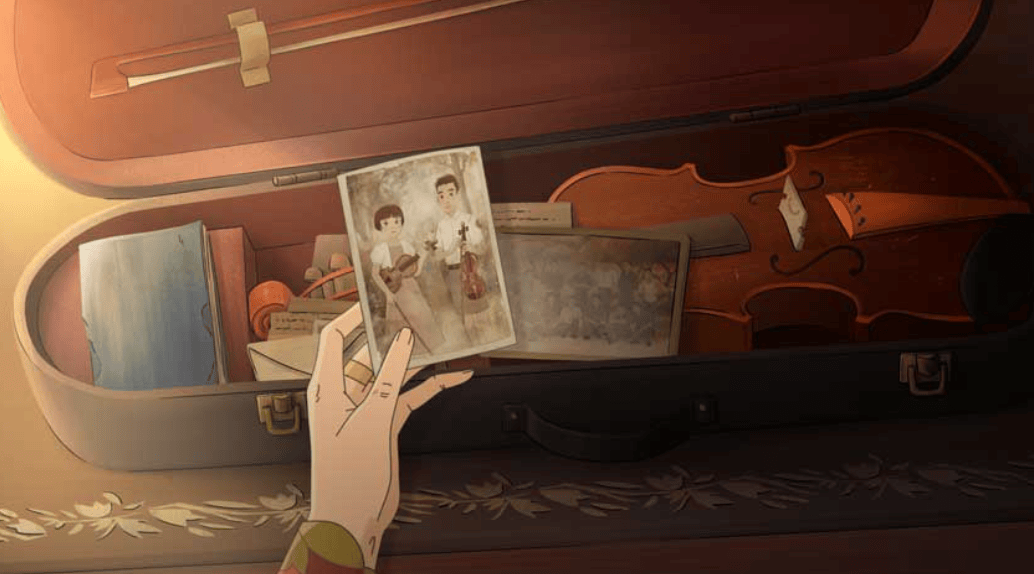
Co-directed by Singaporean filmmaker Ervin Han and Spanish animation veteran Raúl García, The Violinist spans roughly 80 years, following childhood friends Fei and Kai as their shared love of music is tested by war, separation and time. The journalist eventually visits the elderly woman at home and presents an old photograph of her as a young woman beside a man holding her signature violin. The image takes us back to pre-war Singapore, where their story begins.
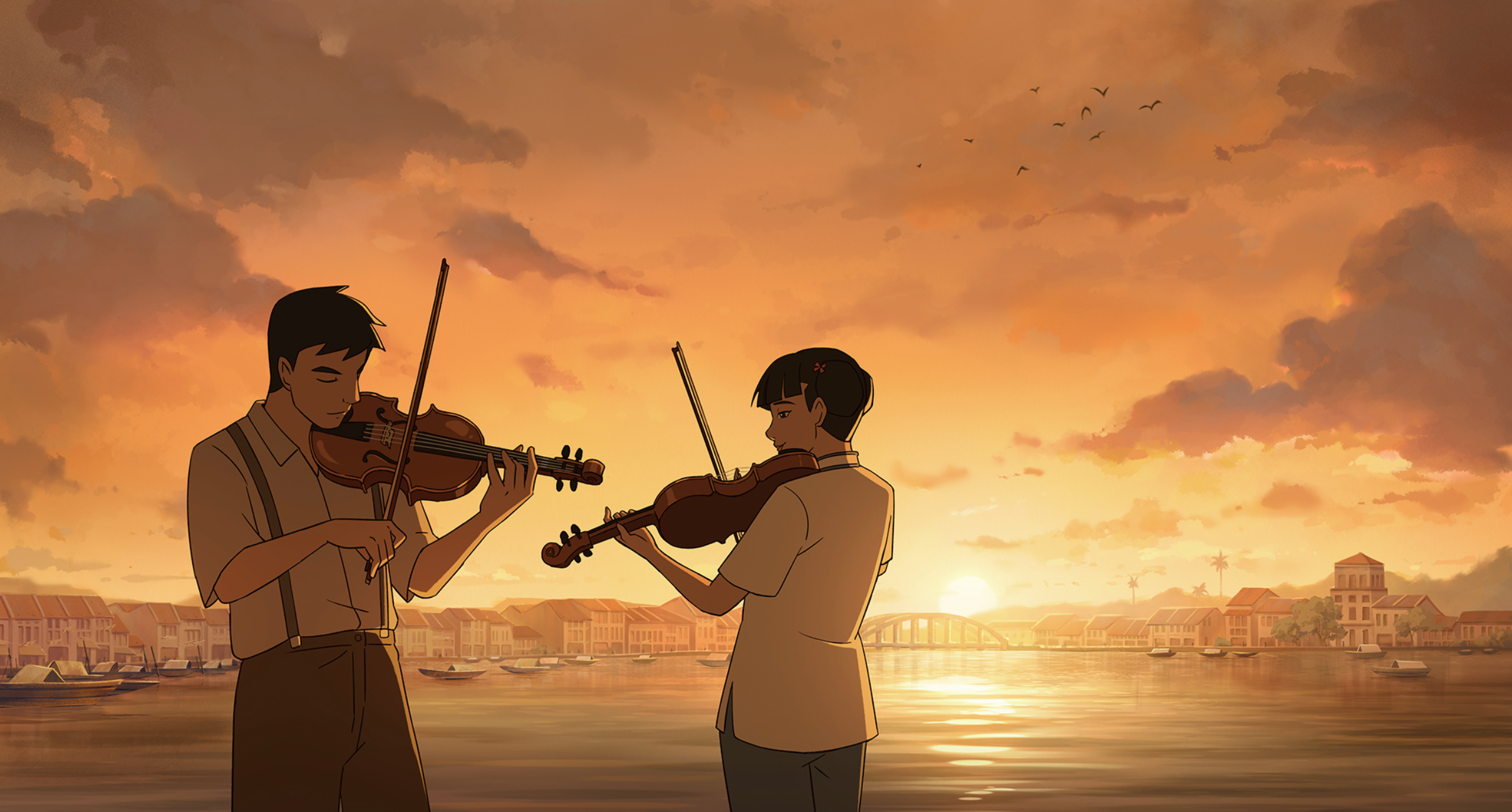
Fei grows up in a privileged Peranakan household, learning the violin, while Kai, an orphan taken in by the family’s servant, discovers his extraordinary musical talent by listening to her practise. Their friendship deepens into romance, and together they compose the Sunset Sonata, dreaming of becoming world-class musicians. Kai’s talent brings him to the attention of Lim Bo Seng (yes, that war hero), who becomes his mentor and gives him a cherished violin. The pair perform for ordinary working people and wander through beautifully reconstructed old Singapore, passing familiar cinemas, streets and buildings that evoke a city on the cusp of transformation.
These scenes are among the film’s greatest pleasures. The historical settings go beyond mere period decoration; they remind us that the Singapore we know today was shaped by people whose lives can easily disappear behind the landmarks we remember. Many of us encounter the Japanese Occupation through fragments of history and social studies lessons, Total Defence Day and accounts of figures such as Lim Bo Seng and Elizabeth Choy during school assemblies and field trips. What The Violinist does is give those fragments faces, families, fears and dreams, and makes history feel lived rather than learned.
The film is unapologetically old-fashioned melodrama, a wartime thriller and a grand romantic tragedy, all bound together by music. Its sincerity is unmistakable. It believes in loyalty, sacrifice and the possibility that art can preserve something of us when everything else is lost. There is little cynicism here, and no attempt to undercut its emotions with irony. The Violinist wants to move you, and commits wholeheartedly to the task.

Then war arrives, and the film changes register. As Japanese warplanes begin bombing Singapore, Kai’s mother is killed, shattering the life he has known. He joins the resistance under Lim Bo Seng, leaving his violin with Fei and promising that they will one day fulfil their shared dream. While Kai travels to Malaya on dangerous espionage missions, Fei remains in occupied Singapore, where her father is captured and killed.
The film’s depictions of Japanese atrocities, including the Sook Ching massacre and executions at Changi Beach, are harrowing. Events often encountered as textbook entries become experiences of terror and helplessness. War destroys not only lives, but also the ordinary futures people once imagined for themselves. While sheltering two orphaned children, Fei develops an uneasy understanding with Takeshi, a Japanese soldier who longs for his family in Japan. He helps her secure an opportunity to perform with an orchestra at Victoria Concert Hall, making their eventual conflict all the more painful. When Fei’s covert work for the resistance is exposed, Takeshi warns her, placing himself in danger.
This is one of the film’s more interesting choices. Takeshi’s humanity does not erase the violence he represents, nor does the film ask us to forget the suffering inflicted by the Japanese military. Instead, it explores the contradictions of individuals caught up in a system of violence. By allowing us to see the person beneath the uniform, The Violinist complicates our understanding of him without excusing his circumstances or diminishing the horrors of the Occupation. Its compassion is not the same as absolution.

If the animation gives The Violinist its visual identity, its soundtrack gives it its soul. Composed by Ricky Ho and Isabel Latorre, the score is consistently evocative, balancing sweeping orchestral passages with delicate, intimate moments. It lends the film grandeur without sacrificing tenderness, capturing both the exhilaration of musical discovery and the loneliness of a lifetime spent waiting for someone who may never return.
Throughout, its emotional core is the Sunset Sonata, the composition Kai initially creates to represent their shared dream of performing around the world. As war pulls them apart, it becomes a promise, a form of correspondence and a memory of the future they once imagined. The melody returns throughout the film, gathering the weight of everything they cannot say or resolve. Music is not simply an accompaniment to their story. It is the language through which they understand each other, and the thread connecting their lives across decades of separation.
The film knows when to let the music speak for itself. Dialogue falls away, the animation becomes impressionistic, and familiar phrases carry us across years without laborious explanation. The score’s tenderness also provides a painful counterpoint to the brutality of war, preserving the beauty of the lives being destroyed without diminishing the violence. Music once offered Fei and Kai a future together; later, it becomes a reminder of everything they have lost.

The animation complements this emotional language, shifting between fluid character animation, carefully choreographed violin performances, sketches and watercolour imagery. The changes are not always seamless, and some scenes reveal limitations in the animation and voice work. Yet at its best, the film uses these shifts to make memory tangible. Images dissolve into colour and gesture when literal representation would be less emotionally truthful, conveying not simply what happened, but what it feels like to remember it.
The violin performances are particularly effective. The movements of the hands and placement of the fingers have been treated with considerable care, lending the music a physical credibility that matters in a story so dependent on performance. The animation takes the discipline of playing seriously, making music feel like an act of expression rather than merely a soundtrack laid over the images.
Meanwhile, Fei’s life moves forward without Kai. Believing him dead, she builds an international career, pursuing the dream they once shared, but success cannot resolve her grief. She continues to hear echoes of their composition and shadows of his figure, and wonder whether he might still be alive. She eventually gives up on the idea of ever finding him again, and puts all her effort into carrying on their shared dream alone, in service of his memory, leading her to become a world class violinist, and to complete the unfinished Sunset Sonata.

As it turns out, Kai has, in fact, survived, but the war has cost him, leaving him unable to play as he once did. Ashamed and unable to face Fei, he builds a new life overseas. But come Fei’s retirement concert, he just may be persuaded to return, as the story comes full circle at Victoria Concert Hall. As Fei looks into the audience and recognises Kai, the decades between them seem to collapse. The Sunset Sonata, now transformed into a concerto, brings their story to its emotional culmination.
This is where the tears come hard and fast, earned through the childhood friendship, the promises they exchanged and the violence that tore them apart. By the time the music returns, we have spent the entire film listening to the shape of their separation. Every note carries that history. The film’s recognition at Annecy, including the Cristal for a Feature Film and the SACEM Award for Best Original Soundtrack, feels richly deserved. The score is one of the principal reasons the film works, making music a craft, a calling, a form of communication and a means of preserving the past.
There is plenty in The Violinist that can be questioned. Its storytelling is unabashedly melodramatic, its characters sometimes embody ideals more than they resemble complicated people, and its emotional signposts can be conspicuous. The animation and voice performances are not uniformly polished. But its imperfections do not obscure its ambition. The film wants to tell a story with the sweep of an old-fashioned epic and the intimacy of a family memory, and it is willing to risk sentimentality in pursuit of sincerity.

Beyond seeing a local production receive international recognition, this is a film that makes a compelling case for Singaporean and Southeast Asian stories as narratives with the emotional and cinematic breadth to reach beyond their place of origin. What stays with audiences most will be the feeling that Singapore’s past had been made newly visible. The Violinist does not pretend that a romantic drama can encompass the full complexity of the Occupation. Instead, it offers an emotional entry point into history, asking us to consider the people behind the dates and events, the lives interrupted by violence and the stories that may never have made it into textbooks.
For a young animation industry in a country that often looks forward so determinedly that it risks forgetting what came before, there is something quietly radical about a film so committed to looking back. The Violinist is a love letter to Singapore, not merely to its glittering skyline and familiar landmarks, but to the generations who lived through the making of the country we know today. Sometimes a country’s identity is found in a piece of music, an old photograph or a story a grandparent never quite finished telling. The Violinist brings those fragments together with uncommon sincerity. It is imperfect, occasionally excessive but always deeply moving. Above all, it reminds us that history is not simply a record of what happened, but a collection of lives, memories and dreams that continue to shape us.
The Violinist is now playing in cinemas such as Golden Village in both English dubs and Mandarin dubs.

