
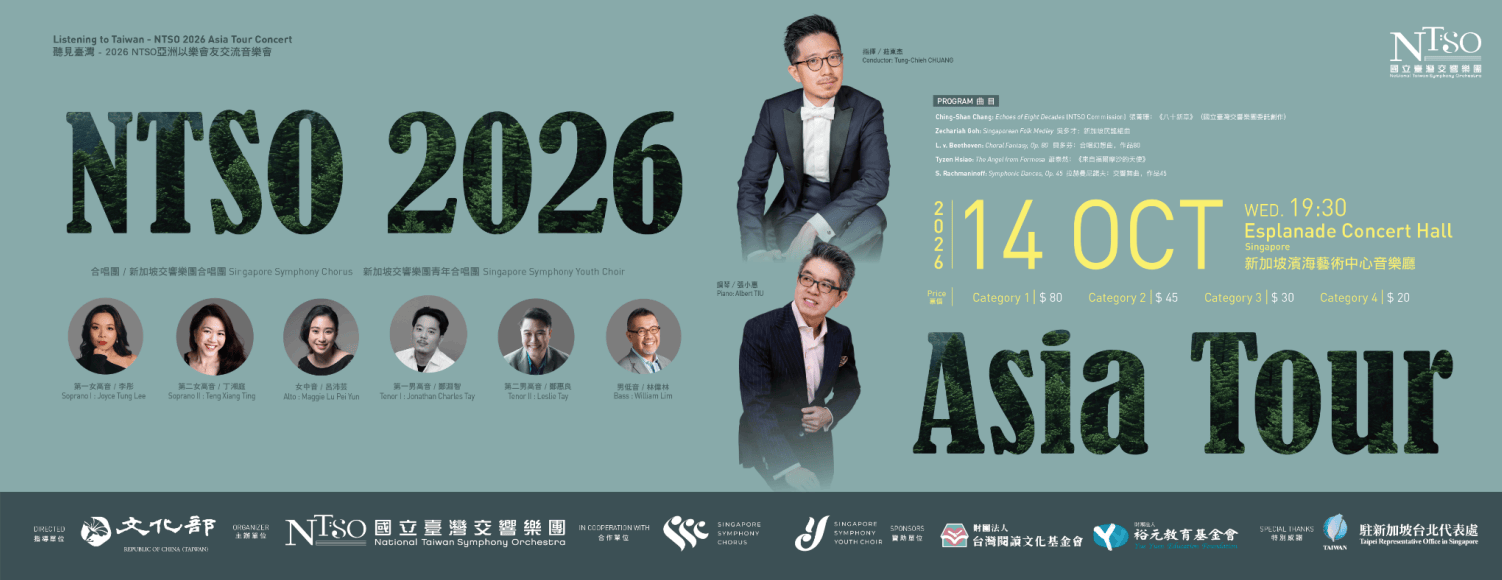
From folk melodies that evoke memories of home to classical masterpieces that transcend generations, conductor Tung-Chieh Chuang and pianist Albert Tiu reflect on the power of music to express the human experience ahead of the National Taiwan Symphony Orchestra’s Singapore performance.
What can music express that words cannot? For Taiwanese conductor Tung-Chieh Chuang, the answer lies in the subtle complexities of human emotion, and the ability of music to bring them to life. “Music is the depiction of life experience through the composer’s lens,” he says. “As conductors bear the responsibility of interpreting these depictions, the richness of their own lived experiences directly fuels the authenticity of their performance.”
For Chuang, this makes the pursuit of new experiences an essential part of being a musician. “Therefore, enriching my life experience has become one of my personal mottos. Be it studying different disciplines or challenging myself to step outside my comfort zone, every encounter ultimately feeds into the depth of my musical interpretation.”

It is a philosophy that resonates with the National Taiwan Symphony Orchestra’s (NTSO) upcoming Singapore concert, Listening to Taiwan – NTSO 2026 Asia Tour Concert. Led by Chuang, the orchestra will take to the Esplanade Concert Hall on 14 October, bringing together Taiwanese and Singaporean musical traditions in a programme that explores culture, identity and the meaning of home.
Founded in 1945, the NTSO is Taiwan’s longest-established symphony orchestra. For this performance, it will collaborate with internationally renowned pianist Albert Tiu, the Singapore Symphony Chorus, the Singapore Symphony Youth Choir and six Singapore-based vocal soloists.
The programme features five works that span folk-inspired contemporary compositions and established classical masterpieces. Yet beneath their stylistic differences lies a common thread: nostalgia and the deep connections between people and their homelands.

Chuang believes music offers a unique way of communicating experiences that can be difficult to articulate. “The invention of words as a communication tool aimed to increase efficiency. Unfortunately, much of the subtle beauty in human emotions is lost in the pursuit of effectiveness. Music does almost the opposite: it prioritizes capturing the full spectrum of human emotion, expressing what words fail to convey. In this sense, music is ultimately far more precise than words could ever be.”
This philosophy shapes the way he approaches the concert’s programme. Rather than presenting a series of unrelated works, the selections are intended to form a cohesive emotional journey. “This program serves as a vivid case in point. The central thread weaving through the selection is nostalgia—the deep bond between people and their homelands. By presenting the distinctly styled works that explore this singular topic, the program assembles a complete and cohesive picture of the human emotional experience.”

The journey begins with Echoes of Eight Decades, a work by American-based Taiwanese composer Ching-Shan Chang commissioned to mark the NTSO’s 80th anniversary. Incorporating beloved Taiwanese folk melodies, the composition reimagines familiar musical material through a contemporary symphonic language. The programme also features Singaporean composer Zechariah Goh’s Singaporean Folk Medley, which brings together songs including Ondeh Ondeh, Suriram, Kopi Susu and Jinkly Nona. Drawing on traditions associated with Malay, Peranakan Chinese and Eurasian communities, the work evokes the warmth of kampong life and the spirit of community.
For Chuang, the inclusion of these works strengthens the connections between the programme’s different musical styles. “Building on the second point, a single thematic thread holds the program together across various musical styles. Furthermore, our collaboration with Singaporean composer and singers adds rich depth to the performance, offering a truly immersive experience.”
The programme continues with Beethoven’s Choral Fantasy, Op. 80, which brings together piano, orchestra and chorus; Tyzen Hsiao’s The Angel from Formosa, with its lyrical portrayal of Taiwan’s land and people; and Rachmaninoff’s Symphonic Dances, Op. 45, a work associated with memories of homeland, faith and reflections on life. Together, the selections invite audiences to consider how music can preserve cultural memories while allowing them to be shared across geographical boundaries.

While the music itself carries the emotional narrative, bringing it to life requires more than simply following a score. Chuang, who rose to international prominence after winning the 2015 Malko Competition in Copenhagen, has conducted extensively across Europe and Asia. His approach places considerable emphasis on listening, communication and adaptability.
Asked what audiences might not realise about the conductor’s role, he explains that the work extends far beyond keeping time. “Indeed, conducting extends far beyond time-keeping. Aside from the essentials; impeccable hearing, strong communication, comprehensive musicological knowledge, and a refined sense of taste, what intrigues me most, and perhaps remains hidden from the audience, is the art of real-time adaptability. Each orchestra reacts differently, and individual musicians dynamically adjust their playing daily in rehearsal, a phenomenon that intensifies further during live performance. How a conductor tailors their leadership to meet these distinct demands is precisely where the magic happens.”

Building a relationship with an orchestra is a process that usually takes time. Yet guest conductors must often establish a shared musical understanding within only a few rehearsals. “Developing a deep relationship with an orchestra often takes years. However, when delivering a single performance after only a few days together, musicians look for clear markers: Thorough score knowledge, historical understanding, and tasteful interpretive choices. Once these credentials are met, listening is paramount. A conductor must actively listen to what the orchestra expresses through their music and what they demand from the podium.”
For Chuang, this interplay between preparation and responsiveness is part of what makes conducting so compelling. The score provides a foundation, but each performance is shaped by the musicians interpreting it together in real time.
He also sees classical music itself as a constantly evolving art form, even as its pursuit of excellence remains constant. “Throughout its history, classical music has constantly evolved, adapting in form, style, and orchestral scale. What remains unchanged, however, is the unyielding pursuit of artistic excellence and the drive to make the impossible possible. That relentless pursuit is, and always will be, what mesmerizes audiences across generations and cultural barriers.”

For Albert Tiu, the concert offers another opportunity to explore unfamiliar musical territory. An internationally recognised pianist and Head of Piano Studies at the Yong Siew Toh Conservatory of Music, National University of Singapore, Tiu has built a career spanning performance, education and international competition juries.
Yet his understanding of success has evolved over time, moving beyond conventional measures of achievement. “In life, not just in music, ‘success’ can mean so many different things, depending on how you look at it. Maybe the bottom line is if you are happy doing the things that you love, and you have the chance to keep doing it over and over again, that to me is my current definition of ‘success’.”
For Tiu, part of that happiness comes from continuing to learn. Rather than relying solely on familiar repertoire, he actively seeks out music that challenges him. “Since I am a musician, I would like to keep learning and exploring, especially music that I have never played before, because there is a whole universe out there. For example, the majority of repertoire that I am performing these days, whether it is solo or chamber music, is music that I have never played before, and it feels good to rise to the challenge. As Artistic Director of the Singapore International Piano Festival, I am exploring themes and ideas that I think have not been done before. I think it’s important to do this, especially in a field in which it seems like everything has already been done before.”

That willingness to embrace new challenges will be particularly relevant to his performance of Beethoven’s Choral Fantasy. Written for piano, orchestra and chorus, the work anticipates some of the musical and philosophical ideas associated with Beethoven’s Ninth Symphony.
For Tiu, the performance will be a first. “It will be my first time performing Beethoven’s Choral Fantasy, which is particularly challenging for the pianist, as the piano plays a big part in the whole work. People listening to it for the first time will notice that the main theme in the Choral Fantasy is foreshadowing the Ninth Symphony, not just in the shape of the melody, but also in the textual theme of universal brotherhood.”
The work’s combination of instrumental and vocal forces also makes it a fitting centrepiece for a concert that brings together musicians from Taiwan and Singapore. Its message of universal brotherhood complements the programme’s wider exploration of shared human experiences.

Tiu’s commitment to learning also informs his work as an educator. As Head of Piano Studies at the Yong Siew Toh Conservatory, he mentors young pianists who are developing their technical abilities and artistic voices.
He believes that aspiring musicians can sometimes become so focused on mastering their instrument that they lose sight of the broader world of classical music. “This is a very good point, and it is indeed something that I keep bringing up to my students. If I had a chance to go back in time, my current self would have given my 16-year-old self so much advice. Pianists tend to focus only on playing the piano well, sometimes neglecting to see the big picture that the world of classical music is so much more than the piano. Also, sometimes, students tend to search for a lofty interpretation when the thing they need to do most is something basic, simple, and pure.”

His reflections also extend to how classical music reaches audiences beyond the concert hall. Although the repertoire is often rooted in the past, Tiu sees opportunities for younger generations to bring it to new listeners. “Classical music is essentially a field that involves the old world, because most of the music that is performed is by dead composers. I think the current younger generation is doing their part by spreading it through social media, and from what I have witnessed, it is being spread to people and places like never before.”
For both musicians, making classical music meaningful to contemporary audiences does not necessarily mean abandoning its traditions. Instead, it involves finding ways to communicate the emotions, ideas and experiences that continue to make the music resonate. Chuang’s emphasis on the richness of human experience and Tiu’s enthusiasm for continual discovery offer two perspectives on the same idea: that music remains alive through the people who interpret it and the audiences who encounter it.
From Taiwanese folk melodies to Singaporean songs, Beethoven’s vision of universal brotherhood and Rachmaninoff’s reflections on homeland, Listening to Taiwan brings together works that approach the human experience from different perspectives. The concert also reflects the NTSO’s longstanding commitment to musical heritage, education and international exchange. By collaborating with Singaporean composers, vocalists and choirs, the orchestra creates a meeting point for distinct cultural voices.

For Chuang, the programme’s unifying idea is ultimately what gives it meaning: music’s ability to convey the full spectrum of human emotion. For Tiu, the opportunity to encounter unfamiliar repertoire and share it with audiences is part of what makes a musical life rewarding.
Their perspectives suggest that listeners need not have grown up with classical music to find something meaningful in it. Whether through the familiarity of a folk melody, the emotional weight of a symphonic work or the collective sound of piano, orchestra and chorus, the music offers an invitation to listen, reflect and connect. And perhaps, that is the enduring appeal of the concert: while the musical traditions may differ, the emotions they express are not confined to any one place or generation.
Listening to Taiwan – NTSO 2026 Asia Tour Concert plays on 14th October 2026 at the Esplanade Concert Hall. Tickets available from SISTIC

