
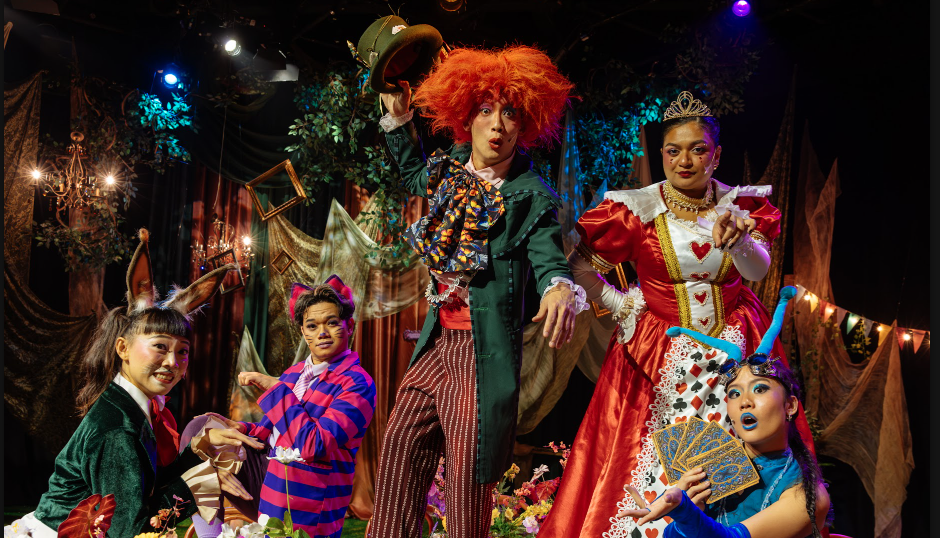
Sight Lines dives into a lighter, fantastical mystery inspired by Lewis Carroll’s classic in their final instalment of Crack the Case.
Duration: ~105 minutes
Over the years, Sight Lines Entertainment has carved out a niche for itself in its Crack The Case series of immersive mystery experiences, and it has become rather good at them. The company’s productions have often excelled in their world-building, concepts and set design, even when their stories feel more like intriguing snapshots than fully fleshed-out narratives. The mysteries, however, are usually compelling enough to keep audiences investigating, and the process of solving them is what’s kept them a hit with each edition.
Written and directed by Krish Natarajan, with Crack The Case: Wonderland, Sight Lines takes a decidedly different approach, trading its usual darker science-fiction and speculative fiction settings for the familiar yet endlessly reinterpreted world of Lewis Carroll’s Alice’s Adventures in Wonderland. This is a considerable risk, after all, it’s a well-established fictional universe, with its many adaptations and the expectations that come with it. Yet, if there’s one thing Sight Lines consistently gets right, it’s transforming a space into somewhere audiences want to explore.

Returning to the Black Box at Goodman Arts Centre, scenic designer Russell Goh delivers a gorgeous, intricately dressed Wonderland that rewards a closer look. Distinct areas are demarcated for each character’s investigations, but the central tea-party table serves as both a stage for important scenes and a gathering point for audiences. Empty golden picture frames hang overhead, while clever drapery, artificial foliage, streamers, flags and signposts evoke a woodland world that feels whimsical without being overly literal.
The individual spaces are particularly delightful. The March Hare’s rabbit hole features a trippy chequered pattern that creates an illusion of three-dimensional depth, complete with tilted doors that suggest a world where time doesn’t quite behave as it should. The Caterpillar’s cavern resembles a fortune-teller’s tent, while the Cheshire Cat’s lair feels like a dark treasure trove crammed with accumulated curiosities. Look hard enough, and there’s even a secret area that feels almost like stumbling into a surveillance room one wasn’t supposed to discover. These details give the environment a sense of history and intrigue, encouraging audiences to look beyond the obvious.

Tan Jia Hui’s costumes are equally thoughtful. Rather than relying on elaborate animal suits, the designs incorporate recognisable features into fashionable, Victorian- and steampunk-inspired clothing. The Caterpillar has her feelers, the March Hare his ears, and the Cheshire Cat his tail, while the Mad Hatter sports a sash made from spools of thread. Drawing from familiar interpretations of these characters while adding distinctive touches of their own, the costumes feel derivative in the best possible sense: recognisable, cohesive and distinctly their own.
The mystery itself begins with a surprise party. The March Hare (Tan Rui Shan), Caterpillar (Victoria Lam) and Cheshire Cat (Zulfiqar Izzudin) are preparing to celebrate the Mad Hatter (Noah Yap), with audiences invited to join in the preparations. There’s a playful, occasionally silly quality to the proceedings, including a moment when the March Hare’s stage fright leads to an impromptu rap. But when the Hatter arrives, the gift prepared for him: a special hat said to contain the very Madness that makes him who he is, has mysteriously disappeared.

Enter the Queen of Hearts (Masturah Oli), Wonderland’s imperious investigator and ruler over order, who begins questioning the Hatter’s friends. Alibis are offered, accusations fly, and nobody seems particularly eager to tell the whole truth. With the culprit still at large, the audience must investigate the surroundings, follow the clues and work out who stole the Madness.
It’s a premise that makes good use of the immersive format, even if the opening exposition takes a little too long to get everyone into the swing of things. There is an inherent tension between the freedom to explore and the need to establish a coherent narrative, and Wonderland doesn’t always strike the right balance. The initial scenes are fairly structured, with the audience largely following the introductions and preparations before being let loose to investigate. More dramatic scenes interspersed throughout the exploration might have helped maintain the momentum, giving audiences additional encounters to look forward to while they pursued their own leads.

Still, the cast makes the most of the material. Lam is playful as the Caterpillar, even offering fortunes through her amusingly named ‘carot cards’, a Wonderland spin on tarot. Zulfiqar’s Cheshire Cat is mischievous and delightfully catlike, darting about and playing pranks, while Tan Rui Shan brings plenty of physicality and vocal characterisation to the March Hare, remaining impressively in character even when audience members try to provoke a reaction. Masturah Oli lends the Queen of Hearts the requisite regal authority, balancing grace with an imposing strictness.
Yap, meanwhile, is a particularly pleasant surprise as the Mad Hatter. His expressive face, animated physicality and commanding stage presence bring a real spark to the role. There’s an infectious joy in the way he inhabits the character, and his energy carries through whenever he appears. The ensemble’s chemistry is especially evident in their shared scenes, where their contrasting personalities make Wonderland feel inhabited rather than merely decorated.

The real pleasure, however, lies in the act of playing detective. The puzzle may ultimately resemble a lateral-thinking riddle or a one-minute mystery more than an intricately plotted whodunit, but it gives the audience a reason to engage with the environment in ways that conventional theatre rarely permits. Posters, playing cards, decorative objects and the arrangement of seemingly innocuous items all become potential sources of information. Even when the clues don’t immediately lead anywhere, the process of looking, comparing observations and following hunches makes the set dressing feel integral to the storytelling rather than simply ornamental.
There’s something wonderfully liberating about being given permission to poke around a fictional world, exchange theories with fellow audience members and approach the actors with questions. The experience is at its best when everyone embraces that spirit of play, turning the room into a temporary playground where performers and audience members can discover things together.

That said, the investigative process can occasionally be frustrating. While atmospheric, some details and wording can be difficult to make out under the limited lighting, and restrictions on physically handling objects mean that examining certain clues requires a little extra effort. These obstacles aren’t debilitating, but they can interrupt the flow of an investigation that depends on close observation. The concluding discussion also feels somewhat overextended, with multiple groups breaking down what happened, identifying the culprit and reconstructing the story. Once one group has pieced the mystery together, there is inevitably less for the remaining groups to contribute, and the repeated explanations can become a little repetitive.
Fortunately, the eventual resolution is surprisingly satisfying. Despite the occasional narrative gap surrounding the significance of the missing hat and the Hatter’s Madness, the final gathering brings the experience together with a welcome sense of release. As the mystery is unbound and the audience gets to share in the revelations, the earlier frustrations recede somewhat, giving way to a collective celebration that feels fitting for this particular Wonderland. The humour can be hit or miss, but the overall tone is light, accessible and refreshingly all-ages-friendly without simply retreading the familiar story.

As the final instalment of Crack The Case, Wonderland is a fitting showcase of what Sight Lines does best with this series: creating imaginative environments, putting audiences inside a mystery and making theatre feel like something to participate in rather than simply observe. There’s room to refine the pacing and better balance the freedom of exploration with the demands of storytelling, but the production’s visual inventiveness, committed performances and sheer sense of play go a long way. With Sight Lines preparing to move towards its new semi-permanent mystery concept, Wonderland is an enjoyable send-off that demonstrates how immersive theatre can be both an entertaining night out and a welcoming introduction to the form. Enjoy the final Crack The Case while you can, and here’s to the company’s upcoming 15th anniversary and whatever curious worlds it dreams up next.
Photo Credit: Sight Lines Entertainment
Crack The Case: Wonderland runs from 9th October to 1st November 2026 at Block M, Level 1, Goodman Arts Centre Blackbox, 90 Goodman Road, Singapore 439053. Various ticket options are available from BookMyShow
Read our reviews of the previous Crack The Case productions – The Dreamcatcher and Mind Hunter
Production Credits
| Writer/Director Krish Natarajan Cast Noah Yap, Tan Rui Shan, Masturah Oli, Zulfiqar Izzudin, Victoria Lam Scenic Design Russell Goh Costume Design Tan Jia Hui Producer/Lighting Designer Derrick Chew Sound Designer Bennett Bay |

