
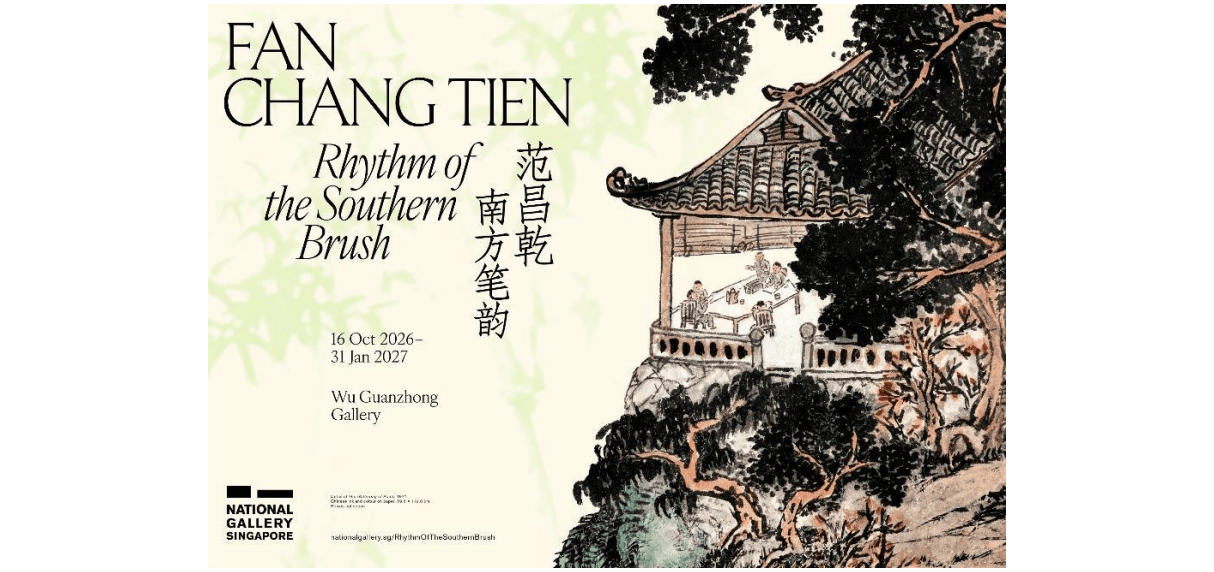
From expressive bamboo paintings and rarely seen depictions of kampong life to poetic landscapes and the artists he mentored, Fan Chang Tien: Rhythm of the Southern Brush traces the journey of an influential ink master whose legacy extends far beyond the brush.
For many familiar with Singapore’s Chinese ink painting tradition, Fan Chang Tien is remembered as the “Gardener”, a master who nurtured generations of artists while helping sustain the practice of traditional Chinese ink painting in Singapore.
Yet there is much more to Fan than his role as a teacher. A poet, calligrapher and seal carver as well as a painter, he approached art as an extension of intellectual inquiry and personal cultivation. His paintings reflect not only a deep grounding in Chinese artistic traditions, but also a willingness to observe, absorb and respond to the world around him.

Fan Chang Tien: Rhythm of the Southern Brush, opening at National Gallery Singapore on 16 October 2026, offers a fresh perspective on these different facets of his life and practice. Bringing together more than 80 works and archival materials, the exhibition traces Fan’s journey from Guangdong to Shanghai, Bangkok and Singapore, exploring how movement across different cultural environments shaped his artistic identity.
The exhibition’s title alludes to this southward journey, but also to the circulation of artistic ideas and traditions across Asia. Fan’s practice was rooted in the Shanghai School, known for its expressive brushwork and reinterpretation of traditional Chinese painting. As he moved beyond China, however, he continued to develop his artistic language in response to new surroundings, without abandoning the values that had guided his training.
Organised across five sections, namely, Moving South, Nurturing the Self, Rejoicing in the Everyday, Wandering through Nature and Tending the Garden, the exhibition unfolds as a journey through Fan’s artistic development, personal philosophy and relationships with the people around him. The exhibit then presents the portrait of an artist for whom painting was never simply a technical exercise. It was a means of cultivating character, contemplating nature, engaging with everyday life and passing knowledge on to others.

The exhibition begins by tracing the artistic foundations that Fan developed in Shanghai during the 1920s. There, he studied under Zhu Wenyun and Wang Geyi, both disciples of Wu Changshuo, one of the leading figures of the Shanghai School. From Zhu, Fan developed a sharply articulated, lyrical approach to brushwork, while Wang’s quick and decisive strokes further shaped his command of ink. These influences provided a foundation that he would carry with him throughout his life, even as his circumstances and surroundings changed.
His subsequent journey southwards was shaped by the political upheavals in China. After moving to Bangkok, where he spent nearly nine years, Fan continued painting and teaching while developing his practice beyond his original cultural environment.

Two works offer a glimpse into this period: Bamboo (c. 1953) and Scholar Admiring the Landscape (1954). The former carries an inscription by the renowned Chinese artist Zhang Daqian, who praised Fan’s talent with the words, “With nature’s own creative power truly in his hand…”. The work was also exhibited in Bangkok, reflecting the recognition Fan had gained beyond China by this stage of his career.
In Scholar Admiring the Landscape, Fan’s engagement with traditional landscape painting remains evident. Yet the significance of these works lies not simply in their connection to established artistic traditions, but in how they reveal an artist continuing to refine his practice while navigating a life across borders.
One idea that recurs throughout the exhibition is the ability to convey the essence of a subject through relatively economical brushwork. Rather than relying on elaborate detail, Fan could capture the spirit of a landscape or the character of a plant with a few carefully considered strokes. His commitment to simplicity was not a rejection of technical skill. Instead, it reflected a command of the medium that allowed him to communicate more with less.

By 1956, Fan had travelled to Singapore, where he held an exhibition at the Singapore Chinese Chamber of Commerce. He subsequently settled in the city, married his wife, Hing Sui-yung Lei, and established a family. The painting Bamboo and Orchid (1956), inscribed for the collector Dan Zizhuo, offers a particularly meaningful connection to this transition. Dan was an important collector of Chinese ink painting, and the National Collection includes a substantial body of works donated by him and his family.
The painting was also featured in Fan’s 1956 Singapore exhibition, linking his earlier artistic development with his entry into the local ink art community. His move to Singapore would prove consequential not only for his own practice, but also for the generations of students he would go on to teach.

If the first section establishes where Fan came from, Nurturing the Self explores what he believed an artist should strive to become. Central to the scholar-artist tradition is the idea that artistic achievement cannot be separated from the cultivation of moral character. Learning, technical proficiency and intellectual depth are important, but so too are integrity, humility and the continual pursuit of self-improvement.
For Fan, painting was one means of putting these ideals into practice. The section is anchored by bamboo, perhaps the subject most closely associated with his name. Bamboo occupies a special place in Chinese literati painting, where its upright form and ability to bend without breaking have long been associated with integrity, resilience and moral steadfastness.
Alongside plum blossoms, orchids and chrysanthemums, bamboo belongs to the group known as the Four Gentlemen, or si junzi (四君子), whose symbolic qualities have made them enduring subjects of traditional Chinese painting.

Fan’s bamboo paintings are among the exhibition’s highlights, but looking closely reveals more than his mastery of a familiar motif. In Young Bamboo and Rock (1973), two traditional subjects are brought together: bamboo represents moral principle, while rock suggests strength and steadfastness. The relationship between the two becomes a visual expression of the qualities Fan sought to uphold.
A selection of bamboo paintings also allows visitors to trace changes in his technique over time. In earlier works, rocks tend to be rendered more descriptively, while the bamboo leaves are articulated through decisive strokes. In later works from the 1970s and 1980s, the rocks become simpler and more bare, while the leaves take on a freer, more expressive quality.
These changes suggest an artist continually refining his visual language. His command of traditional techniques allowed him to move towards greater economy and expressiveness without losing the underlying discipline of his practice.

In Four Hanging Scrolls of Ink Bamboo (1979), an inscription articulates Fan’s preference for painting bamboo over pursuing wealth or status, while also referring to his place in the southern land. The work connects his personal values with the cultural environment in which he had chosen to live.
Not all his works remain within the boundaries of conventional ink painting. Red Bamboo with Banana Leaf (1982), for instance, pairs bamboo with a tropical plant and introduces a striking use of red. The combination offers a distinctive counterpoint to his more traditional compositions, revealing an artist willing to experiment with familiar subjects in response to his surroundings.
The emphasis on self-cultivation also extends beyond painting. Fan was accomplished in poetry, calligraphy and seal carving; practices that, together with painting, form the Four Perfections of the scholar-artist tradition.
His inscriptions are therefore integral to understanding his work. They can deepen the meaning of an image, reveal his observations of the world or articulate the values he hoped to embody. Poetry and painting function not as separate accomplishments, but as complementary expressions of the same intellectual and artistic life. This relationship between image and word is one of the exhibition’s important contributions: it encourages visitors to look beyond the brushwork itself and consider the ideas that shaped it.

For all his grounding in Chinese artistic traditions, Fan was not an artist who simply reproduced established subjects throughout his life. His arrival in Singapore introduced him to a different natural and cultural environment, one that gradually entered his paintings through its tropical plants, birds and scenes of everyday life.
Rejoicing in the Everyday brings together works that reveal Fan’s growing engagement with his adopted home. Coconut palms, mynahs, sparrows and ducks appear alongside local landscapes, offering glimpses of the world he encountered around him.

In Coconut Palm and Mynahs (1973), familiar local flora and fauna become part of a composition grounded in Fan’s established ink practice. The coconut palm provides a strong structural element, while the lively birds animate the scene.
The work demonstrates how Fan observed his surroundings without simply attempting to reproduce them naturalistically. The arrangement of forms, the movement of the brush and the relationship between plants and animals are all carefully considered.
One of the exhibition’s more revealing discoveries, however, comes from a small group of works dated 1964. Among the subjects Fan explored that year were geese, herons and ducks. In Untitled (Geese) (1964), birds move among reeds and coconut palms, their overlapping forms creating a composition that edges towards abstraction.

The brushwork becomes freer, and certain forms take on a more patterned quality. Rather than describing every detail, Fan allows the movement of the ink to carry the composition. The concentration of these experiments within a particular period makes them especially intriguing. During 1964 and 1965, Fan also occasionally signed himself as a ke (a guest or visitor) in Singapore. The reasons behind this choice remain uncertain, but the works from this period point to a moment of experimentation in his practice.
Fan demonstrated that he possessed the technical ability to explore a more abstract visual language. Yet he ultimately continued to work largely within the traditions of Chinese ink painting. The exhibition does not offer a definitive explanation for this shift. Instead, it presents these works as evidence of an artist exploring new possibilities before returning to more familiar subjects.

The same spirit of observation appears in Kampong Scene with Cyclist (1964), one of only two known works by Fan depicting local kampong scenery. The painting offers a rare glimpse of everyday life in Singapore, with its village setting and cyclist. An accompanying inscription references the south, connecting the immediate landscape to Fan’s broader experience of migration and settlement.
Its significance lies partly in its rarity. Unlike artists such as Chen Chong Swee, who are well known for their depictions of kampong life, Fan produced relatively few surviving works of this kind. Yet the painting shows that local life was not peripheral to his artistic world. The people and places around him had become worthy subjects in their own right.
The curatorial research also draws attention to Fan’s empathetic observations of ordinary people and their concerns. His poetry could reflect on the routines, worries and experiences of those around him, giving his depictions of everyday life a more personal dimension. In these works, Singapore is not merely the setting in which Fan continued an established practice. It becomes a source of artistic inspiration.

From the immediate surroundings of Singapore, the exhibition moves into the more expansive world of shanshui (literally “mountains and water”) the traditional Chinese landscape genre. For scholar-artists, landscapes often represented more than geographical scenery. They could provide spaces for reflection, retreat and imaginative wandering, allowing the artist to contemplate the relationship between humanity and the natural world.
Fan’s landscapes embody this tradition while revealing his own responses to nature. In Watching the Waterfall (1956), an early work associated with his time in Bangkok, a solitary figure appears within a mountainous setting. The composition evokes the idea of withdrawing from worldly concerns to find solace in nature.

The accompanying poem describes a waterfall that “roars in the mountain forests regardless of season”. The words reinforce the landscape’s sense of continuity and permanence, suggesting a natural world that exists beyond the changing circumstances of human life.
Elsewhere, a selection of landscape paintings traces Fan’s changing approach to brushwork. Works from 1964 feature more compressed compositions and dense textural strokes, including the traditional niu mao cun, or “ox-hair” texture strokes, used to describe the surfaces of rocks and mountains.
By the 1980s, his brushwork becomes looser and more economical. The reduction in textural detail allows the landscapes to breathe, creating a greater sense of space and movement. Four Hanging Scrolls of Landscape (1978), from the Yang Jia Yuan collection, is one of Fan’s rare sets of landscape hanging scrolls. Displayed together, the works offer a sustained encounter with his interpretation of the natural world.
A further highlight is The Gathering of Poets (1971), which reimagines the traditional motif of a gathering of literati. At first glance, the work appears to follow the conventions of a traditional landscape, with figures gathered within a natural setting. A closer look, however, reveals details that bring the scene into a more contemporary world: coffee flasks associated with local kopitiams and figures reading newspapers. The juxtaposition is subtle but significant. Rather than treating the literati gathering as an idealised scene belonging exclusively to the past, Fan introduces the activities of modern life into the composition.

The result brings together the scholar-artist tradition and the social world of contemporary Singapore. Ideas of learning, conversation and intellectual exchange remain intact, but they are expressed through familiar, everyday details. It is an example of how Fan could sustain a traditional artistic language while allowing it to respond to changing circumstances.
Throughout this section, poetry remains central to the experience of the paintings. The inscriptions evoke seasons, rain, flowing water and greenery, extending the landscapes beyond their visual dimensions. As the curators emphasise, Fan’s words are not simply captions for his images. They contribute to the composition and its meaning, allowing the written and painted elements to work together.

Between the painted landscapes and the final section on Fan’s legacy, visitors encounter a dedicated scholar-artist room that translates some of these ideas into a physical environment. The space incorporates Chinese furniture, including pieces inspired by Song dynasty styles, with its dimensions and proportions developed in consultation with an architect.
Works representing the Four Gentlemen help establish the contemplative atmosphere associated with the scholar-artist tradition. Visitors can also see a selection of Fan’s original seals, many of which appear on his paintings and calligraphy.

Among the inscriptions represented through the seals are Ren Di, associated with the identity of the “Gardener”, and “Beauty is found in simplicity”. Another seal reads Chao Xian Shi, or “Beyond Reality”. Together, these inscriptions offer a compact introduction to the values and ideas that recur throughout Fan’s work.
The room also includes an interactive stamp station featuring motifs adapted from his paintings, including mynahs, ducks, cockerels and a coffee flask. Visitors can use the seals to create their own compositions, bringing together the exhibition’s themes of artistic expression, experimentation and the relationship between image and text.
The activity provides a playful point of entry into practices that can otherwise seem highly specialised. It also underscores a central idea of the exhibition: that the scholar-artist tradition was not simply about producing beautiful objects, but about developing an integrated relationship between artistic practice, intellectual life and personal values.

The exhibition concludes by returning to the aspect of Fan’s life for which he is perhaps best remembered: his role as a teacher and mentor. Fan began teaching in Singapore at Chung Cheng High School in 1957, followed by Whampoa Secondary School in 1963. He also taught at Su Lan Studio, a private studio based at his home, where students could continue learning beyond the school environment.
Over the years, he nurtured artists including Ling Cher Eng, Nai Swee Leng, Tan Oe Pang, Lim Kay Hiong, Lee Soo Chee, Chen Ke Zhan and Chua Ek Kay, among others. Yet the exhibition makes clear that Fan’s legacy was not about producing students who would simply replicate his style. Rather, he provided them with a strong foundation in traditional Chinese ink painting while encouraging them to explore their own artistic directions.

This distinction is evident in the works by his students displayed in the final section. Nai Swee Leng’s Durians and Sparrows (2009) draws on traditional ink painting while incorporating a distinctly local subject. Tan Oe Pang’s Fish and Lotus (2000), by contrast, takes a more modernist approach, moving away from the descriptive treatment of traditional motifs towards a more individual visual language.
Seen together, the works show how a shared artistic foundation could lead to markedly different outcomes. The exhibition also includes video interviews with Nai and Tan, who studied under Fan at Whampoa Secondary School and later at Su Lan Studio. Their recollections offer a more personal perspective on his teaching methods and the character behind the paintings.

Fan would demonstrate brush techniques, observe his students’ work and offer critiques, helping them understand how to handle ink and develop their own compositions. The emphasis was on building the technical and artistic confidence needed to move beyond imitation.
A collaborative painting provides another glimpse into this relationship. In the work, Nai Swee Leng painted the orchid while Fan contributed the bamboo, bringing teacher and student together within a single composition.
The surrounding archival photographs further illuminate the networks through which Fan’s influence extended. Images of him teaching at Whampoa Secondary School, alongside photographs documenting his students and fellow artists, situate his practice within a broader community of artistic exchange.

Fan also maintained connections with artists from earlier generations. When his teacher Wang Geyi visited Singapore for an exhibition in the 1980s, Fan arranged for his students to present their works for Wang’s review. The episode offers a glimpse of how artistic knowledge and mentorship could be sustained across generations.
His contribution to the community also extended beyond teaching. The exhibition’s timeline documents his involvement in charitable exhibitions and cultural organisations, reflecting a commitment to giving back that accompanied his artistic practice.
For Fan, the idea of tending a garden was therefore more than a metaphor for teaching. It described an approach to cultivating people and relationships, providing the conditions for others to grow while allowing them to develop in their own ways.

The exhibition ends with Bird under the Banana Leaf (1987), one of Fan’s final works, made just two days before his death. Its subject is familiar: a bird beneath a tropical leaf, drawn from the natural environment that had become part of his artistic world in Singapore. Yet the treatment is notably spare, with loose, economical brushstrokes that suggest an artist increasingly concerned with direct expression rather than elaborate description.
The work is a poignant conclusion to an exhibition that has traced Fan’s movement across countries, traditions and artistic possibilities. From the bamboo paintings that articulate his moral ideals to the kampong scenes that reveal his observations of local life, the works show how his practice developed through a sustained dialogue between tradition and experience.
The exhibition also returns to the question of what it means to be a scholar-artist. For Fan, artistic achievement was inseparable from the way one lived, learned and treated others. His commitment to integrity, humility and generosity was expressed not only through his paintings and poetry, but also through his teaching and philanthropy.

As Dr Cai Heng, Project Director and Senior Curator at National Gallery Singapore, explains: “The values of self-cultivation, integrity, and generosity shaped Fan’s artistic practice, and offer an important lens through which to understand his work. By bringing together different facets of his practice, the exhibition reveals the breadth of his artistic achievements and the enduring legacy he left through both his work and the students he nurtured. The exhibition also reflects the Gallery’s ongoing commitment to deepening understanding of ink art in Singapore and Southeast Asia, and the artists, networks and exchanges that shaped its development.”
That legacy is perhaps most apparent in the diversity of the artists who emerged from Fan’s teaching. Their work demonstrates that sustaining a tradition does not mean preserving it unchanged. It can also mean giving others the skills and confidence to question, adapt and carry it forward.
Fan Chang Tien: Rhythm of the Southern Brush ultimately offers more than an introduction to a master of Chinese ink painting. It reveals an artist whose life was shaped by movement and exchange, whose work combined technical discipline with intellectual curiosity, and whose influence continued to grow through the people he taught.
The final paintings serve as a reminder that even in his last days, Fan remained committed to the act of painting. But the wider story of his life suggests that his legacy lies equally in the ideas he embodied and the artistic community he helped cultivate. Like a garden, it continues to grow beyond the person who first tended it.
Photo Credit: National Gallery Singapore
Fan Chang Tien: Rhythm of the Southern Brush | 范昌乾:南方笔韵 runs at the Wu Guanzhong Gallery, Level 4, City Hall Wing, National Gallery Singapore from 16th October 2026 to 31st January 2027. General Admission Ticket required (Free for Singaporeans & Permanent Residents), available here

