
Charming mockumentary about the bitter realities of chasing your dreams in practical Singapore.
Duration: 113 minutes
It feels like something out of a comedy film: just before the film’s theatrical release, the real life Sandbox stunt school shuttered its doors in September. What’s left is The Sandbox, a local mockumentary about a somewhat fictitious version of that same struggling business, as written and directed by James Thoo. Filmed at the real-life Sandbox in Raeburn Park, the film stars its actual founder, stuntman Peps Goh, as a beleaguered version of himself, trying to keep his business afloat while entertaining increasingly harebrained schemes to save it. Art imitates life, life imitates art, and the whole thing gets a little meta in the process.
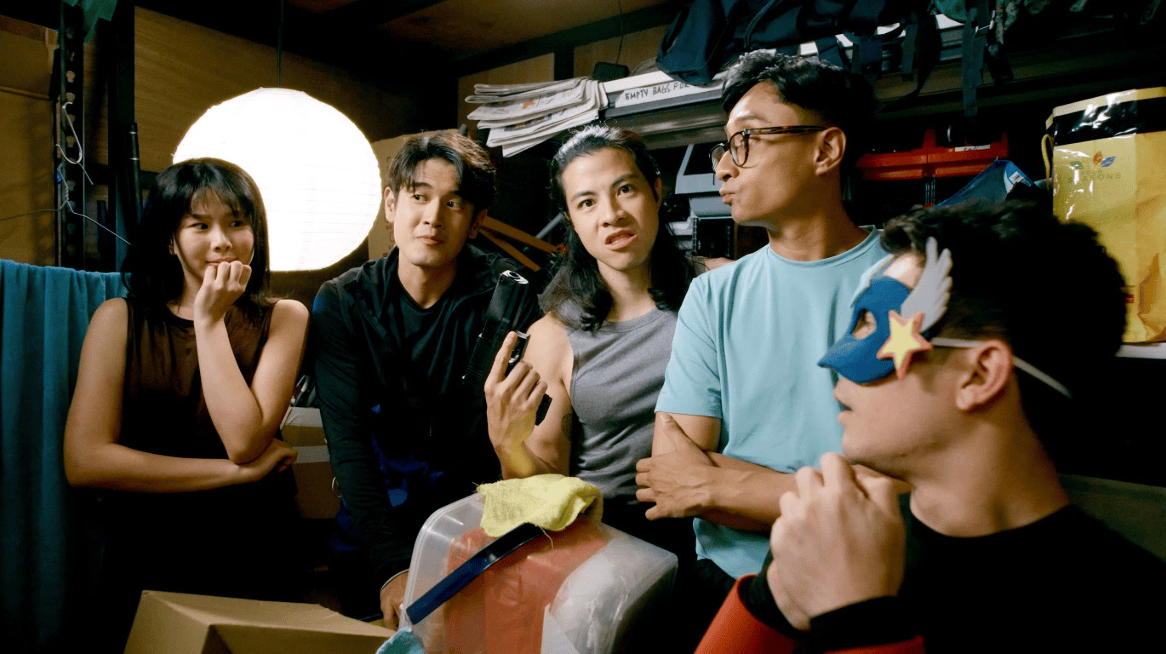
For a mockumentary drawing from the lineage of greats like This Is Spinal Tap or Best In Show, the premise is suitably silly. When an online rumour starts circulating that Marvel is looking for its next superhero in Southeast Asia, Sandbox Training Ground, a stunt school with no students and dwindling prospects, suddenly finds itself inundated with wannabes hoping to make it big. With just a week to turn these zeroes into heroes, Peps and his long-suffering team have their work cut out for them, as a cast of eccentrics wander in from what feels like a particularly unhinged corner of the internet.
Thoo makes good use of the mockumentary format to milk the absurdity of the situation. There are the little visual gags, such as the nameplates that help establish the characters, and the occasional breaking of the fourth wall, as the documentary crew themselves become part of the joke. At one point, a crew member hands Joash a spare camera to practise with, without him realising that it remains off the entire time he acts out an entire film script he seems to have come up with on his own. It’s just one of many off-kilter gags, but one that captures the film’s playful sensibility. The camera isn’t merely observing these characters but often enabling their delusions too.
And what a motley crew they are. There’s Joash Goh (Benjamin Kheng), a Bruce Lee copycat who loves his muscles almost as much as he loves himself, with Kheng chewing up every scene with his exaggerated voice and swagger. Thespian Dennis (Nathan Hartono) won’t stop talking about his theatre training, speaking in an affected accent and demonstrating his acting techniques to anyone who will listen. Former teacher Syafiq (Fauzi Azzhar) looks perpetually incredulous at the nonsense around him while himself haplessly afraid to even rig himself up. Influencer Megan (Xuan Ong) is forever livestreaming and greeting her followers, and finally, there’s Jeffrey (Aaron Mossadeg), whose enthusiasm for method acting extends to actually wanting to fight crime, and whose silly grin is perfectly suited to his particular brand of madness.
Their proposed superhero identities are almost as ridiculous as the people themselves. There are questionable names, dubious abilities and grandiose ideas that bear little resemblance to anything remotely marketable. Watching them try to put these fantasies into practice during Peps’ lessons, whether through Fauzi’s slow-motion antics or Megan’s inexplicable feline tendencies, is frequently hilarious. The physical comedy is particularly enjoyable because these characters are so utterly convinced of their own potential, even when the reality is that they can barely execute a basic stunt without making a hash of it.

The performances are a big part of why this works. Benjamin Kheng commits wholeheartedly to Joash’s buffoonery, going all out with the physical comedy, the voice and the sheer, unshakeable ego. Hartono is so thoroughly insufferable as Dennis that it becomes difficult not to admire the commitment, while Mossadeg’s mischievous grin makes Jeffrey’s overzealous antics all the more entertaining. Xuan Ong gets plenty of mileage out of Megan’s influencer persona, but also finds moments of vulnerability beneath the constant performance. One particularly affecting scene involving a surprise cameo appearance by the actress playing Megan’s mother, whose monologue about disappointment cuts through the silliness, gives the character a dimension that her livestreaming antics might otherwise obscure.
Oon Shu An is another standout as Min, John’s ex-wife and the unfortunate soul left to manage much of the school’s day-to-day drudgery. Her stony expression, icy death stares and dry, monotone zingers make her a natural comic foil to the chaos around her, particularly as the tension builds up around the increasingly bricked work laptop she’s forced to use. Yet when Min’s defences finally begin to crack, Shu An reveals a vulnerability that lands all the harder for the restraint that precedes it. Jon Cancio, meanwhile, plays John, Sandbox’s other co-owner, as a man whose harebrained schemes and self-importance are almost as exhausting as the business he is trying to save. These are broad, sometimes one-note characters, but the cast understands exactly what kind of comedy they are working with.
Against all this nonsense stands Peps, the straight man in a room full of people who seem to have mistaken delusion for talent. He is the one person who takes the stunt work seriously, even when his students seem more interested in cultivating their superhero personas than learning how to fall safely. There is something touching about his unbridled excitement when these hapless wannabes turn up, and his determination to give them a chance despite knowing full well how hopeless they are. Goh’s performance is necessarily more restrained than those of his co-stars, but that is precisely what gives the film its centre of gravity.
And yet, The Sandbox is not content to be a comedy all the way through. Thoo has ambitions beyond assembling a bunch of colourful weirdos and watching them bounce off one another, and the film periodically pauses to explore the insecurities and disappointments lurking beneath their absurd facades. Sometimes this works beautifully; at other times, the film seems determined to give almost everyone an emotional payoff, leaving it overstuffed with backstories that threaten to derail its momentum.
The more affecting moments, however, are often the simplest ones. There is a genuine delight in watching the students successfully execute a piece of wirework, clap when they react to a fake punch or discover the joys of smashing breakable glass bottles over one another. The sugar-glass sequence, in particular, is a wonderfully silly expression of the film’s underlying warmth: grown adults behaving like children, gleefully making a mess while Min is (joylessly) left to clean up after them. Even when John and Min propose secret, private lessons for these gullible wannabes behind Peps’ back, there is something lovely about seeing them join in, devising superhero poses and rediscovering the simple pleasure of playing along.

These are the moments when The Sandbox feels most sincere. For all their egos, pretensions and carefully cultivated personas, the characters find common ground in the act of creating something together. The film’s mockumentary conceit becomes more than a convenient vehicle for jokes: everyone is performing, whether for the camera, for their fellow trainees or for an imagined audience waiting to recognise their greatness. But somewhere along the way, the performance becomes real. They may never become the superheroes they imagined themselves to be, but they begin to experience the exhilaration of learning, collaborating and making something that didn’t exist before.
That sincerity is rooted in Peps himself. Early on, he recounts his childhood and his journey into stunt work, including the many takes it took to get a shot just right. There is a silent joy in his dedication, a smile that can’t be faked, and also in the people and experiences he encounters along the way who keep cheering him on. For him, Sandbox is supposed to be more than a stunt school: it is a playground where actors and artists can experiment, explore and do cool things safely. His vision is big, perhaps impossibly so, but it is not without purpose.
And this is where the film’s distinctly Singaporean sensibility comes into focus. It understands the awkward tension between wanting to pursue something meaningful and having to contend with rent, business realities and the practicalities of making a living. The joke about mothers turning up at Sandbox looking for an actual sandbox is funny precisely because it captures the gap between Peps’ grand vision and the mundane world around him. Enthusiasm alone cannot keep a business alive, and dreams, however sincere, eventually have to contend with the cost of space and the demands of survival.
The film’s nearly two hour runtime does sag at times. With so many characters clamouring for attention, Thoo occasionally struggles to maintain the momentum, and the detours into emotional backstories can occasionally make the film feel more sprawling than it needs to be. The humour is hit and miss, too, particularly when the jokes rely on the sheer ridiculousness of a character rather than finding something new to do with it, ending up repetitive. Still, Thoo generally knows when to break up a more earnest moment with a well-timed gag, and the film’s generous spirit keeps its more indulgent tendencies from becoming too grating.
By the end, Peps begins to recognise that keeping Sandbox alive means adapting his original vision rather than stubbornly insisting on it. The resolution is heartwarming without being entirely fanciful: he has to find a way to balance his passion for stunt work with the realities of running a business, and to make room for a more flexible vision of what Sandbox can be. The final action sequence is a welcome payoff, too, allowing the film to end on a suitably rousing note after spending so much time laughing at the characters’ inability to perform.
It’s almost poetic how The Sandbox arrives after the real stunt school has closed. The film cannot undo the practical realities that brought the original enterprise to an end, nor does it pretend that enthusiasm alone is enough to overcome them. But it preserves something of what the place represented: the possibility of creating a space where people can play, experiment and discover what they are capable of, even if the results are messy, ridiculous or commercially unviable.
That is also what makes the film so endearing. Its characters begin by pretending to be heroes, only to find something worthwhile in the process of trying. Peps, too, has to learn that pursuing a dream is not simply a matter of refusing to give up, but of finding new ways to keep it alive. The Sandbox may be at times uneven and occasionally too eager to have its cake and eat it, but its heart is in the right place. Charming, off-kilter and distinctly local, it is a film to be savoured for its flavour: a little silly, a little sentimental, and a refreshing reminder that sometimes the joy is not in becoming a hero, but in having the chance to play one.
The Sandbox opens from 8th October 2026 in cinemas such as Shaw Theatres. Follow them on Instagram @sandboxmovie.sg

