
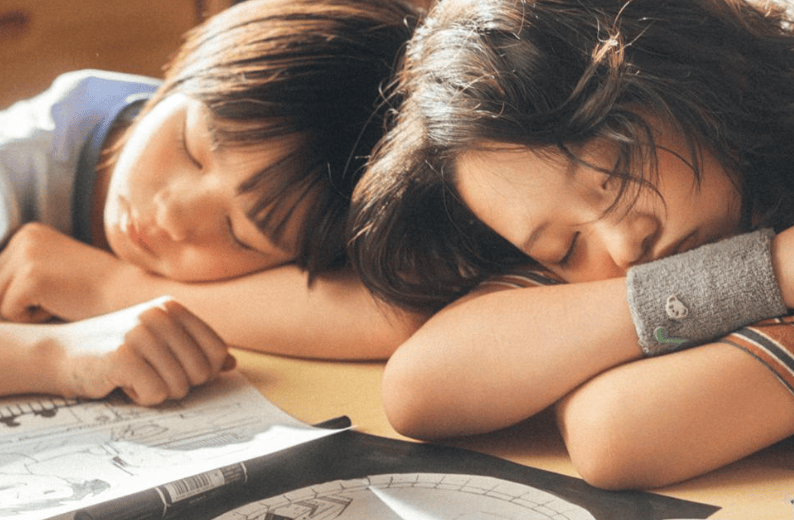

Live action adaptation of Tatsuki Fujimoto’s hit one-shot celebrates the labour of love and sacrifice that goes into art-making against the backdrop of heartbreaking tragedy.
Duration: 100 minutes
Having already received a fantastic anime adaptation back in 2024, the prospect of yet another version of Tatsuki Fujimoto’s hit one-shot manga Look Back might initially seem unnecessary. What more could a live-action adaptation offer a story that had already proved so devastating in its original form? But with acclaimed auteur Hirokazu Kore-eda at the helm, there is good reason to give it a chance. As it turns out, the story is simply that strong, and knowing what is to come does little to diminish its emotional force. Kore-eda’s adaptation is a tender, quietly devastating work that finds new depths in Fujimoto’s story, bringing his own extraordinary sensitivity to childhood, friendship and the passage of time to a tale that feels perfectly suited to his sensibilities.
Kore-eda has always had a particular gift for working with children, and the early passages of Look Back are a wonderful showcase for it. Young Fujino, played by Furi Nanase, takes immense, uncomplicated joy in being admired by her classmates for her four-panel manga strips. She is talented, confident and, above all, delighted to be good at something. There is something recognisably childish about this initial pride, and Kore-eda understands exactly how to capture the moment that innocence begins to curdle into something less pleasant. When her teacher introduces the work of Kyomoto, a shut-in whose drawings are far beyond her own, Fujino’s self-assurance collapses. What follows is an increasingly desperate attempt to close the gap between them, as she abandons her friends and family to devote herself to improving her craft, only to discover that no amount of effort seems enough.

It is a particularly powerful stretch of filmmaking, not least because Kore-eda never needs to overstate Fujino’s anguish. The film simply watches her draw, practise, grow increasingly isolated and eventually give up. The disappointment is not just that she cannot surpass Kyomoto, but that she has sacrificed so much of her childhood in pursuit of a goal that remains frustratingly out of reach. Nanase is terrific, bringing a rawness to Fujino’s internalised jealousy and wounded pride that makes her impossible to dismiss, even when her behaviour becomes increasingly self-destructive. Kore-eda draws the audience so deeply into her inner life that every decision, however misguided, feels emotionally comprehensible.
Then comes the wonderful sequence in which Fujino is tasked with delivering Kyomoto’s graduation certificate. The unexpectedness and awkwardness of Rokka Okada’s Kyomoto is immediately endearing, and their encounter turns Fujino’s world upside down once again. To discover that the girl she has spent so long resenting is, in fact, her biggest fan is a revelation that transforms her entire relationship with drawing.

Watching Fujino skip home in the rain, her creative spark suddenly reignited, is one of those small, almost weightless moments that Kore-eda does so well. The music swells alongside her excitement, giving the scene a rush of exhilaration without diminishing its simplicity. Her happiness is not entirely selfless: there is an undeniable thrill in discovering that someone admires her so completely. Yet there is something wonderfully pure about it, too. For the first time in a long while, drawing feels exciting again.
What follows is the gradual transformation of this initially rather selfish impulse into a genuine, deeply felt friendship. Fujino and Kyomoto become unlikely partners, discovering that their contrasting abilities complement each other perfectly. Where Fujino supplies the stories and characters, Kyomoto brings the backgrounds and atmosphere to life. Together, they create something neither could quite achieve alone. Kore-eda wisely resists the temptation to explain too much through dialogue. Much of their growing closeness is conveyed through quiet scenes of the two drawing side by side, spending time together and developing the rhythms and private language of a friendship. Their chemistry does much of the work, allowing the relationship to emerge naturally rather than announcing itself as something profound.

One particularly lovely detail is Kyomoto teaching Fujino how to listen to the ocean with her hands, a practice she learned from her mother. It is an intimate, almost incidental gesture, but it captures the film’s tenderness towards the little things people pass on to one another. Friendship here is not built solely through grand declarations or shared ambitions. It is formed through habits, discoveries and moments of attention that might seem insignificant to anyone looking in from the outside, but which gradually become the substance of a shared life.
Within this adaptation, Kore-eda adds just enough to Fujimoto’s original manga to flesh out these characters and their world, using small gestures and additional touches of backstory without losing sight of what made the source material so powerful. Look Back isn’t a reinvention so much as a thoughtful act of interpretation, one that understands that fidelity to a story sometimes means finding new ways to inhabit its emotional spaces.

The shift into adolescence and adulthood brings another change in energy, and the casting of Natsuki Deguchi and Aju Makita as the teen counterparts is pitch-perfect. Both actresses convincingly carry forward the personalities established by their younger counterparts while bringing their own nuances to the characters. Makita is especially lovely as the older Kyomoto, conveying a quiet beauty and an enduring awkwardness that never quite disappears, even as she grows more comfortable in the world. Deguchi, meanwhile, brings a wonderful vitality to Fujino, whose confidence and determination make her a natural driving force in their partnership. Their energies complement each other beautifully, and the friendship feels all the more convincing for how effortlessly they inhabit it.
Perhaps the film’s greatest pleasure lies in how lovingly Kore-eda observes the creative process itself. There is a tactile pleasure in watching pencils meet paper, ink spread across a page, whiteout fluid transform a blank space into a cloud, or an experimental technique involving blown ink produce an unexpected pattern. The mistakes and discarded pages are just as important as the finished work. Even when we eventually see the shift towards digital tools, Kore-eda remains interested in the physical actions and decisions involved in making something. Creating manga is laborious, often tedious work, but the girls’ dedication gives that labour an unmistakable tenderness. There is something profoundly moving about watching two people spend so much time trying to make something together, each page a small testament to their shared ambition and affection.

This attention to the act of creation also makes the film’s quieter scenes feel magical. Whether the girls are submitting their work to Shueisha or trudging through the snow to a Lawson convenience store to check the results of their competition, Kore-eda has an extraordinary sense of mise-en-scène, of how to turn an ordinary location into a space charged with feeling. Their little celebration in the convenience store, jumping with barely contained joy, is a delight. So, too, is the sequence in which they emerge from a train tunnel and head into town together. Seen partly from Kyomoto’s perspective, the world outside is overwhelming, but Fujino reaches for her hand and pulls her forward. For a brief moment, the two seem absolutely unstoppable: a perfect duo, stepping into a world that suddenly feels full of possibilities.
The film’s sound design is equally attentive to the emotional rhythms of these moments. The score swells when the girls’ happiness threatens to spill over, whether in Fujino’s jubilant dash home or in the film’s final animated passage. These musical flourishes never feel imposed upon the images; instead, they give expression to feelings that the characters themselves struggle to articulate. The sounds of drawing, too, make the creative process feel immediate and tangible, grounding the film’s more lyrical moments in the patient, repetitive work through which the girls build their shared world.

These are the moments that make the film’s eventual heartbreak so unbearable. Their friendship is never simply an abstract ideal; Kore-eda has made it tangible through all these little experiences, through the time they spend together and the things they make. When Kyomoto decides to pursue an education in art rather than continue their manga career together, Fujino’s hurt is understandable, even if her response is cruel. She lashes out, insisting that Kyomoto will never succeed on her own. It is a particularly painful moment because both sides are understandable: Kyomoto’s desire to discover her own artistic path, and Fujino’s fear of losing the person who has become so integral to her own.
The irony of what follows is completely devastating. Fujino goes on to achieve the success she once dreamed of, with her manga Shark Kick becoming a hit, yet the accomplishment feels hollow without Kyomoto beside her. The film never suggests that her professional success is meaningless in itself. Rather, it reveals the inadequacy of success as a measure of fulfilment. Fujino has achieved her dream, but the person with whom she once shared that dream is no longer there. Deguchi is particularly affecting here, conveying Fujino’s grief with remarkable restraint. Her performance never reaches for melodrama; the smallest changes in expression are enough to reveal the enormity of what she has lost.

What follows is where Look Back truly comes into its own. Returning to confront the memories of their time together, Fujino begins to imagine how their lives might have unfolded differently. These reflections are painful precisely because they offer no easy answers. The possibility of another life becomes inseparable from the recognition of what the life they actually shared meant. Kore-eda understands that grief is not simply about mourning someone who is gone, but about reckoning with all the possibilities, ordinary moments and imagined futures that their absence leaves behind.
The film’s final animated watercolour sequence is its most powerful passage. As Fujino revisits the memories she shared with Kyomoto, those experiences are transformed into something almost ethereal, a visual expression of everything the two girls created and gave to each other. The music rises, and the film’s carefully accumulated emotions finally spill over. It is not simply a montage of happier times designed to provoke tears. It is the culmination of the film’s understanding of what art can do. Drawing cannot undo the past, nor can it restore what has been lost. But it can preserve the meaning of a friendship, allowing Fujino to recognise that their time together was not erased by the way it ended.

More importantly, she begins to understand why she must continue drawing. At the beginning, Fujino draws because she wants to be admired, because she wants to prove herself better than someone else. Later, she draws because she has discovered the joy of creating alongside Kyomoto. Now, she must find a way to carry that friendship forward through her work. Drawing becomes an act of remembrance, a way of honouring the person who changed her life and the dream they pursued together. Kyomoto’s absence does not erase what they accomplished; their art, and the memories bound up in it, continue to exist. Fujino’s return to drawing is not a neat resolution to her grief, but an acknowledgement that what they shared remains worth creating for.
There is something especially fitting about this conclusion for a film so attentive to the process of creation. All along, Fujino and Kyomoto have been turning their time together into art, page by page, panel by panel. Now, Fujino must make something of the memories that remain. She cannot recreate their partnership, but she can honour it. In this sense, Look Back becomes more than a story about artistic ambition or the pursuit of a dream. It is about the people who make those dreams meaningful, and how the things created together can outlast the circumstances that brought people together in the first place.

The title itself takes on a quiet poignancy in this light. To look back is to revisit the past, but also to reconsider it: to recognise the significance of moments whose true value may only become apparent with time. For Fujino, looking back is neither an escape into nostalgia nor an exercise in regret. It is a way of understanding what her friendship with Kyomoto gave her, and why that gift remains meaningful even in her absence. The past cannot be changed, but its meaning can be carried forward.
For all its devastation, Look Back is ultimately a film about the extraordinary value of having shared a life with someone, however briefly. Kore-eda’s gentle, patient filmmaking finds beauty in the changing seasons, the familiar streets, the quiet domestic spaces and the ordinary routines that make up the girls’ world. His attention to the Japanese environments they inhabit, from convenience stores and railway crossings to shrines and the surrounding landscapes, never feels ornamental. These places become inseparable from the memories formed within them. The world is beautiful not because it is untouched by tragedy, but because it is where these two girls were fortunate enough to find each other.
For a story already so affecting in manga and animated form, a live-action adaptation might have seemed superfluous. Instead, Kore-eda finds something uniquely his own in Fujimoto’s work: a sensitivity to the small, fleeting moments through which relationships take shape, and an understanding that the significance of a life cannot be measured by achievement alone. His version of Look Back does not need to replace its predecessors or prove itself the definitive version. It simply offers another way of seeing a story about two artists who changed each other’s lives, and the art that remains when one of them is gone. Sometimes, drawing begins with the desire to be seen. Sometimes, it becomes a way of seeing someone else. And sometimes, looking back is how we learn to carry forward what we have lost.
Look Back played on 24th October 2026 as part of the Singapore International Film Festival. More information available here
The 37th SGIFF runs from 21st October to 1st November 2026. More information and lineup available via their website here

