
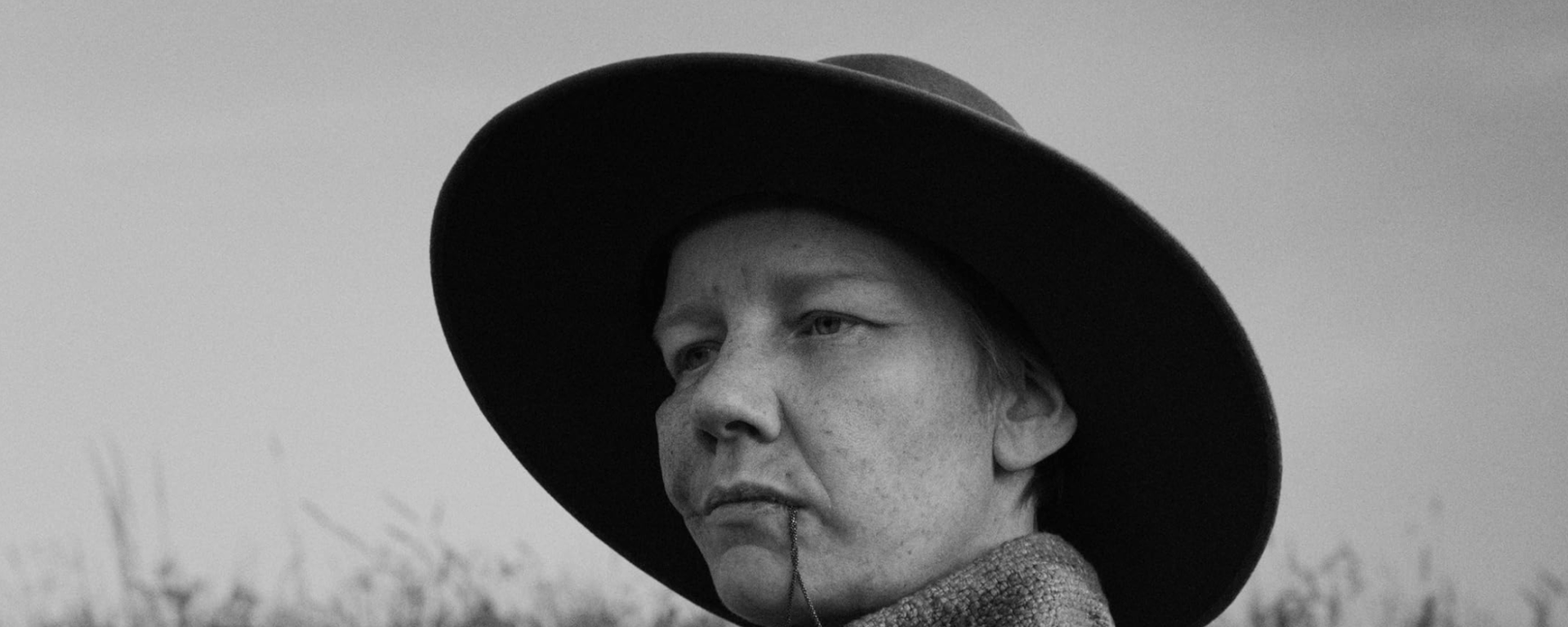

Markus Schleinzer’s stark, folktale-like drama is anchored by a remarkable Sandra Hüller, examining the absurdity of gender norms and the courage it takes to claim a life of one’s own.
Duration: 93 minutes
The first thing that strikes viewers about Rose is its striking black-and-white cinematography. The monochrome palette draws attention to the textures of faces, clothing and the pastoral landscape, giving the film the feeling of an old folktale brought to life. With its detached narration, period costumes and occasional bursts of absurd humour, it feels less like a conventional historical drama than a strange, unsettling legend.
Set in seventeenth-century Germany, the film follows Rose (Sandra Hüller), a former soldier who arrives in a remote village claiming an abandoned farmstead as her inheritance. There is a secret beneath her identity: Rose is a woman who has spent years living as a man, knowing that independence, property and opportunity are far more readily available to those who wear trousers.

Hüller is extraordinary in the role. There is an initial strangeness to watching her inhabit a masculine identity, but as the film progresses, her posture, gestures, voice and carefully chosen clothing make Rose increasingly convincing. The transformation is a testament to Hüller’s remarkable physical performance, but it also makes the film’s point about gender as a social performance. Rose is accepted as a man because she looks and behaves as the village expects one to, until the truth threatens the rules that sustain its order.
Rose works tirelessly to rebuild the farm, earns the villagers’ respect and gradually establishes a prosperous life. The film takes pleasure in showing the details of this world, from its richly textured costumes to the practicalities of farming and beekeeping. Its humour is often wonderfully strange, arising from the gap between what the audience knows and what the villagers believe. Yet this absurdity gradually gives way to something much darker.

Rose’s marriage to Suzanna (Caro Braun), the daughter of a neighbouring landowner, initially appears to offer a way forward. Their relationship develops into something more tender and complicated than its arrangement suggests, and for a brief moment, it seems possible that they might build a life together on their own terms. But the village’s acceptance has always been conditional. When Rose’s secret is exposed, the same community that benefited from her labour turns against her.
The confrontation outside Rose’s farmhouse is among the film’s most powerful scenes. Hüller delivers an impassioned monologue defending everything she has accomplished: she has made the farm prosperous, contributed to the community and helped those around her. Why, then, should the truth of her body invalidate all of it? Her anger is justified, but there is also desperation in the knowledge that no amount of reason will change the minds of people determined to preserve their prejudices. The law requires a man to inherit the land, and Rose’s achievements mean nothing against that rule.

The film’s pastoral beauty becomes increasingly painful as its cruelty unfolds. The surrounding countryside offers an image of freedom and possibility, while the village imposes increasingly brutal restrictions on anyone who falls outside its expectations. Even Rose’s attempt to escape with Suzanna and their child cannot outrun a society determined to punish them. The trial that follows occasionally feels prolonged, but Hüller remains compelling as Rose is stripped of the identity she has painstakingly constructed. The contrast between her earlier masculine bearing and her later vulnerability is remarkable, without diminishing her conviction in what she has done.
What makes Rose so affecting is that, despite its grim trajectory, it is strangely uplifting. Rose is no uncomplicated revolutionary. Her ambition can be selfish, and her choices have consequences for Suzanna, whose own freedom becomes entangled with Rose’s. Yet the desire to do more than merely survive is hardly unreasonable. Rose wants to work, own land, love and determine the course of her own life. The tragedy is that the society around her cannot accept this without first demanding that she conform.

In its final moments, Rose offers no easy salvation. Instead, it leaves behind the image of someone who has refused to surrender the belief that her life belongs to her. Its story is a reminder of how arbitrary social rules can become when they are mistaken for moral truths, and how readily a community can turn against someone whose existence challenges them. Rose may not succeed in escaping the world that condemns her, but the film never suggests that her desire for freedom was misguided. Sometimes, simply insisting on the right to live differently is an act of resistance.
Rose plays on 25th and 28th October 2026 as part of the Singapore International Film Festival. More information available here
The 37th SGIFF runs from 21st October to 1st November 2026. More information and lineup available via their website here

