

There is jam and butter beside the loaf of bread. Not a metaphorical pat of butter, not a painted image of butter, but quite literally, butter, set out with a butter knife beside a lampshade made from a loaf. It is a funny little arrangement, almost absurdly literal. It is also a rather good introduction to No Straight Lines, an exhibition that understands how much can be said about intimacy by paying attention to the things through which we live it.

The bread lampshade is Alvin Ong’s Beatitudes (2026), made using a Pampshade, the Japanese bread lamp product. At first glance, the object invites a laugh: bread, transformed into a lampshade, accompanied by the implements of its consumption. But the longer one looks, the less straightforwardly comic it becomes. What initially resembles mould begins, on closer inspection, to reveal scenes of quiet intimacy. Something that looks as though it belongs to the slow business of decay becomes a place where private moments are impressed into the domestic. The work is funny, certainly, but it is also tender and a little uncanny. It asks what intimacy looks like once it has settled into the ordinary surroundings of a home, and what happens when those surroundings become the place where we encounter art.
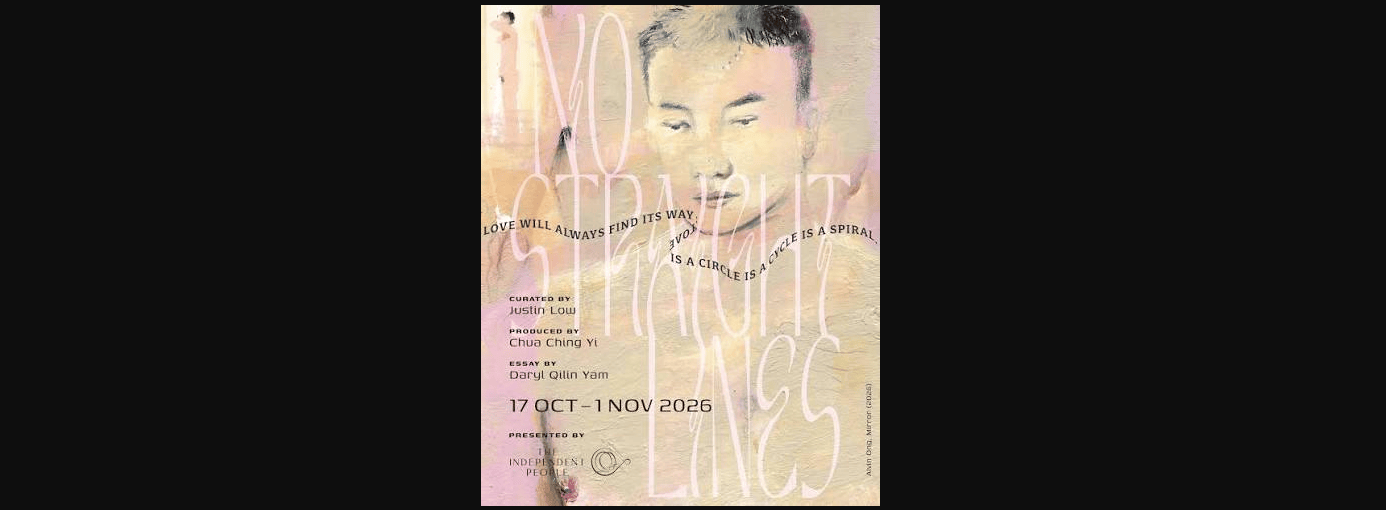
That question feels especially apt here, because No Straight Lines is itself housed in a home. Curated by Justin Low and produced by Chua Ching Yi, with an accompanying essay by Daryl Qilin Yam, the exhibition runs from 17 October to 1 November 2026 at 26 Paterson Road. It is the second time Low has opened his home for an exhibition. There is no attempt to disguise the domestic setting as a conventional gallery. Instead, the apartment is temporarily converted into one, with all the interesting tensions that such a transformation entails.

You walk past the kitchen, pass through some curtains, and enter the living room. The transition is modest, but it matters. You do not arrive at a white cube with its familiar invitation to leave the everyday behind. You enter a room that already belongs to somebody, painted bright yellow. And almost immediately, you meet Armin Mayer’s Jockstraps with Orchids series.
These ceramic works are the exhibition’s centrepiece and immediately, its highlight. They catch you the moment you step inside: striking enough to command attention, but compelling for reasons more complicated than spectacle. Grouped together, they have the feeling of a gathering. The juxtaposition of jockstraps and orchids brings kink, sensuality and intimacy into the same visual conversation. There is something deliberately provocative about the combination, but also something unexpectedly comforting. The works can feel turned on and comforted at the same time; their erotic charge does not cancel out their tenderness.

That combination establishes the emotional register of the exhibition. Queerness here is not presented as a single mood, nor does it have to choose between the erotic and the affectionate, the playful and the serious. Desire can be explicit without being stripped of feeling. Tenderness can coexist with kink. Even the orchids complicate the apparent provocation, bringing another register of delicacy to the encounter.
The works are also practical objects in a way that seems entirely in keeping with the exhibition’s interest in the domestic: most have been sold, and they can literally be hung as planters. This is more than a charming bit of information about their possible afterlife. It brings the work back into the world of use, care and habitation. The objects are not necessarily destined to remain at a distance, encountered only on a gallery wall or pedestal. They might be taken home, hung up and lived with. Their eroticism does not make them incompatible with domestic life; it becomes one more thing that domestic life can hold.

And so the exhibition begins, not so much with a thesis, but with a feeling: the sense that a home might be able to accommodate forms of desire and intimacy that are too often kept out of sight, or permitted only under certain conditions. The works are not all doing the same thing, and the show is not reducible to a single statement about queer identity. But there is a shared insistence that queer life deserves to be seen in its variety, including its pleasures, awkwardnesses, softness and contradictions.
The room itself takes time to reveal. It is a small, rectangular living room, with a high window bearing the exhibition title. The walls have been painted yellow especially for the show. Beyond the room, Orchard stretches into view. There is no theatrical lighting isolating each artwork or instructing you where to look. The works sit within the ordinary light and proportions of the space. The effect is not careless; a great deal of effort has clearly gone into making the exhibition possible. Rather, the installation avoids the kind of polish that might make the apartment forget what it is.

Justin’s own personal photographs remain on display. There are thematic arrangements among the works, including the presence of a book about buttocks. These details matter because they keep the home visible beneath the exhibition. The room has not been emptied of its life to make way for art. Nor has it been staged so completely that it becomes a theatrical set of domesticity. Instead, the visitor encounters a space in which the personal and the curated overlap, and where the distinction between them is never entirely settled.
This is one of the pleasures of seeing art in a private home: the viewer is made conscious of the conditions of looking. In a gallery, one can sometimes move quickly from work to work, allowing the institutional setting to do some of the work of separating art from the world. Here, the works are surrounded by traces of a life beyond the exhibition. You look, turn, return to something you have already seen, notice another work from a different angle. The smallness of the room does not make the visit feel hurried. If anything, it encourages a more sustained kind of attention. There is enough to look at, and enough to make you curious about how one work might speak to another, that you find yourself spending longer in the space than its dimensions might suggest.

Tin Nguyen’s paintings are among the works that reward this slower looking. on no longer a rehearsal (2025) and on quiet summer afternoons like these you asleep as the trees hum (2026) have an impressionistic softness, a quality that feels close to waking up beside a lover and seeing them before they have composed themselves for the day. The paintings seem to hold the fragile interval between sleep and waking, when a person is simply there, not yet performing a self for anyone else.
One is particularly drawn to on quiet summer afternoons like these you asleep as the trees hum. There is something affecting about the way the work holds a private moment without needing to turn it into a grand declaration. Its title gives the scene a gentle, almost suspended rhythm; the painting feels less like an announcement than a memory one is still trying to remain inside. In the context of this exhibition, that softness is not incidental. A body at rest, a lover beside you, the feeling of being allowed to exist in an unguarded state: these are intimate experiences, but they are also ways of being alive that deserve space and attention.
The paintings also suggest how easily intimacy can be disturbed. Rest is never entirely separate from the world beyond the room; the private moment is held within time, memory and the knowledge that it will pass. Yet Nguyen’s work does not need to make a spectacle of that vulnerability. Its quietness is precisely what allows it to breathe. In a show that includes explicit erotic imagery, this softness offers another kind of intensity. The body does not have to be exposed to be revealing.

Lucas Tan’s Expired Photo series brings the body into view in a much more confrontational register. These paintings are explicit: genitalia are displayed without coyness, and kink appears in images that include dog-like tails emerging from exposed buttocks. There is no point pretending otherwise, or softening the work into a vague account of intimacy. The sexuality is direct, and the images can feel deliberately challenging.
Yet there is also something freeing about encountering them. Their explicitness does not merely offer a spectacle for the viewer; it unsettles the expectations that govern what kinds of bodies and desires are allowed to appear in public. The works are erotic, but they are also confrontational. They make it difficult to maintain the comfortable distance through which queer sexuality is sometimes made acceptable: acknowledged in the abstract, perhaps, but kept discreet, implied or safely out of view.

Placed within a home rather than a conventional gallery, this directness takes on an additional charge. The works do not arrive in a separate world marked off from ordinary life. They are here, in a room that remains recognisably someone’s living room. The encounter asks the viewer to consider what it means for explicit queer imagery to occupy a shared space, and whether the discomfort it produces belongs to the work itself or to the expectations we bring to it. The answer need not be settled. The friction is part of the experience.
The movement between Tan’s explicitness and Nguyen’s tenderness is one of the exhibition’s strengths. Neither is presented as the more legitimate form of queer intimacy. One insists on visibility; the other attends to a moment that might otherwise pass unnoticed. One confronts the viewer; the other draws the viewer into a softness that can be difficult to describe without diminishing it. Together, they resist the idea that queer art must choose between being provocative and being gentle.

Jihoon Cha’s Mokyoktang series introduces a different kind of looking. The works depict figures associated with the Korean public bathhouse, a place where bodies are visible and people are conscious of one another even when they may not be directly interacting. Cha’s treatment feels pop-art-like, pared back and minimal rather than strictly realistic. Yet the faces and eyes are expressive. That combination is striking: the figures may be simplified, but their expressions retain a sense of inner life.
The bathhouse is a particularly suggestive setting for an exhibition concerned with bodies and the social conditions under which they are seen. It is a place of physical exposure, but exposure does not necessarily lead to intimacy. People can be close together while remaining emotionally separate; looking can become an act of awareness, caution or self-consciousness. Cha’s expressive faces and eyes seem to hold that tension. The body is present, but the person is not entirely available to the gaze.
In a room full of work concerned with queer visibility, this distinction matters. To be seen is not always the same as to be understood, and being visible can itself produce a complicated kind of self-awareness. Cha’s works bring a quieter uncertainty to the exhibition: the possibility that the gaze can connect people, but can also keep them at a distance.

Eko Bintang’s Self-Conquest, Happy Trail and Fantasizing offer another register of vulnerability. The figures have something of the storybook about them. They can seem squeezed into the frame, as though the borders of the image are not merely edges around a scene but the limits of a small world in which the figures are trying to live. The effect is dreamy, yet the figures feel realistic enough to elicit sympathy. Their vulnerability does not make them abstract or remote; it gives them a recognisable emotional presence.
There is something touching about figures who seem to inhabit the frame so completely. They are not simply placed within an image for us to inspect. They seem to be living there, subject to the constraints of their own little world. The storybook quality invites imaginative projection, while the feeling of compression makes that world seem fragile. The works hold a tension between fantasy and feeling: the figures may inhabit dreamlike situations, but their vulnerability feels real.

That, too, seems of a piece with No Straight Lines. The exhibition does not offer a single, uncomplicated picture of queer life. It makes room for bodies that are explicit, bodies that are resting, bodies under observation, and figures whose emotional worlds seem to press against the edges of their frames. The differences between these works are important. Their shared ground is not a uniform style or a common message, but a willingness to take queer experience seriously in its many forms.
Richie Nath’s Heads or Tails and 1930 Rangoon bring the exhibition’s questions of sexuality and power into a historical and political register. Daryl Qilin Yam’s essay draws attention to Nath’s interest in mythology and to the way sexual positions can carry assumptions about who holds power. In discussing 1930 Rangoon, Nath asks whether depicting a colonial officer as sexually passive changes the balance of power, and whether that story changes when the other figure is of South Asian descent. These questions complicate any easy equation between sexual role and political authority. A reversal within an erotic encounter does not necessarily reverse the structures that surround it.

A political argument cannot be exhausted by a glance at the paintings, and neither can every layer of their meaning be immediately legible. Yam’s essay is useful here precisely because it opens the works onto questions that exceed their surfaces. The relationship between eroticism and power is not simply a matter of who appears dominant in an image. It also concerns the histories that determine whose bodies are represented, whose desires are legible, and what kinds of power persist even when the expected roles seem to have been reversed.
Across the exhibition, the works resist the idea that queerness is one thing. It can be a source of pleasure and a condition of exposure; it can be tender, absurd, erotic, vulnerable or politically charged. It can inhabit the bedroom and the bathhouse, the storybook and the historical imagination. The title No Straight Lines suggests a refusal of neat routes and fixed categories, and the exhibition’s variety gives that refusal substance. Its works do not all arrive at the same conclusion. They create a set of encounters in which the viewer must keep adjusting how they look.
Yam’s accompanying essay takes a similarly oblique route. Rather than presenting a continuous argument that moves neatly from premise to conclusion, it is arranged as thirteen inscriptions, fragments, responses and asides, each associated with one of the thirteen artists. It braids together quotations and citations, imagined conversations and screenshots, visual analysis and personal reflection. The result is less a single interpretive key than a constellation of texts: a structure that can help orient the visitor while also leading them elsewhere.

This form suits the exhibition. A straight line from one artwork to one definitive meaning would be too restrictive for a show so interested in the complications of looking and living. Yam’s fragments allow different histories, voices and associations to enter the room. They make the essay feel like an active encounter with the works rather than a set of instructions for how to understand them. At its best, the writing extends the exhibition’s invitation to look again, to make connections and to remain with uncertainty rather than rush towards resolution.
The essay is also a reminder that queer life is lived amid inherited stories and public language, not outside them. The works may be intimate, but intimacy is never entirely private in its implications. What can be shown, what must be hidden, who is permitted to be ordinary, and which relationships are treated as legitimate are all shaped by the world beyond the home. The exhibition’s domestic setting does not remove those pressures. Instead, it offers a temporary space in which they can be examined from another angle.

The fact that the exhibition includes talks as well as artworks feels significant. No Straight Lines is not only an arrangement of objects for visitors to view; it is also an occasion for artists and audiences to gather. During our visit, we found ourselvess looking not only at the works but also at the other people in the room. The visitors seemed to include queer people and people who were there in support of them. There was a sense of being among others who understood why this kind of space matters.
That feeling is difficult to manufacture through programming alone. It comes partly from the works themselves, partly from the setting, and partly from the way people occupy the room together. The apartment is small, but the visit does not feel slight. You take your time, look again, notice the details, and become aware of other viewers doing the same. For a while, the room becomes a place where queer art can be encountered without having to justify its presence, and where queer people and their supporters can simply coexist around it.

This is where Justin Low’s decision to open his home feels most consequential. The exhibition does not need to transform the apartment into a grand institution to make it meaningful. Its resourcefulness is part of its character. The yellow walls, the high window marked with the show’s title, the personal photographs that remain in place, the thematic arrangements and the ordinary light all contribute to a space that is recognisably domestic yet temporarily changed by what it contains. Chua Ching Yi’s production work makes this temporary conversion possible, while Yam’s essay gives the exhibition another layer of conversation.
There is real labour and care behind such a project. Opening a home to an exhibition means allowing a private space to become public, even if only for a limited period. It means making room for other people’s attention, and for the unpredictable ways that artworks will be encountered together. Low has done this before, and doing it again suggests more than a willingness to host. It suggests a belief that a home, a collection and a gathering of artists can create the conditions for a serious exhibition without needing to imitate the conventions of a dedicated gallery.

The bread lampshade returns to mind here. Its first impression is funny; its second is stranger and more affecting. The apparent mould gives way to scenes of intimacy, and the everyday object becomes a surface on which private life has been impressed. It is an apt image for the exhibition as a whole. Something that might seem ordinary or even slightly absurd opens, if we look closely enough, onto a more complicated account of how people live, desire, remember and care for one another.
No Straight Lines does not make the home disappear behind the art, nor does it turn queerness into a neat statement that can be taken away and filed. Instead, it makes a small room hold a surprising amount: explicit sexuality and quiet affection, vulnerability and pleasure, the private and the public, the personal and the political. It allows these things to sit beside one another without pretending their differences have been resolved.

You enter past the kitchen, through the curtains, and find yourself inside. You stay longer than you might expect. You look at the works from different angles, notice the details, and notice the other people looking with you. Outside, Orchard continues on as usual. Inside, for the duration of the exhibition, a living room has become a place to see queer art and to be among others seeing it.
The room is temporary, and so is the exhibition. But the invitation it offers is not insignificant: to let queer life occupy space, to allow its many forms of intimacy to be seen, and to recognise that a space can become public without ceasing to feel personal. Sometimes, making room is itself a curatorial act. Sometimes, the most meaningful gallery is the one that lets you feel, however briefly, that you are welcome to stay.
No Straight Lines runs till 1st November 2026 at 26 Patterson Road. Registration required here

