
From a field of repeated hearts and light to paintings exploring memory, social identity and the interconnectedness of life, this year’s UOB Painting of the Year winners reveal how Southeast Asian artists are expanding the possibilities of painting.
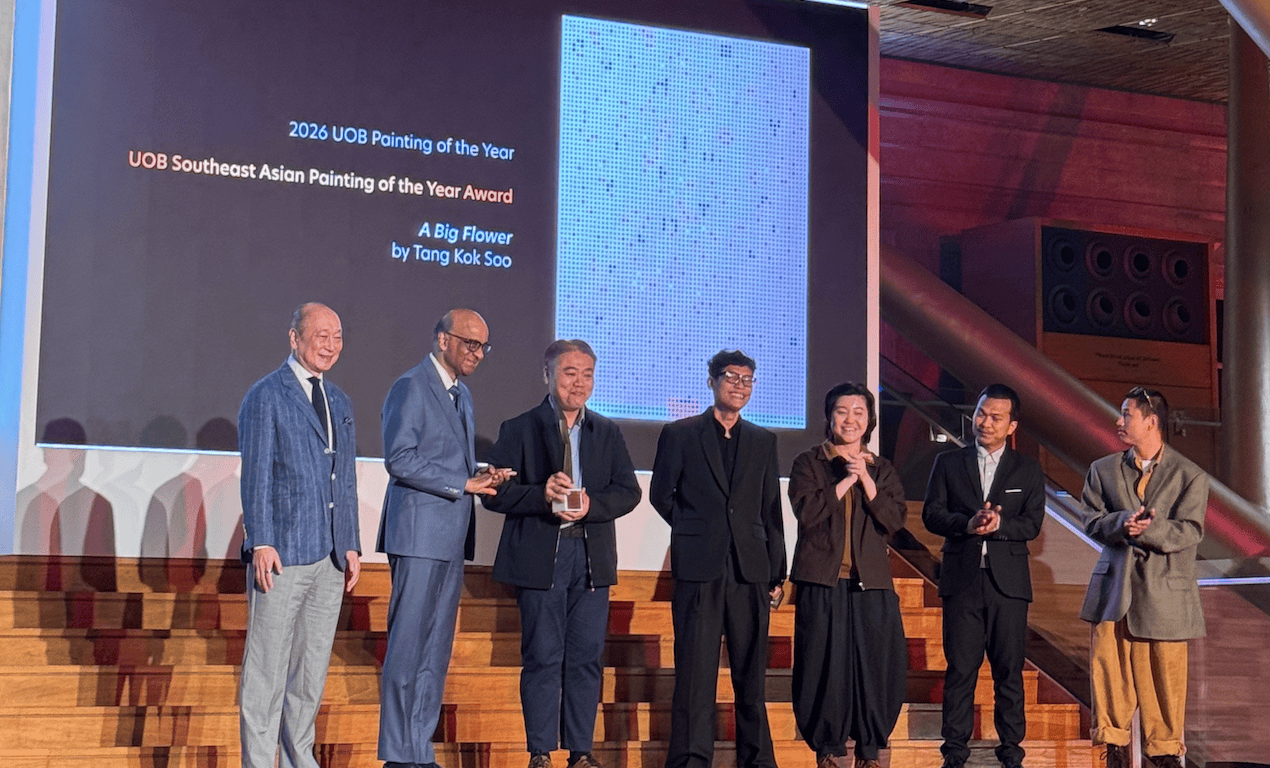
A flower composed of countless tiny pink ‘hearts;, each radiating its own halo of light, has earned Singapore artist Tang Kok Soo both the 2026 UOB Southeast Asian Painting of the Year award and the UOB Painting of the Year (Singapore) title, bringing the competition’s top honour back to Singapore.
At first glance, A Big Flower appears to be an exercise in geometric repetition: a pink, flower-like form built from an intricate arrangement of dots, circles and grids. Yet beneath its seemingly simple composition lies a philosophy that Tang, 51, has spent 12 years developing, drawing together ideas about consciousness, meditation, love and the relationship between order and freedom. The winning work, executed in mixed media on paper using graphite ink and collage, is less concerned with depicting a flower in the conventional sense than with using its emerging form to express something intangible.
“The painting itself took me about half a month,” Tang explained in an interview following the awards ceremony. “But the philosophy behind it came from 12 years of accumulation, transformation, exploration and discovery.” His words capture a distinction central to understanding the work: while its physical execution was relatively brief, its underlying ideas are the product of a much longer artistic journey.
The artist, who previously won the Gold Award in the Established Artist Category at the 2016 UOB Painting of the Year (Singapore) competition for Elephants Crossing the Water, admitted that he was surprised to win both the national and regional titles this year. He suspected that some viewers might regard the new work as too simple, overlooking the ideas that had shaped it. “What I’m selling is the philosophy behind it,” he said, describing the years spent experimenting, observing and refining his approach before arriving at the final composition.

For Tang, the grid is more than a convenient structure for organising shapes. Inspired in part by the American minimalist painter Agnes Martin, his exploration of grids and repetitive mark-making has become a meditative practice, one in which sustained attention to a single point generates a sense of clarity. “When your mind is fixed in one place, your mind is very clear,” he said. The repeated forms in A Big Flower reflect this discipline, with each mark occupying a place within a larger pattern without losing its individual character.
The relationship between centre and deviation is equally important. Tang explained that the mind may wander away from its focus, but that movement does not necessarily mean it has become disconnected from the whole. In the same way, the individual forms in his painting can move away from a central point while remaining within the underlying structure. The idea is one of coexistence rather than opposition: stillness allows movement, just as structure makes room for freedom. The work’s philosophical foundation draws on the idea, associated with the Dao De Jing, that the greatest forms transcend fixed definition.
The flower itself emerged gradually rather than from a predetermined plan. “When I start creating a painting, I don’t know what I’m going to do. There is no plan, no desire,” Tang said, describing a process that unfolds through concentration and experimentation. Only after the composition had developed did he realise that it resembled a flower. He subsequently made adjustments to give the image a more recognisable form, explaining that an entirely abstract arrangement might be difficult for viewers to approach. The flower therefore became a way of reaching out to an audience without abandoning the ideas that underpin the work.

Even the materials reflect this experimental approach. Tang initially considered making metal discs to give the work a more pronounced three-dimensional quality, but tried stickers before proceeding with that idea. He was pleased with the effect and decided to retain them. The finished painting’s countless circles, which Tang associates with light radiating from the human heart, reinforce the work’s central message of love, purity and interconnectedness. “The heart of a person will shine,” he said, explaining how the circles become expressions of light and how the pink forms suggest innocence and purity. “So love radiates infinite light. This painting is to express that.”
His surprise at the win was partly rooted in the difference between what the viewer sees and what the artist brings to the work. Before creating A Big Flower, Tang had made an earlier painting using the same philosophy and hung it in his bedroom, looking at it over the course of a year. Its continued ability to hold his attention convinced him that the approach was worth pursuing further. The new work represents another stage in that inquiry, bringing years of accumulated thought into a composition that is at once visually accessible and conceptually layered.

Tang’s victory raises a broader question about what painting can be today. Although A Big Flower uses a visual language of repeated dots and could be loosely compared with pointillism, its purpose differs from the historical technique’s emphasis on the optical effects created by individual marks of colour. Tang’s repetitions function as both image and idea: each point contributes to a larger field of light, while the repeated process of making becomes an expression of meditation, attention and spiritual inquiry. It is a contemporary, concept-driven approach in which the philosophy behind the image is inseparable from the way the image is constructed.
This willingness to move beyond conventional representation can be seen across several of this year’s winning works. Some artists use familiar materials in unexpected ways; others revisit historical images, make the invisible visible or turn everyday objects into records of human experience. Painting is no longer necessarily about reproducing a scene or depicting a recognisable subject. It can become a means of examining the relationships between people, nature, memory and society, with materials and techniques chosen to reinforce the ideas being explored.
The competition itself accommodates a range of approaches, accepting media including ink, collage and mixed media alongside oil, acrylic and watercolour. The 2026 selection demonstrates how broadly artists can interpret the possibilities of painting while retaining the medium’s capacity to communicate through visual form. In Tang’s case, a grid of repeated shapes becomes an expression of love and consciousness; elsewhere, a painting can function as a personal archive, a social critique or an investigation into the boundaries of the human body.

For Wong Yik Knee, this year’s Most Promising Artist of the Year (Singapore) in the Emerging Artist Category, the starting point was much more modest: a corner of her studio where containers are used to wash paintbrushes. Her oil painting, Echoes of Belongings, brings together worn containers bearing individual names, transforming ordinary studio objects into quiet records of the people and relationships associated with them.
Wong said the idea grew from her observation of the containers in the studio and the personal significance they had acquired over time. She invited friends to write their names on some of them, turning everyday tools into objects that carried a connection to particular people. “Each container actually carries a memory. Each name on the container tells their story,” she explained. The differences in their sizes, surfaces and accumulated marks give each object its own identity, while their arrangement creates a sense of community.
“All together, it connects to our community,” she said. The work’s meaning extends beyond the physical objects themselves: the names point to individual lives, while the collection suggests a network of shared experiences. Wong also draws attention to the shadows and impressions left by containers that are no longer physically present. Their absence becomes part of the composition, suggesting that things can continue to occupy our memories even after they have disappeared.

The title captures this relationship between physical possessions and emotional attachment. “Belongings” refers both to the objects themselves and to the human desire for a sense of place, identity and connection; “echoes” evokes the traces of relationships and experiences that remain long after a particular moment has passed. In this sense, the containers become more than a record of a studio. They stand for the stories that accumulate around ordinary objects and the ways those stories connect individuals to a wider community.
For Wong, receiving the award is an encouragement to continue looking more closely at the world around her. “Beauty is everywhere. It’s everywhere around us,” she said. The observation offers a fitting counterpoint to Tang’s more abstract philosophy. Where A Big Flower turns repetition into a meditation on universal ideas, Echoes of Belongings discovers meaning in familiar things that might otherwise go unnoticed. Both artists begin with close observation, but their works invite viewers to look beyond the immediate image and consider what it might contain.

Other Singapore winners extend the exploration of memory and belonging into more explicitly social territory. Ezekiel Wong’s 108 Sheep and Counting, which received the Gold Award in the Established Artist Category, reimagines Chua Mia Tee’s 1955 painting Epic Poem of Malaya. Retaining a recognisable compositional framework while transforming its meaning, Wong replaces the original orator with an open pasture and a CCTV camera, while the remaining figures are ageing veterans of street brotherhoods who now occupy the margins of Singapore’s modern narrative.
The title combines the number 108, a reference to a secret-society brotherhood, with the image of sheep as a symbol of the herd. Executed in charcoal on linen at the scale associated with history painting, the work questions who gets remembered, who is forgotten and how people who once occupied a visible place in society can find themselves excluded from its dominant narratives. By revisiting an established work of art, Wong does more than pay homage to an earlier image: he uses it to interrogate the stories through which a society understands itself.
This concern with the traces people leave behind connects 108 Sheep and Counting with Echoes of Belongings, although the works approach it from different directions. Wong Yik Knee locates history in the names, marks and associations attached to everyday objects, while Ezekiel Wong examines the ways entire communities can be included in or excluded from collective memory. Both suggest that the past is not simply something that has ended. It remains active in the objects, identities and people that persist into the present, even when their significance is overlooked.

Nature also emerges as a recurring subject, but the winning works rarely treat it as merely a picturesque scene. Tan Chin Boon’s A Pond of Freedom, awarded the Silver Award in the Established Artist Category, uses Chinese ink on rice paper to depict a lotus pond as a living ecosystem. Plants appear at different stages of growth, while fish, insects, grasses and birds share the same space. A hidden tadpole hints at life beyond the viewer’s immediate field of vision, reinforcing the sense that the pond contains more than can be seen at first glance.
The work reflects Tan’s practice, which spans more than five decades and is rooted in Chinese ink painting and seal carving. Through delicate lines and restrained observation, he captures the rhythms of growth, decline and renewal, presenting the pond as a place of coexistence and quiet abundance. Its approach contrasts with Tang’s geometric abstraction: where A Big Flower uses repeated forms to express a philosophical principle, A Pond of Freedom draws meaning from the careful observation of nature. Yet both works arrive at a similar understanding of the world as a whole made up of interconnected parts.

Koh Kai Ting’s Our Unresolved Plurality, which received the Bronze Award in the Established Artist Category, pushes this idea further through an experimental use of materials. Painted on translucent polyester mesh stretched across branching oval frames, the work evokes microbial colonies, organs and embryonic ecosystems. Inspired by the idea of the body as an ecosystem, it challenges the notion of the human being as a singular, self-contained entity, instead presenting the body as something shaped by relationships with microorganisms, animals and the surrounding environment.
The choice of translucent mesh is integral to the work. Its surfaces blur distinctions between inside and outside, self and other, while the branching structures suggest a web of dependencies without a single fixed centre. The painting consequently occupies a space between image and object, challenging the expectation that a painting must be a flat, opaque surface. Here, the medium is not merely a support for the idea; it becomes part of the argument.
Together, these works suggest a compelling thread running through this year’s selection: the individual is repeatedly understood as part of something larger. Whether expressed through a lotus pond, the human microbiome or a field of radiating hearts, interconnectedness becomes both a subject and a way of seeing. The works also demonstrate how artists can use different materials and visual languages to explore similar questions without arriving at identical answers.

Other artists turn inward, examining the emotional experiences through which people make sense of their lives. Ong Paik Sim’s Recesses, which won the Gold Award in the Emerging Artist Category, reflects on a beloved parent’s changing state of mind and the fragile persistence of memory. The mixed-media painting holds on to the hope that stories, memories and moments of recognition may remain within the mind even when clarity becomes difficult to sustain.
Its central concern is the possibility of connection: those brief moments when a meaningful conversation becomes possible again, bringing comfort and familiarity to a relationship altered by time. Rather than presenting memory as something either present or lost, the work dwells in the uncertainty between the two. It is a meditation on love, patience and resilience, acknowledging the difficulty of change while refusing to abandon the possibility that what appears lost may still endure.

Camille Eugenie Mabasa Cheng’s Obsolete?, which received the Silver Award in the Emerging Artist Category, considers another question of human value: what remains of achievement when conventional markers of success no longer seem sufficient? The oil painting depicts figures associated with professions and forms of public recognition, partially concealed beneath translucent fabric. At the centre, a young girl searches through a box amid disorder and uncertainty, embodying the difficult journey towards finding purpose and defining one’s place in the world.
The work questions a society that often measures worth through productivity, prestige and recognition. The fabric obscures the figures without completely erasing them, suggesting that the traces of a life can endure even when public attention fades. Nur Iman Bin Sumani’s We Can Like Two Different Things, which received the Bronze Award in the Emerging Artist Category, approaches identity through the coexistence of cultural influences. Drawing on street art and graffiti alongside deeper cultural, religious and personal foundations, the work suggests that new influences need not erase what came before. Identity, in this reading, is not a choice between opposing influences but a space where different perspectives can exist together.

Although these works differ in subject and technique, they share an interest in the complexities of being human. They resist easy conclusions, treating memory, identity and belonging as things that evolve through experience and relationships. Their significance lies not only in what they depict, but also in the questions they leave open for viewers to consider.
Tang’s double win was announced at the 2026 UOB Painting of the Year Awards Ceremony and Exhibition at National Gallery Singapore on 28 October, with President Tharman Shanmugaratnam attending as guest of honour. The ceremony brought together winning artists from Singapore, Indonesia, Malaysia, Thailand and Vietnam, reflecting the competition’s role as a platform for artistic exchange across the region.

In the Established Artist Category, the other country winners were Begok Oner from Indonesia for Urban Realism Layers, Lim Tong Xin from Malaysia for She Waited, Weerapong Sansomporn from Thailand for Memories from the Forest, and Le The Lam from Vietnam for Life, Death and Neon. Their works bring further perspectives to the regional selection. Lim’s She Waited, for instance, explores the fragility of the body and the enduring presence of love through a portrayal of her grandmother’s final year of life. Weerapong’s Memories from the Forest, made from woven copper wire on black velvet, reflects on the traces that remain in memory as landscapes change and the physical world shifts.
In the Emerging Artist Category, the Most Promising Artist of the Year winners were Wong Yik Knee of Singapore for Echoes of Belongings, Alif Lamra of Indonesia for Liminal Fragment 03, Harpreet Kaur of Malaysia for Matriarch, Watcharaphong Seethiang of Thailand for Life Is Impermanent, but Death Is Certain, and Nguyen Ba Dat of Vietnam for Ahead – “Slow Down”.

Tang will compete with the other four Established Artist Category country winners for a UOB-sponsored overseas art residency at Cité Internationale des Arts in Paris, offering an opportunity to develop his practice and engage with an international artistic community. For an artist whose winning work emerged from more than a decade of philosophical exploration, the residency represents a further stage in a process that is unlikely to end with a single award.
Now in its 45th year, the UOB Painting of the Year competition has uncovered more than 1,000 artists across Southeast Asia since its establishment in Singapore in 1982. It subsequently expanded to Indonesia, Malaysia and Thailand before adding Vietnam in 2023. Among its alumni are Singapore Cultural Medallion recipients Goh Beng Kwan, the 1982 winner; the late Anthony Poon, the 1983 winner; and the late Chua Ek Kay, the 1991 winner. Their achievements underscore how recognition through a competition can form part of a longer artistic journey.

Speaking at the ceremony, Dr Vichaya Mukdamanee, the Singapore competition’s chief judge and a leading Thai artist and curator, reflected on the importance of the competition as a platform connecting artists across a diverse region. Drawing on his experience as an artist, academic and arts administrator, he noted the breadth of approaches represented in this year’s submissions, from works exploring history and memory to those responding to contemporary society. His assessment emphasised the importance of originality, conceptual depth and a distinctive artistic identity alongside technical accomplishment.
Dr Mukdamanee also offered a reminder that the outcome of a competition can represent only one moment in an artist’s development. The judging process requires decisions to be made about the works presented, but an artist’s practice and potential extend beyond any single award. That perspective is particularly relevant to this year’s selection, in which many artists use painting to investigate complex questions that do not have straightforward answers. Recognition can provide encouragement and visibility, but the larger challenge is to continue developing a practice, refining ideas and finding ways for art to connect with society.

The competition’s wider role in nurturing artists was also a central theme of remarks by Wee Ee Cheong, UOB’s deputy chairman and chief executive officer. Reflecting on its 45-year history, Wee highlighted how the competition has supported more than 1,000 artists across Southeast Asia, many of whom have gone on to establish significant careers and contribute to the wider arts community.
“Supporting the arts goes beyond recognising artistic excellence. It is also about creating opportunities for artists to grow and realise their potential,” Wee said in the press release accompanying the awards. He added that many UOB Painting of the Year artists had gone on to make meaningful contributions to the arts and the wider community through their work.
The distinction between recognition and long-term support is important. Winning an award can bring an artist to a wider audience, but sustaining a practice also requires opportunities to exhibit, exchange ideas, develop professional skills and reach new communities. In his remarks, Wee emphasised that UOB’s continuing commitment is intended to help artists grow and strengthen cultural connections across ASEAN, rather than stopping at the moment of recognition.
The bank has also sought to bring art into more public settings through exhibitions, community initiatives and its collection of more than 3,000 works by established and emerging artists from Southeast Asia, Hong Kong and mainland China. Its initiatives include programmes that connect artists with residents and students, alongside exhibitions and workshops designed to make art accessible to people who might not otherwise encounter it.

The National Arts Council shares this emphasis on broadening participation. NAC chief executive Elaine Ng said the renewed partnership builds on a common belief in the ability of art to connect people and enrich lives. “We are excited to build on our partnership to help more Singapore artists to grow, showcase their works, and connect with audiences across the region,” she said, adding that she hoped the collaboration would encourage more businesses to support artists and contribute to a vibrant arts scene.
The two organisations have renewed their partnership through a three-year memorandum of understanding aimed at strengthening Singapore’s position as a regional arts hub and supporting artistic development across Southeast Asia. Under the agreement, UOB will contribute S$5 million to NAC’s Sustain the Arts (stART) Fund, which supports the continued development of Singapore’s arts ecosystem. The partnership will create opportunities for artists and curators through professional exchanges, residencies, exhibitions and collaborations, while also using Singapore Art Week as a platform to showcase Southeast Asian art and UOB’s collection.
The agreement builds on an earlier memorandum signed in 2022, which focused on developing the financial and business competencies of Singapore’s arts community. UOB also received NAC’s Distinguished Patron of the Arts Award for the 24th time in 2026, recognising its longstanding contribution to the development of the arts in Singapore.

The range of works recognised this year suggests that painting remains a medium capable of adapting to the questions artists want to ask. A painting may be made from ink and careful observation, charcoal and historical references, translucent mesh and experimental structures, or stickers arranged in a grid. What connects these approaches is not a single style or technique, but the determination to find a visual language for experiences that might otherwise be difficult to articulate.
In A Big Flower, Tang Kok Soo turns repetition into a meditation on consciousness, love and the relationship between a single point and the larger whole. Wong Yik Knee finds the traces of a community in the containers used in her studio. Other artists revisit national histories, explore the body’s relationship with its environment or reflect on the persistence of memory through change. Their works suggest that the boundaries of painting are not necessarily defined by traditional materials or familiar forms of representation, but by what artists can make those forms communicate.
For Tang, the image of a flower emerged through a process he could not entirely predict. Its final form offers viewers something recognisable, but the work’s meaning lies in the ideas that surround it: the repeated act of making, the clarity of sustained attention and the light that radiates from a centre without remaining confined to it. In that sense, A Big Flower is also an apt metaphor for the competition itself, where individual artists develop distinct voices while remaining connected to communities, histories and ideas beyond themselves.
The 2026 UOB Painting of the Year Regional Winners’ Showcase will be held at National Gallery Singapore, Level B1, Supreme Court Wing, Concourse Gallery, from 1 November 2026 to 31 January 2027, open daily from 10am to 7pm. The winning artworks can also be viewed online at UOBandArt.com.

