
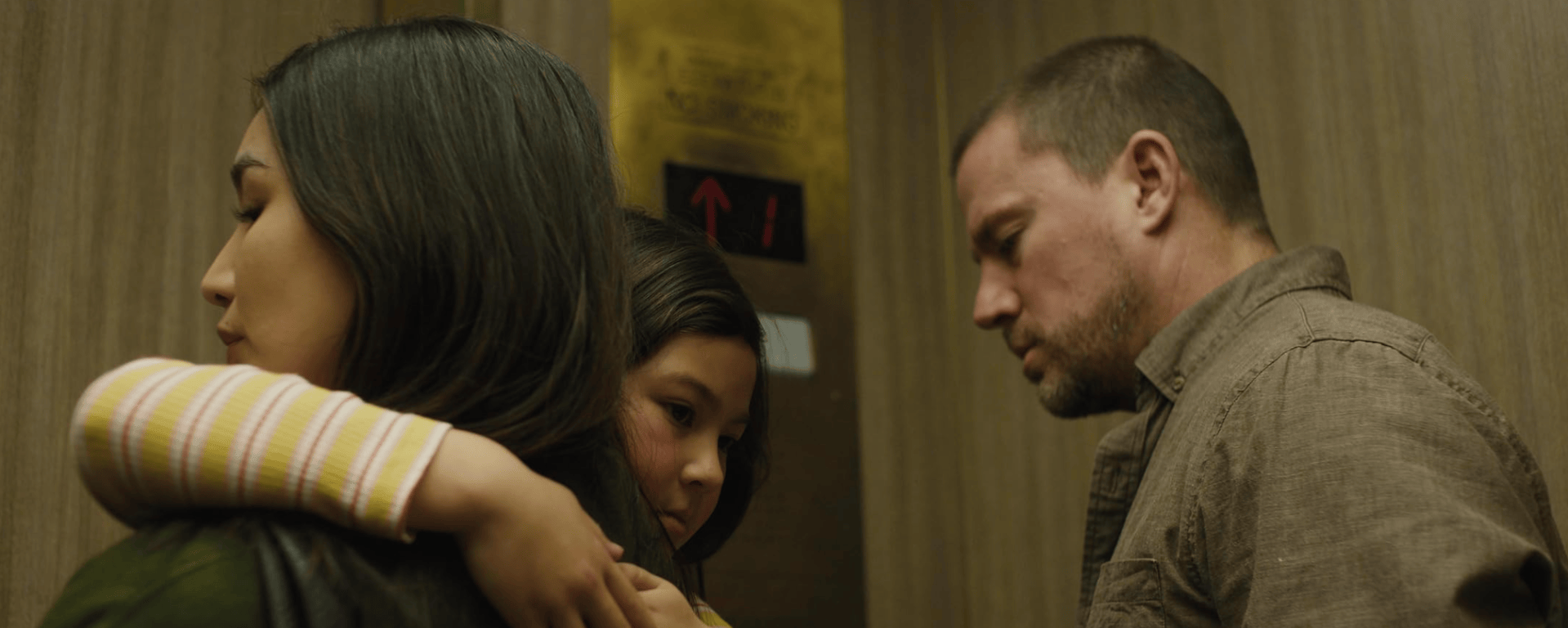
A masterfully crafted reminder that the most terrifying thing about being a parent is knowing that love cannot protect a child from everything.
Duration: 121 minutes
Some of the most frightening monsters are the ones that exist in the real world, and some of the most devastating horrors are the ones that cannot be undone. Beth de Araújo’s Josephine is a masterful film that understands this all too well, employing the language and atmosphere of a psychological horror film to explore a parent’s worst nightmare: the possibility that something unimaginably awful could happen to their child, and the crushing realisation that no amount of love or protection can guarantee their safety. What begins as an ordinary Sunday morning gradually becomes an unrelenting study of fear, trauma and the loss of innocence, told through the fractured perspective of an eight-year-old girl who has witnessed something she cannot possibly comprehend.
The film opens on an almost disarmingly wholesome note, with Damien (Channing Tatum) encouraging his daughter Josephine, affectionately known as Jo or Jojo, to make a little jump out of the garage before joining him for their morning run. It is a lovely, playful introduction to their relationship, establishing a doting, athletic father and a daughter who clearly adores him, sharing their own little world of sports, encouragement and gentle teasing. The warmth of these opening moments makes what follows all the more jarring. Separated from her father in Golden Gate Park, Josephine witnesses the brutal sexual assault of a female jogger. It is an extraordinarily harrowing sequence, made all the more disturbing by de Araújo’s decision to position the camera at a distance, much like Josephine herself, observing from behind the trees as the woman is attacked, overpowered and violated.
There is no need for the camera to move closer to communicate the horror; the detached perspective is precisely what makes the sequence so unbearable. The audience is placed in the uncomfortable position of a helpless witness, watching something terrible unfold without any ability to intervene, while the child at the centre of it has no real understanding of what she is seeing. When the assailant eventually spots Josephine and begins moving towards her, Damien intervenes and chases him down, plunging the entire situation into further chaos. Everyone is suddenly shouting, calling the police and trying to work out what to do, but amid the confusion is a little girl attempting to process an experience far beyond her years.

What makes the immediate aftermath so effective is the film’s understanding that trauma is not confined to the most obviously horrific moments. The arrival of the police does not necessarily make Josephine feel any safer. Placed in the back of a police car, she slowly realises that she cannot get out, while the injured woman is eventually brought into the same vehicle, bleeding and visibly traumatised. As officers question the survivor, Josephine watches, attempts to console her and is even asked to look for the woman’s missing scrunchie. Later, she sees the perpetrator in handcuffs, close enough to recognise him, as Damien spits in his face.
These seemingly incidental details are extraordinarily telling: the unfamiliar adults towering over her, the car door that will not open, the injured woman sitting beside her, the strange man whose face is now seared into her memory. De Araújo frequently frames the world from Josephine’s height and perspective, making ordinary surroundings feel imposing and unfamiliar. Even interactions with authority figures acquire an unsettling quality, as the people who should be there to help her inadvertently become part of an overwhelming and confusing experience. It is an extraordinary amount for an eight-year-old to process in such a short period of time, and the film never loses sight of just how young she really is.
The real horror, however, lies in everything that follows. How does one explain something like this to a child? How does a parent help their daughter understand what she has witnessed without exposing her to even more than she already has? And perhaps most painfully, how does one reassure a child that she is safe when there can be no honest guarantee that something terrible will never happen again? Josephine is particularly perceptive in recognising that the adults are just as unequipped to navigate this situation. Claire (Gemma Chan) and Damien both love their daughter tremendously, but their contrasting approaches to parenting, already quite distinct, become increasingly incompatible in the wake of the incident.
Damien is a physical, sports-oriented father who believes in resilience, discipline and preparing Josephine to defend herself. He takes her out to play football, encourages her to be strong and eventually enrols her in self-defence classes. Claire, meanwhile, is more nurturing and protective, preferring to shield her daughter from the uglier realities of the world while seeking professional help to address her trauma. Neither approach is entirely right or wrong; they are simply two parents desperately trying to find a way forward while dealing with their own fear and helplessness. Tatum and Chan are both excellent, sharing a convincing chemistry that makes them feel like a genuinely lived-in couple. Their disagreements are never reduced to simplistic differences between a good and bad parent, but instead reveal two people whose love for their daughter is unquestionable, even as their own coping mechanisms threaten to drive them apart. Tatum is particularly affecting as a father whose confidence and physicality are suddenly no match for something he cannot punch, outrun or train his daughter to overcome. Beneath Damien’s tough exterior is a man who is increasingly frightened by the realisation that he cannot protect his child from everything.

The true revelation, however, is Mason Reeves, whose debut performance is nothing short of extraordinary. She carries the film with a remarkable understanding of Josephine’s conflicting emotions, balancing the innocence and curiosity of a child with the increasingly alarming behaviour of someone whose trauma has nowhere to go. Her performance never feels calculated or overly theatrical; instead, it captures the disjointed, sometimes contradictory ways in which a young mind attempts to process something incomprehensible. Josephine’s distress manifests itself in ways that are both overtly disturbing and almost imperceptible. She begins exhibiting increasingly violent behaviour, eventually retaliating against a boy at school with a level of aggression that goes far beyond what anyone would expect, grabbing a plastic bag and attempting to suffocate him after being pushed to the ground. The disturbing part is how pleased she appears with herself afterwards.
Elsewhere, she searches for answers online, deliberately Googling words and concepts that children her age should never have to grapple with, and begins asking her friends whether they know the meaning of certain profanities. It is a particularly unsettling illustration of how exposure to adult realities can accelerate a child’s development in the most damaging and uncontrolled ways. The parents can attempt to manage what Josephine sees and hears, but they cannot put the knowledge back into the box once it has been opened.
Perhaps the film’s most effective recurring device is Josephine’s hallucination of the perpetrator, who begins appearing in her bedroom and following her around. He is largely silent, never particularly active or threatening in these visions, but his mere presence is deeply unnerving. He appears almost like an unwanted imaginary friend, always physically close, occupying spaces that should otherwise feel safe and familiar. It is a chilling visualisation of how trauma can follow someone everywhere, even into the sanctuary of their own home. Josephine begins shutting her windows and becomes increasingly paranoid about the possibility of being watched or approached, while the family’s anxiety intensifies when they learn that the perpetrator has been released on bail. Even the decision to relocate to a new apartment offers little reassurance, as the visions continue to follow her.
There is a particularly effective sense of dread in the way de Araújo stages ordinary domestic situations, constantly placing Josephine in precarious circumstances that leave the audience anticipating another disaster. When she discovers knives and scissors among the family’s belongings, she begins playing with them and constructing elaborate string webs, which might initially appear to be innocent childhood mischief but acquire a much darker significance in context. Her parents’ amusement at these activities is especially uncomfortable because the audience can recognise the troubling associations behind them. Miles Ross’s discordant, unnerving score is instrumental in sustaining this atmosphere, frequently suggesting that something terrible is about to happen even during otherwise ordinary moments. The tension is almost relentless, making Josephine feel like a horror film in which the greatest source of terror is simply the inability to know when the next frightening incident might occur.

One of the film’s most evocative sequences is the montage intercutting Claire’s contemporary ballet performance with Josephine’s self-defence training. The choreography and physical movements of the two women begin to echo one another in unexpected ways, with Claire’s performance incorporating gestures that evoke choking and physical restraint while Josephine learns how to defend herself against an attacker. It is a beautifully conceived juxtaposition, connecting two very different forms of physical expression while suggesting the ways in which both mother and daughter are attempting to process and communicate something that cannot easily be articulated. Claire’s performance is particularly affecting, and the sequence also offers a lovely glimpse into Josephine’s relationship with her mother. Dressed in a cheongsam for the occasion, a subtle nod to Claire’s Chinese heritage, Josephine is visibly proud to be there. The film is similarly attentive to the small visual details that establish the family’s dynamic. Damien and Josephine are frequently dressed in athletic wear, often sharing matching Adidas pieces, reinforcing their closeness and common interests, while Claire is more often seen in elegant coats and fashionable attire. These distinctions are never overstated, but they contribute to a wonderfully complete portrait of a family whose members inhabit different worlds while remaining deeply connected to one another.
As the situation escalates, the disagreements between Claire and Damien become increasingly difficult to contain. Josephine’s behaviour grows more unpredictable, the threat of the perpetrator returning becomes a persistent source of anxiety, and the question of whether she should provide a formal statement and eventually testify in court introduces another difficult dimension to their already complicated circumstances. The parents are understandably reluctant to subject their daughter to further distress, but there is also the question of justice and the importance of having her account heard. The film never makes these decisions feel straightforward. Even the moments that should be reassuring are fraught with anxiety, and the parents’ inability to agree on the best course of action becomes another source of instability for Josephine. A particularly heartbreaking moment comes when she mistakes her parents’ consensual intimacy for another act of violence, interrupting them because she believes Damien is hurting Claire. It is a devastating indication of just how thoroughly the assault has altered her understanding of the world, with even the most ordinary expressions of intimacy now filtered through the lens of what she witnessed.
The process of seeking justice introduces another layer of anxiety, particularly when Josephine is first asked to record a formal statement about what she witnessed. During the interview, she initially freezes when asked to state her name, an almost unbearably simple question that suddenly becomes difficult in such an unfamiliar and intimidating environment. Yet even here, de Araújo never loses sight of Josephine’s age. There are little flashes of childhood that are both amusing and heartbreaking, such as when the interviewer explains that the officers outside can see them through the one-way glass, prompting Josephine to immediately get up and start jumping and waving at them, even though she cannot see them herself. It is such an innocent, spontaneous reaction, and a reminder that beneath all the fear, anger and increasingly troubling behaviour, she remains just a little girl.
Her recorded statement is only the beginning, however, as she is subsequently required to appear in court and face cross-examination by the defence lawyer. The courtroom sequences are particularly nerve-racking, and among the film’s most effective demonstrations of Josephine’s vulnerability. During her initial appearance, she freezes again, unable to even state her name, before eventually returning to face an aggressive line of questioning designed to challenge her recollection and undermine her credibility. The perpetrator is sitting right there, within her sight, while an adult repeatedly questions whether she could possibly have seen what she claims to have witnessed. She is being asked to defend her memory, articulate something she barely understands and withstand scrutiny from people whose entire purpose is to cast doubt on her account. It is an appalling burden to place on a child. Her eventual retort to the defence lawyer, questioning why the woman herself did not intervene, is another wonderfully telling moment of childlike directness cutting through the carefully constructed formality of the courtroom.
The emotional heart of the film lies in the changing relationship between Josephine and her parents, particularly Damien. His attempts to toughen his daughter up are well-intentioned, but his frustration eventually boils over, and there are moments when his anger only pushes her further away. Claire, meanwhile, tries to communicate with Josephine in a way that Damien struggles to. Her speech about pain and trauma, and the responsibility Josephine will eventually have to take in learning to live with what she has experienced, is particularly affecting. It is not presented as a magical solution, nor does the film suggest that a few reassuring words can undo something so devastating. Rather, it is an attempt to give Josephine something the adults have largely failed to provide: an explanation, and the reassurance that she does not have to face her pain entirely alone. The revelation that Claire herself has experienced sexual violence adds another layer of complexity to their relationship, with Gemma Chan conveying an extraordinary amount through restraint rather than exposition. Both parents are ultimately trying to do right by their daughter, but the incident exposes their own vulnerabilities and forces them to confront the limitations of their parenting in ways they could never have anticipated.
The film heavily implies that the perpetrator may ultimately walk free, refusing the audience the comfort of an uncomplicated resolution or the reassuring certainty that justice has been served. Josephine eventually reunites with the woman she witnessed being assaulted, who thanks her for what she has done. It is a small but deeply meaningful moment of connection between two people whose lives have been irrevocably affected by the same event. And then there is the final scene on the beach, which brings the film full circle in the most beautiful way. Damien and Josephine are running together again, much as they did at the beginning, except this time she is the one who can keep going while he struggles to catch up. When they eventually sit down to rest, Damien breaks under the weight of his own fear, confronting the painful realisation that no matter how much he loves his daughter or how hard he tries, he cannot protect her from everything this world might throw at her. It is heartbreaking to see a man who has spent the entire film trying to teach his daughter how to be strong finally acknowledge the limits of his own strength. But Josephine simply helps him with an exercise, gets him back on his feet, and they continue running. It is a lovely reversal of their relationship, with the daughter offering reassurance to the father who has spent so much of the film trying to reassure her. The ending is hopeful without being falsely comforting, acknowledging that the family cannot simply return to the innocence of that first Sunday morning, but that they can still find a way to move forward together.
There is an extraordinary amount of thoughtfulness in Josephine, from its carefully considered framing and recurring visual motifs to its performances, sound design and nuanced characterisation. Its many smaller moments gradually accumulate into a remarkably cohesive portrait of a family trying to find its footing after something unimaginable, and de Araújo demonstrates tremendous control in navigating such a difficult subject without reducing her characters to simplistic ideas of good or bad parenting. The film’s greatest achievement is its ability to make the audience feel the world as Josephine experiences it: frightening, confusing, unpredictable and suddenly stripped of the safety that childhood should provide. It is not simply a film about witnessing violence, but about the long and often invisible aftermath, the failure of adults to find the right words, and the painful realisation that some experiences cannot be undone or neatly resolved.
Ultimately, Josephine is a parent’s worst nightmare, but it is also a profoundly compassionate film about the resilience of children and the imperfect ways in which love manifests itself when there are no easy answers. Mason Reeves is an absolute revelation, Tatum and Chan are superb, and Beth de Araújo has crafted a work of extraordinary emotional and psychological depth. Harrowing, deeply unsettling and unexpectedly tender, it is a film whose horror lies not in the extraordinary, but in the terrifying possibility of the ordinary.
Josephine played on 29th and 31st October 2026 as part of the Singapore International Film Festival. More information available here
The 37th SGIFF runs from 21st October to 1st November 2026. More information and lineup available via their website here

