
Some friendships last a lifetime, while others leave scars that last just as long in this tender, affecting debut feature.
Duration: 117 minutes
Kohei Kadowaki’s feature debut is a remarkably assured and deeply affecting work of animation, one that announces an exciting new voice in the medium. It is also the kind of film best experienced with as little prior knowledge as possible. What begins as a deceptively simple story about two boys growing up in a small Japanese town gradually reveals itself to be something far more complicated, and far more devastating. There is a great deal to admire here, but what strikes viewers most would be how Kadowaki manages to capture the innocence, absurdity and emotional intensity of childhood while refusing to romanticise it.
Tsubasa and Gyotaro are an unlikely pair. The former is a lonely, withdrawn boy who struggles to find excitement in life, while the latter is an eccentric whirlwind of energy and imagination, constantly talking about aliens and coming up with increasingly ridiculous ideas. Their friendship is one of the film’s greatest pleasures, particularly in the way it captures the almost boundless enthusiasm of childhood. One of the sweetest moments comes when the two repeatedly shout “See you tomorrow!” to each other, as though the promise of another day together is the most wonderful thing in the world. It is a simple, almost throwaway moment, but one that perfectly captures the kind of earnestness and sincerity that children are capable of. There is something genuinely moving about watching two people find a kindred spirit in each other, especially when neither seems to have found much joy elsewhere.
Kadowaki is extraordinarily attentive to the details of childhood, and this is where the film really shines. There are so many little observations that make its world feel lived in, from the peculiarities of school life to the small rituals, obsessions and objects that seem insignificant to adults but mean everything to children. The number of plies on a roll of toilet paper a nosebleed might leak through, the awkwardness of Valentine’s Day and White Day, the school pets, a Deoxys sticker: these are the kinds of details that might easily be overlooked, but here they contribute to an incredibly rich and convincing portrait of childhood. Even the most incidental moments feel carefully observed, as though Kadowaki understands that the texture of growing up and the world around us, often found in things we don’t even realise we remember. There is a real tenderness to the way the film captures the world through a child’s eyes, with all its strange rules, overwhelming emotions and seemingly endless possibilities.

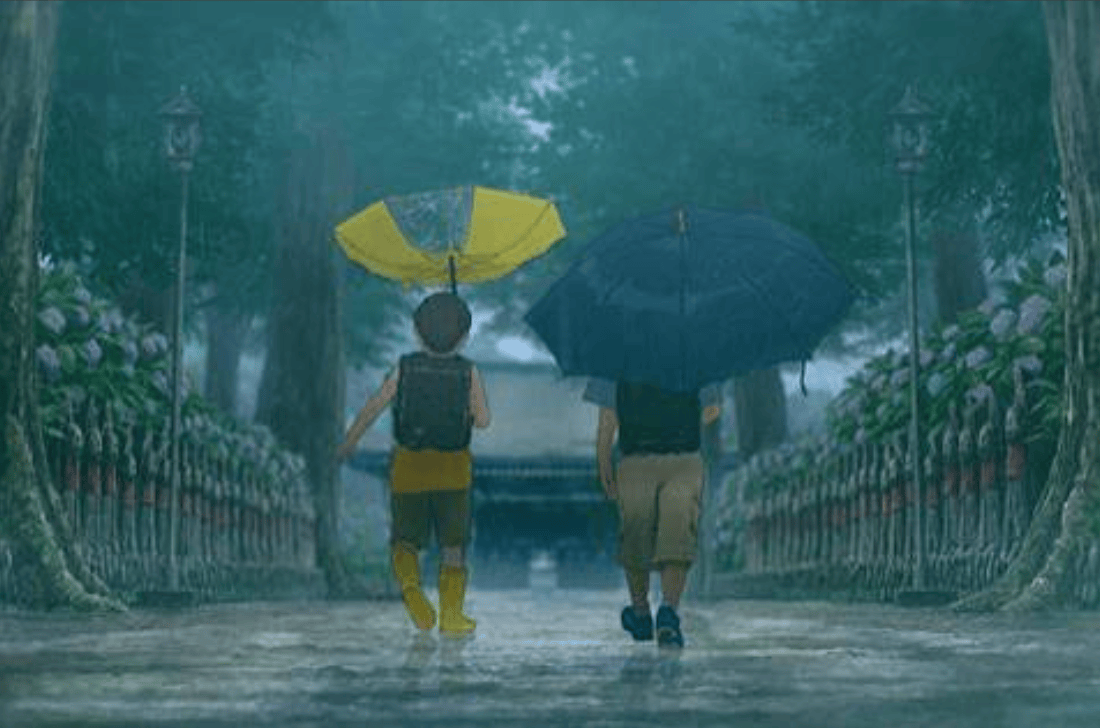
The film’s use of light and water is particularly beautiful. Rain, puddles, reflections and the movement of water become an integral part of its visual language, lending the film a dreamlike quality that is often breathtaking. There is something almost tactile about the animation, with its combination of rotoscoping and hand-drawn imagery creating a world that feels both grounded in reality and capable of transforming at any moment. This is precisely why animation feels like the right medium for this story. It has the ability to capture the physicality of childhood while also stretching, distorting and morphing the world in ways that reflect the characters’ inner lives. The film’s more surreal moments never feel like arbitrary flourishes; they emerge naturally from the emotional experiences of its characters, allowing us to see the world as they do rather than simply observing them from a distance.
What makes We Are Aliens so compelling, however, is its refusal to romanticise childhood. As the boys grow older, their friendship becomes increasingly complicated by misunderstandings, insecurities and the consequences of their own actions. The film is deeply interested in how a seemingly small mistake can have devastating repercussions, and how obsession can become a destructive force when left unchecked. It understands that childhood innocence can explain our mistakes, but it cannot undo their consequences. There is a painful honesty to the way the film portrays its characters, allowing them to be selfish, impulsive, cruel and deeply vulnerable without reducing them to simple villains or victims. Both boys are capable of hurting each other, and both are forced to live with the consequences of their actions. Neither is entirely innocent, and neither is entirely to blame.
The dual-perspective structure is especially effective, and one of the film’s most exciting storytelling choices. Just when you think you understand what has happened between the two boys, the film shifts its perspective and asks you to reconsider everything. It is a powerful reminder that we are rarely the protagonists of someone else’s story, and that the people we think we understand best may be carrying experiences we never imagined. The same events can take on entirely different meanings depending on who is remembering them, and the film is remarkably perceptive about how memory, guilt and resentment can distort our understanding of the past. One appreciates how the film allows these shifting perspectives to complicate our understanding of the characters rather than simply providing a definitive explanation for their actions. It trusts the audience to sit with the discomfort of not knowing exactly how to feel about either of them.

The animation is often breathtaking, particularly in the way it captures the physicality of its characters and allows their emotions to spill into the world around them. The character designs may be divisive, but their expressive, sometimes grotesque quality feels entirely appropriate for a film about the intensity and awkwardness of growing up. As the story progresses, the animation becomes increasingly elastic and surreal, reflecting the instability of the boys’ inner lives. There are moments when the film seems to abandon the boundaries of reality altogether, and these are among its most striking. It is a testament to Kadowaki’s confidence as a filmmaker that he can move so effortlessly between the mundane and the surreal, the tender and the grotesque, without ever losing sight of the emotional truth at the centre of the story.
Some of the film’s emotional beats are perhaps a little too emphatic, and its final stretch occasionally pushes its ideas further than necessary. There are moments one feels the film could have trusted its audience a little more, allowing its imagery and character dynamics to speak for themselves rather than spelling out its intentions. But even when it threatens to become overwhelming, there is an undeniable sincerity to the way Kadowaki approaches his characters. He is clearly fascinated by the ways people hurt each other, but also by the strange, sometimes absurd ways they remain connected long after they have drifted apart.
What ultimately makes We Are Aliens so affecting is its understanding of how a childhood friendship can shape an entire life. It is a film about the people we lose, the mistakes we cannot take back, and the ways we continue to carry one another even when we no longer know how to be together. It is also a reminder of how important it is to hold on to the people who make us feel understood, and how easily those connections can be damaged by our own inability to see beyond ourselves. A beautiful, unsettling and deeply human film, and a remarkable debut from a filmmaker whose next move audiences can and should follow.
We Are Aliens played on 28th and 30th October 2026 as part of the Singapore International Film Festival. More information available here
The 37th SGIFF runs from 21st October to 1st November 2026. More information and lineup available via their website here

