

Edwin’s attempt at horror is wonderfully camp and atmospheric, but collapses under a muddled mix of labour satire, uneven narrative and weak worldbuilding.
Duration: 96 minutes
With Sleep No More, Indonesian director Edwin makes his first foray into horror, following his earlier SGIFF 2021 opening film Vengeance Is Mine, All Others Pay Cash with another story rooted in social realities. Here, he uses a wig factory, and the spirit haunting it, to explore how exploitative working conditions grind people down, while reaching for the lurid excesses of Indonesian genre cinema. It’s an intriguing combination: a supernatural horror film that wants its grotesque imagery to expose the horrors of labour itself. The ambition is clear, even if the film struggles to make its different impulses cohere.
In this film, sisters Putri (Rachel Amanda) and Ida (Lutesha) return to the wig factory where their mother died, hoping to uncover what happened to her. The factory is run by Maryati (Didik Nini Thowok), a flamboyant boss with an ever-changing wig and a workforce pushed to the limits: workers stay awake for night after night of shifts, chasing overtime and praise while their health deteriorates. But the factory is haunted by a spirit that preys on the exhausted, and the sisters’ search for answers draws them into a grotesque mystery involving stolen body parts, their brother Bona (Iqbaal Ramadhan), and Maryati’s own history with the entity.

The setup suggests a film about the human cost of exploitation, where a supernatural horror grows out of the factory’s brutal working conditions. Sleep No More also reaches for the campy excess of 1980s Indonesian horror, mixing social satire with absurd comedy and grisly practical effects. There’s plenty to admire in that ambition. The trouble is that the film never quite decides how these elements should work together.
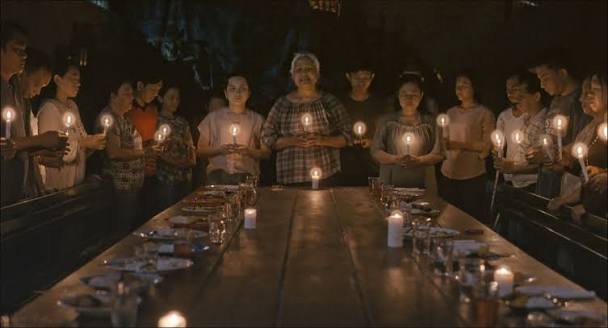
The factory is its strongest asset. It feels dour, dangerous, and quietly oppressive: a place where workers seem almost cult-like in their devotion, taking a mysterious health drink to stay awake and competing for employee-of-the-week praise at the expense of their bodies. Even the way they mourn Putri’s mother is telling; they remember her less as a person than as a model employee. The factory’s late-night atmosphere is bleak and haunting, and the film’s opening makes effective use of it. An eerie animation of a sperm-like strand of hair gives way to workers labouring in the dark, before the hair slips into one woman’s ear and sends her tumbling into a vat of boiling liquid. We’re led to assume she is the sisters’ mother.

Putri arrives with a suitcase, hoping to settle her mother’s affairs, only to learn from Maryati that her mother had debts to pay. Putri has bills of her own, and when a storm leaves her stranded, she retreats to the factory dormitory and decides to work there. She eventually discovers Ida is also staying there, and the two begin investigating their mother’s death.
They learn that the factory is haunted by a spirit that possesses people when they are exhausted. The attacks are grisly: one worker smashes her face into a nail board used for combing wigs; another digs out his own eyes. The practical grotesquerie is often striking, but the scenes land more as absurd spectacle than genuine horror. The characters are shocked, but often so casual in the wake of such tragedy, and with the film’s world so accepting of its own madness, the violence rarely builds into dread.
That’s the film’s biggest problem. Sleep No More seems to mistake absurdity for tension. The horror is introduced so casually, and the supernatural logic is so slippery, that it becomes difficult to feel invested in the danger. There is little sense of escalation, and an early revelation about the culprit further drains the mystery. The film can be strange, but its strangeness doesn’t consistently create unease; too often, it simply makes the stakes feel unclear.

The story grows more convoluted when their brother Bona enters the picture. He has an accelerated healing ability, which he first exploits by cutting off his own ear to claim insurance money, only for it to grow back. The idea gestures toward the desperation poverty can produce, but Bona’s introduction is abrupt, and the sisters’ apparent indifference to him makes his eventual kidnapping feel strangely low-stakes.
The spirit, revealed to be a gigantic floating ball of hair, pursues Bona. Maryati, meanwhile, has apparently been communicating with it and trading his regenerating body parts for money and replacement parts for injured workers. The film adds another explanation: the spirit is jealous of human beings for having human forms, and wants to take their body parts. It is responsible for the death of Rudi (Sal Priadi), whom it possesses and sends jumping from the factory roof, before stealing his legs. But whether the spirit is corporeal or supernatural, and what exactly it can or cannot do, remains murky. The rules keep shifting, making it hard to settle into the story or understand what the characters are up against.

Maryati’s backstory only complicates matters further. As a child, she befriended and cared for the spirit because her own mother was always working late. The spirit eventually killed her mother, yet Maryati has continued looking after it ever since. The revelation might have been tragic or unsettling, but the film never makes clear why Maryati would keep protecting it or what she gains from doing so.
Didik Nini Thowok is a welcome exception to the film’s inconsistencies. He leans into Maryati’s campiness with gusto, and the costumes and wigs are wonderfully extravagant; the film even gives him room to show off his dancing. The final chase, in which the sisters use Maryati as bait, has flashes of tension. Maryati’s eventual literal explosion, after consuming an expanding liquid used to make wig moulds, is exactly the kind of grotesque absurdity the film seems built for, and elicits the laughter it deserves.
But these moments remain isolated pleasures. Sleep No More has a strong atmosphere and plenty of memorable images, and one appreciates the ambition behind its mix of labour satire and supernatural horror. Yet the ideas never quite cohere, and the story is not compelling enough to carry the film through its many unexplained turns. Its horror is too casual to keep you on tenterhooks, while its social critique is too loosely developed to give the chaos much shape. The result is a film with plenty of things to say, but no clear sense of how to bring them together.
Sleep No More played on 27th and 31st October 2026 as part of the Singapore International Film Festival. More information available here
The 37th SGIFF runs from 21st October to 1st November 2026. More information and lineup available via their website here

