
Part revenge thriller, part folk horror, Kamila Andini’s newest, ambitious work sees Putri Marino embroiled in a personal battle against her village’s systemic, violent misogyny.
Duration: 137 minutes
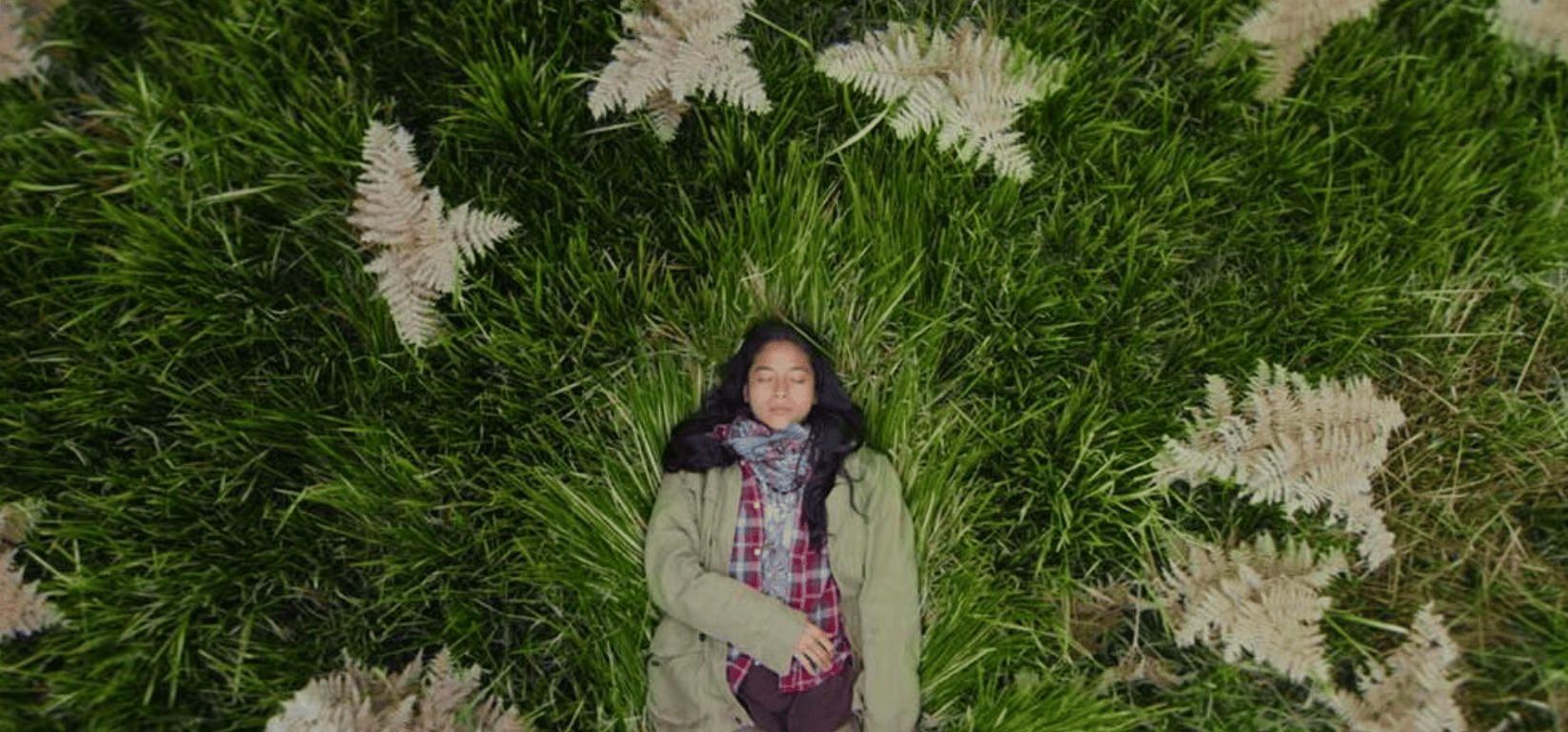
The opening of Kamila Andini’s Four Seasons in Java is deceptively peaceful. Pertiwi (Putri Marino) lies in a field of grass, looking entirely at ease with the world around her, until an elderly man interrupts her solitude to ask for help. She obliges, and eventually accepts a ride back to her hometown. It is only during their journey that the man realises who she is: Pertiwi, a woman who has just been released from prison after serving twenty years for murder. Her homecoming is hardly a warm one either, with her parents exchanging worried glances as they watch her approach their house, seemingly more afraid of their daughter than happy to see her again.
Andini takes her time revealing the circumstances behind Pertiwi’s imprisonment, initially presenting her as an unpredictable and rather volatile figure. Her behaviour can be decidedly strange, whether it is her awkwardly confrontational encounter with the new village chief, a former teacher of hers, or her decision to release a man whom the villagers regard as mentally unstable. She also manages to cause an uproar at a local bar, further reinforcing the impression that she is someone the community would rather keep at a distance. While we naturally give her the benefit of the doubt, there is an interesting point at which we almost find ourselves understanding the villagers’ apprehension. After all, we are told that she killed a man, and her behaviour does little to dispel the suspicions surrounding her. It is only as the film gradually fills in the gaps in her past that our perception of her begins to change, revealing just how thoroughly she has been failed by the very people who were supposed to protect her.

Her only real source of comfort initially comes from Bisma (Arya Saloka), a former flame who is now married to her childhood best friend, Niken (Hana Pitrashata Malasan). The two frequently find themselves meeting away from the village, surrounded by the expansive countryside and the mountains in the distance. Their encounters have a quietly romantic quality, with plenty of lingering glances and unspoken sexual tension, although neither quite crosses that line. There is something rather poignant about these moments, as Bisma seems to offer Pertiwi a rare sense of peace in a life otherwise defined by hostility and suspicion. Meanwhile, she finds another unlikely source of companionship in Mak Ira (Christine Hakim), an eccentric older woman and former sex worker who runs a small food stall on the outskirts of town. Hakim is almost unrecognisable in the role, bringing a wonderfully eccentric presence to a character whom the village has similarly dismissed as crazy. Pertiwi eventually finds work helping her out, although her increasingly disruptive presence does little to keep the establishment intact.

There are plenty of other characters and subplots competing for attention, but perhaps the most important is Raras (Hanna Areta), a deaf girl whose experiences bear an unsettling resemblance to Pertiwi’s own. The two initially struggle to connect, but Pertiwi soon recognises that Raras has also suffered sexual abuse, and becomes determined to protect her from experiencing the same fate. When a group of men attempt to take advantage of the girl, Pertiwi intervenes, eventually helping Raras and her mother, who runs a traditional ritual performance studio, bring the matter to the police. Unfortunately, reporting the abuse is one thing, but securing justice is quite another, especially when there is insufficient evidence to hold the perpetrators accountable.

It is here that Four Seasons in Java begins to reveal its larger concerns with systemic misogyny and the ways in which violence against women is perpetuated by those in positions of authority. Pertiwi’s own history is eventually revealed to be particularly horrifying. Her father, having accumulated gambling debts, effectively bartered his young daughter away, allowing her to be sexually exploited by her teacher. On one occasion, Jonet (Nagra Pakusadewo), one of the men involved, rapes her while she is unconscious. When she awakens to the horror of what has happened, she kills his accomplice in a desperate act of self-defence, while Jonet manages to escape. It is a devastating revelation, particularly when we realise that Pertiwi was the one imprisoned while the men responsible continued to enjoy positions of power and influence within the village. Jonet himself is genuinely chilling, embodying the sort of casual, deeply entrenched male entitlement that the film is so intent on exposing.

Andini’s treatment of these events is not entirely straightforward, however, and much of the film’s appeal comes from its willingness to venture into magical realism. Pertiwi is repeatedly haunted by a gigantic, shadowy creature with elongated claws, while televisions and radios seem to take on a life of their own whenever she is nearby, transmitting fragments of memories and images from her past. These sequences are among the film’s most haunting, turning the abstract persistence of trauma into something almost tangible. Rather than confining Pertiwi’s memories to conventional flashbacks, Andini allows them to intrude upon the present in increasingly uncanny ways. The creature itself remains an unsettling presence, suggesting that the violence she has experienced has taken on a life of its own. There is also something intriguing about the film’s recurring counting motif, with Pertiwi repeatedly reciting the count of satu, dua, tiga, empat, before eventually arriving at lima in the film’s extraordinary final moments to signify progress.

For all its darkness, the film is ultimately interested in the possibility of recovery, particularly through the relationships Pertiwi forms with other people who have been rejected by society. Rather than simply seeking revenge, she gradually begins building a home for herself and those around her, offering shelter to Raras and her family, Mak Ira and the supposedly crazy man she had earlier freed. This unlikely collection of outsiders becomes a makeshift family, united by their shared experiences of marginalisation. Pertiwi also puts her knowledge of solar power to use, allowing them to become increasingly self-sufficient. There is something quietly moving about this development, as a woman who was denied the protection of her own family eventually finds a way to create a home for others. The film’s title seems to resonate with this broader sense of cyclical suffering and renewal: the past keeps returning, much like the changing seasons, but there remains the possibility of something new emerging from the wreckage.

The film’s political and fantastical strands eventually converge in an increasingly surreal climax, as the village prepares to embrace Pertiwi’s solar-powered initiative and present itself to visiting delegates as a model of progress. Yet the underlying injustices have hardly disappeared. With Raras’ mother performing a ritual, the village’s men are subjected to a supernatural reckoning, becoming possessed and turning against themselves. It is an audacious and rather bizarre development, culminating in Pertiwi being seemingly beamed up by a UFO, finally appearing completely at peace as she completes her familiar counting sequence. It is certainly not an ending that one could have easily anticipated, although its fantastical excess seems consistent with the film’s broader interest in forces that exist beyond the reach of conventional justice.

If there is a weakness here, it is that Andini has perhaps bitten off more than she can comfortably chew. At 137 minutes, Four Seasons in Java introduces an enormous number of characters, narrative threads and thematic concerns, some of which feel considerably more developed than others. Niken’s involvement in the village’s political machinations, for instance, occasionally feels like a distraction from Pertiwi’s more compelling journey, while certain developments seem to exist primarily to accommodate another of the film’s many ideas. Pertiwi’s subsequent return to the city, where she reunites with the women who cared for her during her imprisonment and even reads a poem at an underground metal concert, is another unexpected detour. Yet there is also something to be said for this sprawling approach. Trauma rarely unfolds in a neat, linear fashion, and the film’s constant movement between memories, relationships, supernatural encounters and present-day injustices can feel like an expression of the very experiences it is attempting to explore. Not every detour is successful, but its ambition is difficult to dismiss.

Visually, the film is quite remarkable. Cinematographer Batara Goempar makes particularly effective use of the East Javanese landscape, with its lush greenery, mountains and expansive countryside providing a striking contrast to the more claustrophobic confines of the village. The latter feels like a place suffocated by its own social hierarchies and deeply ingrained prejudices, while the open landscapes offer fleeting moments of freedom and respite. The contrast is especially effective during Pertiwi and Bisma’s encounters, where the natural world seems to offer a temporary escape from the oppressive environment they inhabit. The magical realist sequences are equally memorable, with the shadowy creature and the strange occurrences surrounding the electronic devices lending the film an eerie, almost dreamlike quality. Putri Marino is excellent as Pertiwi, conveying an extraordinary amount through her stoic expressions and visibly exhausted demeanour. She carries herself like someone who has endured far more than she should have had to, yet there is an underlying resilience and determination that gradually emerges beneath her restrained exterior. Christine Hakim is another standout, while Arya Saloka provides a convincing romantic counterpoint to Pertiwi’s otherwise turbulent existence. Nagra Pakusadewo, meanwhile, makes for an appropriately menacing antagonist.
For all its excesses, Four Seasons in Java remains a compelling and visually arresting work, anchored by a strong central performance and an unflinching examination of systemic misogyny, sexual violence and the abuse of power. Andini occasionally struggles to bring all her ideas together, and the film’s sprawling narrative could certainly have benefited from a little more restraint. Nevertheless, its exploration of trauma, solidarity and the possibility of reclaiming one’s life gives it a strong emotional foundation. More than anything, it is a film about people who have been cast aside finding a way to build something for themselves, even when the world around them seems determined to keep them down. It may be occasionally overwhelming in its narrative threads, but there is considerable power in its ambition.
Four Seasons in Java played on 26th and 27th October 2026 as part of the Singapore International Film Festival. More information available here
The 37th SGIFF runs from 21st October to 1st November 2026. More information and lineup available via their website here

