
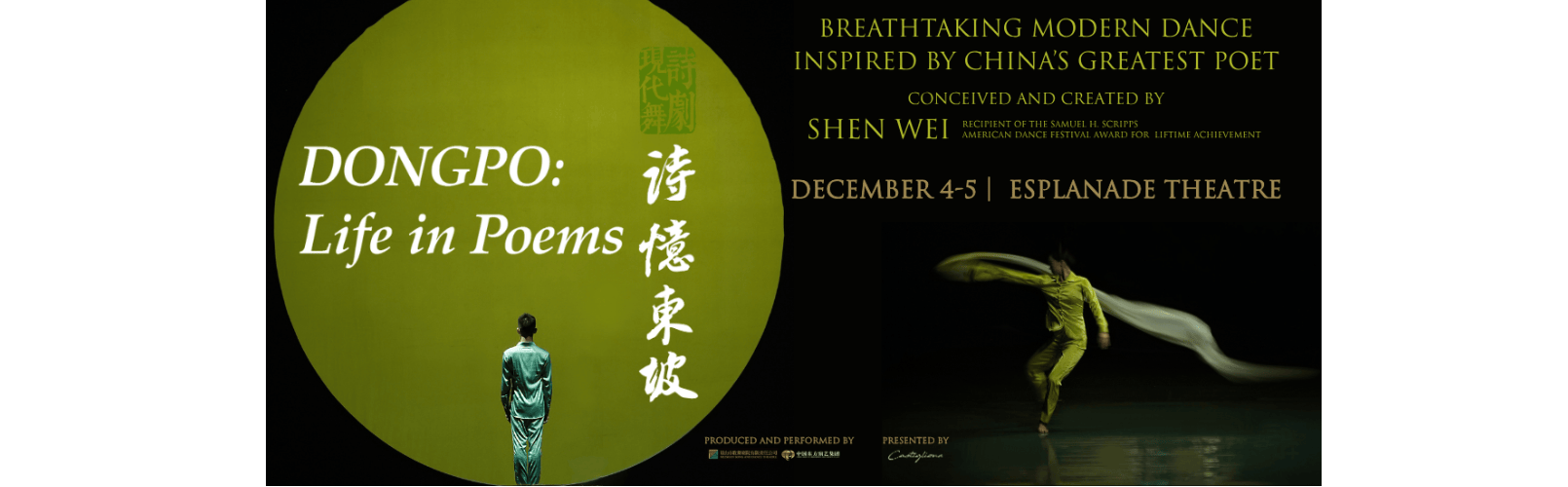

The acclaimed choreographer talks about the poet, artist and restless traveller who inspired Dongpo: Life in Poems, making its Singapore debut this December.
There is a piece of calligraphy written by Shen Wei’s father hanging in the choreographer’s New York apartment. It features the work of Su Dongpo, the legendary Song Dynasty poet who has occupied much of Shen’s thoughts in recent years.
The connection between the two artists goes beyond that family keepsake. “While I grew up in China, I learnt a lot about Dongpo’s poetry,” Shen says. “In Dongpo’s life, he travelled everywhere in China. I see many parallels in how he doesn’t really have a permanent home.”
Shen has spent roughly three decades travelling and working around the world, rarely staying in one place for long. Like Dongpo, he has also cultivated a wide range of artistic interests.
“He has a passion for cultural art, like poetry, and I write poetry too,” he says, mentioning his new volume of poetry published just last year. “He also plays music, and does calligraphy and paints and cooks. In a way, he really is very familiar in the way his passion relates to myself.”

That sense of familiarity became one of the starting points for Dongpo: Life in Poems, an operatic contemporary dance drama directed and choreographed by Shen, with music by composer Chen Qigang. The production makes its Singapore debut at the Esplanade Theatre this December, following performances at New York’s Lincoln Center and Washington, D.C.’s Kennedy Center.
The project began in 2021, when Shen was living in Paris and received a call from Beijing. The Oriental Song and Dance Ensemble, together with organisations connected to Dongpo’s hometown of Meishan in Sichuan, approached him about creating a production around the poet. But his initial reaction was hesitation.
“I was like, it’s such a tough piece to do,” he recalls.
But after 4 months, he agreed. “I came to Beijing, did research, and thought about how to transform his work into a cultural performance. It was quite a challenge for me too.”
By September 2022, Shen was back in Beijing, assembling the dancers and beginning to shape the production. The research soon led him away from the idea of creating a straightforward biography.
“I travel around the world and live, and I think a lot about what matters to me. I’m not sure the story of his life is the most important thing to share with the audience,” he says. “Everyone has their own journey in life anyway.”

What instead interested Shen more was Dongpo’s creativity and his relationship with Chinese culture. “The spirit of his passion for life in his poetry, and how impactful Chinese culture was in the last almost 1,000 years, was very important,” he says.
At the centre of that cultural legacy is Dongpo’s poetry. Shen points to Prelude to Water Melody, one of the poet’s most famous works, written during the Mid-Autumn Festival while he was separated from his younger brother.
“Especially with the Mid-Autumn Festival approaching, it’s such a famous poem about the moon,” he says. “He wrote this poem for someone who he could not be together with. It’s so impactful to Chinese culture. Every Chinese person grew up learning this poem.”
For Dongpo: Life in Poems, Shen selected many important poems that he felt could move beyond their historical context and speak to universal experiences.
“I chose the poems that transcend the values of his philosophy, lifestyle and collective values of all human beings,” he says. “Not just for this history and how he went through life journeys that may not be as important from his point of view, but to shape what meanings of human journeys and life and struggle and how to get through it, his attitude about life.”
That became the key to transforming Dongpo’s poetry into dance. “His poems are more about values of human beings,” Shen explains. “That’s why it translates so well to a dance performance.”

The challenge, however, was considerable. “There was so much information in this,” he says. “When you do a dance, you don’t tell them what it is. It’s abstract, it’s a feeling.”
Unlike theatre, where dialogue can explain a character’s motivations or a historical event, Shen had to find a physical language for the ideas contained in Dongpo’s poems.
“You can’t just use dialogue like in theatre,” he says. “How can we make these ancient cultural poems relate to people of today, especially the young people who might have nothing to do with the Song Dynasty or understand it?”
Even in China, he notes, classical poetry can be difficult for contemporary audiences to fully understand. “So I had to translate it to English when people didn’t understand the poetry in its original text,” Shen says. “So I hope that they may understand better through the English translation.”

Ultimately, he wanted audiences to experience the poetry emotionally, through music and dance, and to understand what the poems mean in his life and in theirs.
That idea of translation extends throughout the production. Contemporary dance is woven together with Chinese opera, Tai Chi and elements of ballet, while calligraphy, painting and seal engraving inform the visual language. Shen was particularly fascinated by Dongpo’s many names and the way they reflected different periods of his life.
“In his life, he has so many names, like how his birth name is Su Shi, before changing it to Dongpo in middle age,” he says. “He has maybe over 50 names, and it’s about him going through different periods and eras, and given by himself or other admirers.”
Those names, represented through seals and stamps, also became part of the physical vocabulary of the production.
“It is really interesting,” Shen says. “The dancers move like the calligraphic style of the seals and stamps. The sharpness of the movements also relates to the dramatic life of Dongpo.”
For Shen, these details offered a way to explore the complexity of Dongpo’s identity and how he understood himself across different stages of his life. The production’s visual world similarly avoids a literal recreation of the Song Dynasty.
“You will see many things related to the Chinese Song Dynasty beauty, but you won’t find anything specifically from there,” Shen says. “All are modernised, but you will see the colour and the sense of the style references are from the beauty of Song Dynasty.”
The music incorporates Chinese opera with Western orchestral music, while an ancient Chinese instrument, the guqin, is played onstage between segments. Dongpo himself also played the guqin.
“Dongpo was so artistically rich,” Shen says. “He has so many ways to express himself.”
The musical collaboration is particularly significant because Chen Qigang and Shen have worked together before. The pair first collaborated on the Beijing Olympics Opening Ceremony in 2008, when Chen was music director and Shen choreographed the celebrated scroll-painting sequence.
“He personally composed for me,” Shen recalls. “It was 18 years ago now, in 2008.”

Their work on Dongpo brought them together again, although the process was more complicated this time because Chen was ill during the production.
“He gave me all his work from the past he created for me to choose,” Shen says. “I looked through all his music and chose all the parts that I think will be a good fit to put into this production.”
Shen also selected five original pieces of guqin music to complement Chen’s orchestral score. Both Shen and Dongpo share an appreciation for the instrument.
The result is a production that draws on multiple forms rather than fitting neatly into one category.
“It’s not a theatre storytelling production,” Shen says. “It is a very colourful artistic production.”

That artistic approach appears to have helped the work connect with audiences beyond China. Shen recalls taking the production to the Kennedy Center, Hong Kong and Macau, including audiences who had never heard of Dongpo.
“They were deeply moved and loved the production,” he says. The same goes for Lincoln Center in New York, where Shen estimates around 90 per cent of the audience was Western. The response was similarly strong. “They really connected to it,” he says.
For audiences who already understand the cultural references, the experience may carry additional meaning. But Shen has deliberately built the production so that cultural knowledge is not a prerequisite.
“People who do know it, they of course understand it better with cultural background, why the elements were incorporated into those sections,” he says. “But I wanted to make it more colourful, complex and not just for modern dance audiences.”
The production has also changed Shen’s own understanding of Dongpo.
“Before creating this production, maybe I only knew about four poems by him, and a little of his story,” he admits.

Research revealed a much more complex and exuberant figure. “When you go deeper, you are a lot more appreciative of how much he loved life, how sensitive he was and how passionate he was,” Shen says. “He’s someone who loves life, and no matter what situation he could make things beautiful and nice. He’s so full of passion too, and he lived a very rich life.”
Some of those discoveries surprised him. “I didn’t even know he painted or played music so well,” Shen says. “But everyone knows he cooked well. Dongpo Meat is named after him!”
But it was the intimacy of Dongpo’s poetry that ultimately made Shen feel closest to him.
“When he wrote poetry, it’s like he was writing a journal,” he says. “It’s so personal, and people will find a lot of connections through his poems.”
That is also what Shen hopes Singapore audiences will find when they encounter the work this December.
“I definitely do want them to understand how each section moves audiences, whether through his passions or his thoughts or his philosophic thinking,” he says.
But he doesn’t expect audiences simply to come away with facts about a historical figure. He wants them to think about themselves and life. The poems, he suggests, can move audiences in different ways: through Dongpo’s love, his struggles, his resilience and his ability to find beauty in difficult circumstances. At another level, the production offers the pleasure of experiencing the art forms themselves—the music, movement and visual beauty inspired by Song Dynasty culture.
“Some poems are full of love, and audiences will be very moved by his love,” Shen says. “And another thing to appreciate is to see how art forms and music, incorporating all the Song Dynasty elements and beauty, can eventually move audiences through the beauty of the art form itself.”
For Shen, perhaps the most lasting discovery has been how familiar Dongpo ultimately feels, not as a distant historical figure, but as another artist trying to make sense of a constantly changing life.
“I think I didn’t understand initially,” he says of his discoveries about the poet. “Later on, I realised how close I felt to him, and he was no longer just a famous figure, but someone I got to know personally, through his writing.”
Nearly a thousand years separate Dongpo from the audiences who will sit inside the Esplanade Theatre this December. Yet through poetry translated into movement, Shen hopes that distance will disappear for a few hours.
And for Singapore audiences, Dongpo: Life in Poems offers the opportunity to encounter that closeness for themselves: not through a history lesson, but through bodies in motion, music, light, poetry and the visual language of an artist who lived a millennium ago, and whose questions about how to live remain remarkably immediate.
Dongpo: Life in Poems 现代舞诗剧《诗忆东坡》 runs from 4th to 5th December 2026 at the Esplanade Theatre. Tickets available from SISTIC

