
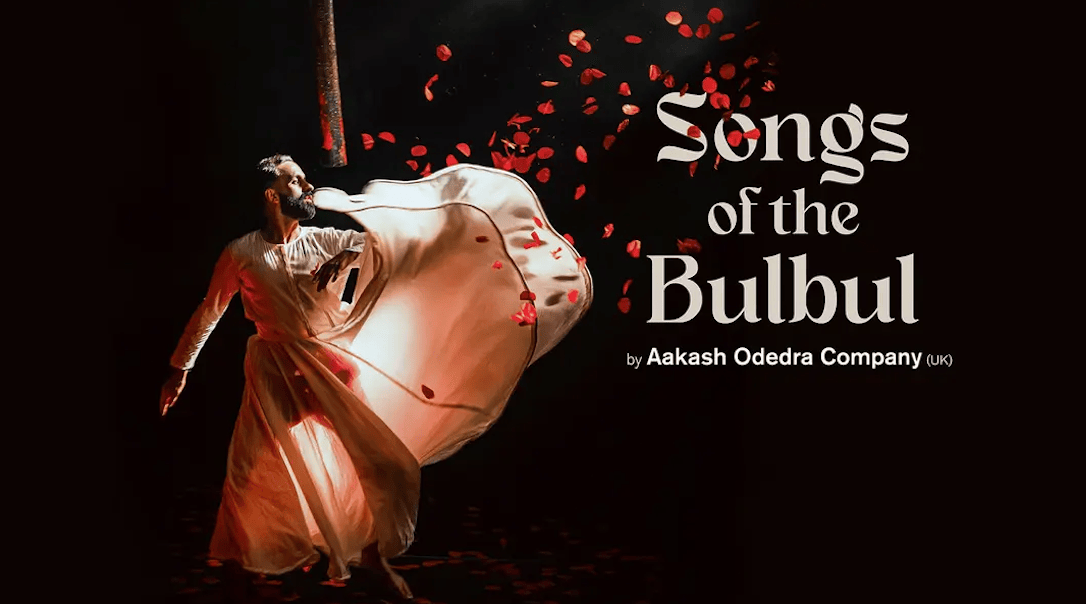
Aakash Odedra excavates hope and beauty from suffering through the heavy metaphor of a nightingale’s swansong.
Duration: 55 minutes
According to Persian and Sufi traditions, the bulbul, or nightingale, is often associated with the soul’s yearning for divine love, its song a symbol of longing and devotion. Yet the story behind Songs of the Bulbul takes this romantic symbolism somewhere considerably darker. Drawing on an ancient practice of a captive bird deliberately subjected to increasingly cruel conditions to refine its voice, the work explores the uneasy relationship between suffering, sacrifice and the pursuit of perfection. It is a curious premise, one that asks whether beauty can emerge from the most devastating forms of deprivation, and whether freedom might ultimately be found in surrender.
Choreographed by Rani Khanam, with music by Rushil Ranjan and performed by Aakash Odedra, Songs of the Bulbul translates this fable into an hour-long solo that brings together Kathak, Sufi storytelling and contemporary theatrical expression. It is also, as Odedra has suggested, an allegory for the artistic process itself: the relentless pursuit of perfection, the gradual shedding of one’s identity and the sacrifices required to create something meaningful. Across its various stages, the bulbul’s suffering becomes a metaphor for the artist’s own journey, culminating in a final act of release that is as visually extravagant as it is philosophically contemplative.
The production establishes its visual language with considerable economy. A semi-circle of flickering candles surrounds a stage scattered with red petals, while suspended branches evoke the woodland, or the cage, that becomes the bird’s gilded prison. Against an otherwise sparse, almost entirely darkened space, these elements create a striking environment that feels at once earthly and otherworldly. The lighting is particularly effective, carefully illuminating fragments of the stage while allowing the surrounding darkness to gradually encroach. As the bird’s circumstances deteriorate, the diminishing light becomes an increasingly palpable expression of its suffering.
Odedra’s performance follows a similarly progressive trajectory, beginning with the tentative curiosity of a creature discovering its surroundings before gradually descending into desperation. His Kathak training is evident throughout, with intricate footwork, rapid chakkars (spins) and expressive hand gestures providing the foundations for his storytelling. Yet the choreography is far from confined to the classical form. There are contemporary flourishes, expansive leaps and even ballet-like extensions, creating a physical vocabulary that is eclectic without feeling entirely disconnected from its roots. Particularly effective is the use of his flowing white dervish costume, whose sweeping and dynamic skirt work becomes an extension of his movements. As Odedra spins and traverses the stage, the fabric billows around him, occasionally sweeping up the scattered petals in a flurry of movement.
There is an almost frantic quality to his early choreography, as he darts around the stage in quick, restless movements that evoke a bird desperately seeking an escape from its cage. This physicality becomes increasingly expressive as the narrative progresses. When the bird is plunged into darkness, Odedra begins lighting candles one by one, his gestures growing more anxious as he searches for something to hold onto. Later, in a particularly visceral sequence representing the blinding of the bird, he uses the surrounding red petals to act as blood gushing from his eyes as he unleashes a series of guttural cries, his body contorting in a moment of raw anguish. It is among the performance’s most unsettling passages, briefly cutting through the otherwise graceful aesthetic with something considerably more primal.
With his sight taken away, Odedra is now blindfolded, and appears disoriented, before discovering a renewed sense of perception through small illuminated lights at his fingertips. It is perhaps a little on the nose, but the gesture communicates its intended symbolism clearly enough: even when deprived of the physical senses, the soul retains its capacity to see. There is an unabashed showmanship to moments like these, where the choreography occasionally edges towards the spectacular and the symbolism is made almost deliberately literal, as each wave of the hand lights a candle as if by magic. Yet there is also something endearing about this willingness to embrace theatrical excess rather than retreat into abstraction.
Much of the production’s emotional continuity comes from Ranjan’s score, which provides a rich musical landscape for Odedra’s movements. Combining classical Indian influences, Sufi sensibilities and orchestral textures, the recorded music possesses an almost ancient quality while remaining remarkably timeless. Its sweeping melodies and dramatic crescendos lend the work the atmosphere of a fable being retold, elevating the physical performance into something that feels larger than the individual dancer. The music also becomes the closest thing to the bulbul’s voice itself, expressing the yearning and resilience that words cannot quite capture.
The final act sees Odedra gradually relinquish his physical form, his movements becoming increasingly ethereal as he transitions from captive bird to something resembling a departing spirit. With strong gusts from fans and flowing fabric introducing a sense of wind and movement, the stage takes on an entirely different, almost spiritual energy. It is an entertaining and visually satisfying conclusion, and one that clearly resonates with the audience, who respond warmly to the spectacle. Yet this is also where the production’s central metaphor becomes most apparent, and perhaps where its limitations begin to emerge.
For all its exploration of suffering and sacrifice, Songs of the Bulbul ultimately offers a rather straightforward interpretation of its source material. The bird’s ordeal is reframed as a story of resilience: despite being deprived of everything, it continues to sing, finding beauty and freedom in the act of creation itself. There is something almost reminiscent of Emily Dickinson’s famous notion of hope as the thing with feathers, an enduring presence that persists even in the face of adversity. It is a compelling sentiment, particularly when considered through the lens of artistic creation, but it also risks simplifying the brutality of the original myth. The bird is not merely overcoming hardship; it is being subjected to extraordinary cruelty for the sake of its song. To transform that suffering into an uplifting narrative of perseverance is an interesting artistic choice, though one that might have benefited from a little more ambiguity.
The opening voiceover, which explains the bulbul’s captivity and the successive stages of its suffering, is similarly a double-edged sword. While it provides useful context for audiences unfamiliar with the myth and its Sufi symbolism, it also establishes the narrative rather explicitly before the choreography has the opportunity to reveal it. There is something to be said for allowing audiences to discover the bird’s increasingly desperate circumstances through Odedra’s movements rather than having every symbolic development explained in advance. The production is already visually legible, and a little more trust in its own storytelling might have allowed some of its more devastating moments to land with greater impact.
Nevertheless, there is much to admire in what Odedra and his collaborators have created. Songs of the Bulbul is a remarkably accessible work, one that does not demand extensive familiarity with Kathak or Sufi philosophy to appreciate its emotional trajectory. Its combination of classical foundations, contemporary movement and unabashed theatricality makes for an engaging performance that is as inviting as it is visually striking. While its interpretation occasionally feels a little too neat for the complexity of its source material, it never loses sight of the simple power of movement, music and storytelling working in concert.
Ultimately, Songs of the Bulbul is perhaps most successful because it chooses not only to meditate on the full horror of captivity, but excavates art from it, celebrating the creative spirit’s determination to keep singing regardless of the odds. Whether that constitutes genuine liberation or simply the ability to find beauty through resilience is a question the production does not entirely resolve. But in Odedra’s capable hands, the bulbul’s final song makes for a captivating theatrical experience, reminding us that even in the darkest of circumstances, there remains the possibility of something beautiful taking flight.
Photo Credit: Angela Grabowska
Songs of the Bulbul played on 20th November 2026 at the Singtel Waterfront Theatre. More information available here
Kalaa Utsavam – Indian Festival of Arts 2026 runs from 20th to 29th November 2025 at Esplanade – Theatres on the Bay. Full lineup available here

