
What makes a memory last? Is it a photograph tucked away in an old album, a familiar song, a treasured family heirloom or even a gesture passed down through generations? At the Singapore Art Museum’s latest exhibition, visitors are invited to explore these questions through 22 thought-provoking artworks that uncover forgotten histories, personal stories and the many ways we remember.
Memories have a curious way of finding their way back to us. Sometimes, they surface through an old photograph, the sound of a familiar language or an everyday object that carries more meaning than meets the eye. Other times, they live on in traditions, rituals and stories passed quietly from one generation to the next.

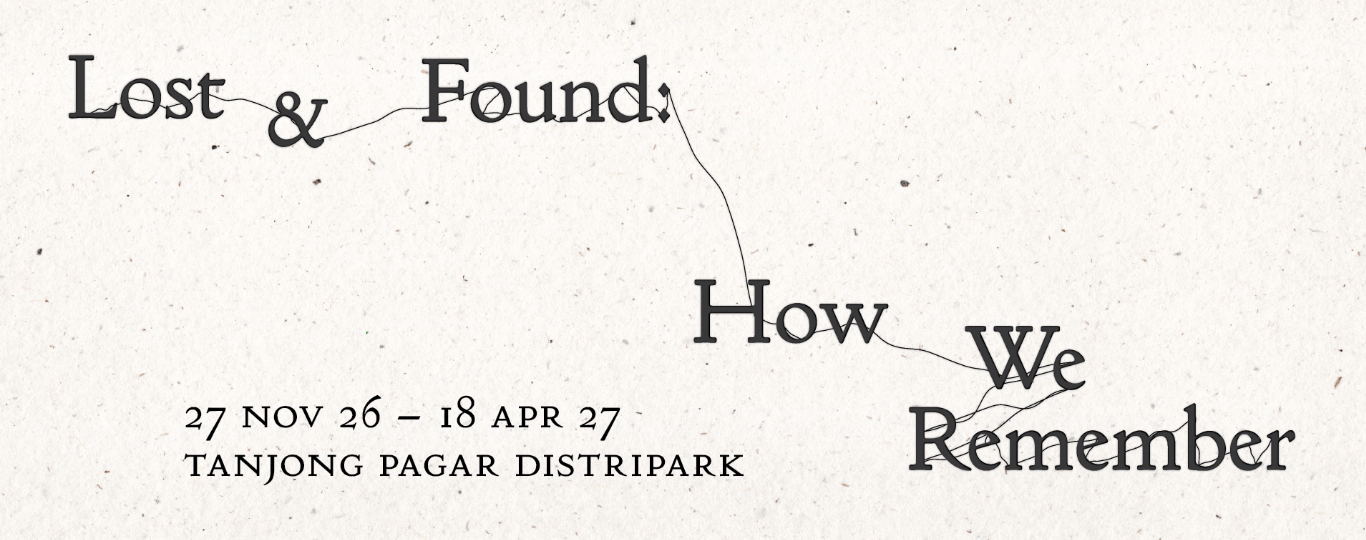
It is this fascinating relationship between memory, identity and history that Singapore Art Museum (SAM) explores in Lost & Found: How We Remember, opening on 27 November 2026 at SAM at Tanjong Pagar Distripark.
Bringing together 22 artworks by 16 artists from Asia and beyond, including three newly commissioned works, the exhibition invites visitors to look beyond conventional archives and consider the many different ways our histories are preserved, interpreted and passed on. Spanning film, installation, photography, sculpture, painting and performative objects, the works reveal how memories can be carried through the body, language, cultural practices, everyday materials and our relationship with the natural world. Rather than simply presenting history as a collection of dates and documented events, How We Remember asks a more personal question: whose stories are remembered, and whose are left behind?

For Shabbir Hussain Mustafa, Chief Curator of SAM, the exhibition is the culmination of a wider exploration into the nature of memory and archives. “An archive does more than preserve the past. It also shapes whose experiences become part of history. Since 2023, Lost & Found has explored how memories travel beyond official records, through songs, gestures, languages and everyday objects. How We Remember concludes this multi-year curatorial project, bringing its different enquiries together. It reminds us that remembering is not simply an act of looking back, but also a way of questioning the histories we inherit and imagining what we might carry into the future.”
And that is precisely what makes this exhibition so compelling. As visitors move between the different works, they are encouraged not just to observe, but to pause, reflect and perhaps even reconsider the stories they have inherited themselves.

One of the most immersive encounters awaits in Candice Lin’s Seeping, Rotting, Resting, Weeping (2021). A tent-like installation draped in indigo-dyed textiles, complete with rugs and ceramic cats, creates an environment that invites visitors to step inside what the artist describes as a “feline temple”.
There is more to this intriguing installation than its unusual setting. Lin’s use of indigo connects the work to a much longer history of colonial trade and exploited labour. Rather than relying solely on historical documents, the artist explores how these histories remain embedded in the materials themselves.
During the pandemic lockdowns, Lin cultivated, harvested and fermented indigo plants in her Los Angeles studio. The process of fermentation, involving decomposition and transformation, became an important part of the work’s meaning. Its title also reflects feelings of isolation, grief and uncertainty experienced during that period. It is a reminder that even the materials surrounding us can carry traces of the past.

The natural world takes centre stage again in mantera apotropaic (2026), a new commission by ila, created in collaboration with Alysha Rahmat Shah and Jennifer O’Connor. Imagine a world in which the last remaining mangrove forest is dying. This speculative scenario forms the starting point for an installation featuring an abstract embroidered map of the Maritime Southeast Asian archipelago, two tree effigies and a soundscape incorporating recordings from mangrove forests.
The work brings together ecological knowledge, local folklore and the cultural traditions connected to these coastal ecosystems. Visitors are invited to consider the intricate relationships between mangroves, marine life, communities, ocean currents and monsoon winds, while reflecting on what might be lost if these habitats disappear.

Elsewhere, Leyla Stevens’s PAHIT MANIS, Night Forest (2024) draws on Balinese storytelling and shadow puppetry to explore environmental destruction. Through the voice of a shadow puppeteer, monochromatic animations and recordings of the forest, the work revisits traditional tales while highlighting the growing threat to Bali’s remaining forest habitats.
Together, these works suggest that preserving nature is also a way of protecting the cultural memories and knowledge systems that have grown alongside it.

The exhibition also turns its attention to the limitations of official historical records, questioning how much of the past has been preserved and how much has been overlooked. In Shubigi Rao’s River of Ink II (2023), 270 handmade books are submerged in black ink, their pages warped, crumpled and slowly falling apart. The installation recalls the Siege of Baghdad in 1258, when the Mongol army destroyed the House of Wisdom and books were thrown into the Tigris River.
The resulting image of books deteriorating under the weight of ink is both haunting and powerful. It speaks to the fragility of knowledge in the face of war, cultural destruction and censorship, while asking whether the erasure of information can sometimes become an act of resistance.

Another fascinating encounter comes through Chia-Wei Hsu’s Volcano and Pencak Silat (2026), a newly commissioned two-screen installation that brings together archival footage, contemporary martial arts movements and artificial intelligence.
Drawing on colonial-era films from the Eye Filmmuseum collection in Amsterdam, Hsu places historical images alongside contemporary footage of Pencak Silat practitioners filmed at Mount Bromo in East Java. Pencak Silat, a martial art from the Indonesian-Malay Archipelago, combines fighting techniques with physical and spiritual practices and dance. The artist explores how these traditions may have survived colonial restrictions through movements embedded in dance and ritual.
By using footage of contemporary Silat movements to train an AI model, Hsu offers an alternative way of examining gaps in historical documentation. It is an intriguing meeting of tradition and emerging technology, raising questions about how cultural knowledge can be recovered and reinterpreted when written records tell only part of the story.

For a more intimate perspective on how historical events affect individual lives, spend time with Vincent Rumahloine’s Don’t Call Me Hero: Finale (2026), another new SAM commission. The work brings together photographs, personal belongings, testimonies and visual diaries from Indonesians who were unable to return home following the political upheavals of the 1960s, eventually building new lives in the Czech Republic.
Presented within an intimate living-room setting, the installation offers a glimpse into the domestic worlds of a community shaped by displacement. Family photographs and cherished possessions become quiet reminders of home, friendship and belonging. Rather than focusing on grand historical narratives, the work gives space to the everyday experiences of people whose stories might otherwise remain undocumented.

Some of the exhibition’s most affecting moments come from works that turn to familiar objects and personal experiences. In RROSE: A Story of Two Worlds (2004–2026), Minstrel Kuik revisits her relationship with two very different places: her hometown of Pantai Remis, a fishing village in Perak, Malaysia, and Arles in France, where she studied photography.
Beginning the project in 2004, Kuik explored the feelings of displacement, separation and longing that came with living between two places. More than two decades later, she returns to the work with a fresh perspective, expanding the original artist book into an installation of prints and smaller publications, marking an exploration of how our understanding of home evolves with time, and how memories change as we grow older and experience new places.

Language becomes another powerful expression of identity in Amy Suo Wu’s Shapeshifty (2021), created in collaboration with Sarafina Paulina Bonita, Sami Hammana, Karen Huang and Sandim Mendes. Presented through garments that can be worn and read, the work explores how languages are carried through the body and transformed by diasporic experiences. Much like clothing, language becomes something we move between, adapting as we navigate different cultures and identities.
The everyday is also celebrated in the photographs of Malaysian artist Ismail Hashim. Through carefully composed and hand-tinted images of roadside mailboxes, workers’ bicycle seats and domestic kitchens, Hashim documents ordinary aspects of Malaysian life that might otherwise have escaped the attention of official historical records.
His photographs remind us that history is not only made up of major events and celebrated figures. It is also found in the routines of homemakers, the working lives of communities and the humble objects that quietly shape our surroundings.

Meanwhile, Nona Garcia’s Recovery (2015) offers a different way of looking at cultural heritage. Presented in a darkened room, the installation comprises 60 illuminated X-ray images of objects belonging to Ifugao communities in the Philippines.
Among them are bulul, wooden sculptures of rice guardian deities, and ling ling-o fertility pendants associated with healing practices. While the X-rays reveal the hidden interiors of these objects, the artist questions whether seeing beneath their surfaces is enough to understand their cultural and spiritual significance. It is a thoughtful reminder that not all knowledge can be accessed through sight alone.

What makes How We Remember particularly engaging is that the experience does not end with viewing the artworks. Visitors are also encouraged to participate, reflect and contribute their own stories. At the Learning Station, visitors can revisit earlier chapters of SAM’s Lost & Found project through music videos, writing exercises and creative activities. There is also an opportunity to create a special layered stamp designed by Budi Agung Kuswara, inspired by his artwork Wildly Convenient (2019).
Another interesting stop is the interactive zine Exercises in Recounting by artist Pixie Tan. Revisiting conversations from the earlier Lost & Found: Assembly symposium, the take-apart zine allows visitors to remove and explore individual pages, offering a more hands-on way to engage with archived reflections and ideas.

For those who enjoy making things, artist Kaede Yamato’s Base Origami offers a playful yet thought-provoking activity. Located at SIP at SAM café, the drop-in station invites visitors to follow folding instructions that transform paper cut in the shape of a planned military base in Henoko, Okinawa, into butterflies. The transformation serves as a metaphor for change.
There is also What We Carry, an activity inspired by Nona Garcia’s Recovery. Visitors are invited to bring or choose a small personal object associated with protection, healing or comfort, and contribute its story to a shared archive. It is a lovely opportunity to reflect on the seemingly ordinary things we keep close and the memories attached to them.

For visitors with visual impairment, a tactile discovery bag with audio descriptions is available from the Visitor Experience Counter. All visitors are welcome to use this resource, with priority given to those with visual impairment.
The museum experience continues through a series of artist- and curator-led tours, workshops and community programmes designed to bring people together through creative expression. Opening weekend highlights include an artist- and curator-led tour on 28 November, featuring Chia-Wei Hsu and Vincent Rumahloine, with Singapore Sign Language interpretation.
That evening, visitors can also take part in NIGHT @ THE MUSEUM: THE ARCHIVE ART CLUB, marking the launch of seniSAM: Community Art Clubs, developed with senisini. Through guided reflection, art-making and writing, participants will document their own stories and contribute their creations to a collective digital time capsule.
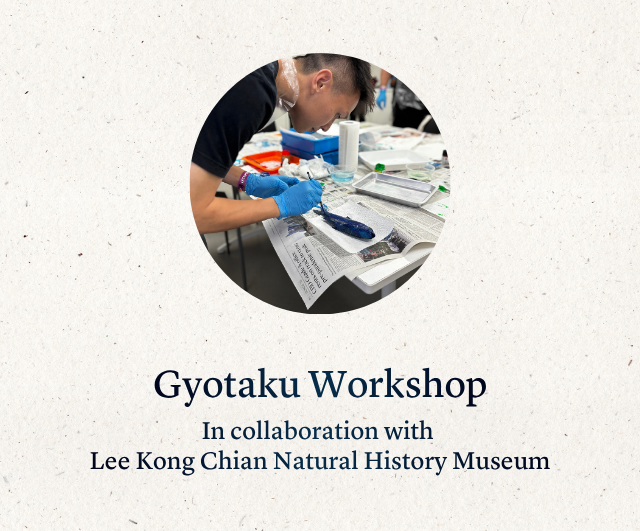
Over the following months, the programme continues with opportunities to create personal zines, experiment with cyanotype printing, explore traditional Japanese fish-printing techniques through a gyotaku workshop, and transform discarded textiles into personalised soft toys.
One particularly meaningful gathering, SENICIRCLE: THE OBJECTS OF US, invites participants to bring along an object and share the story behind it. Through conversations about the things we keep, leave behind and pass on, the session explores how personal belongings become markers of identity and connection.
Beyond the museum, the exhibition also extends into Singapore’s public libraries through Yussef Agbo-Ola’s Proposal for HOYA: 5 Lungs Temple. Inspired by the critically endangered Hoya wallichii plant and made using fabric derived from deep-sea plastic waste, the presentation considers how materials can carry memories and how remembering can become an act of care for vulnerable habitats.

Ultimately, Lost & Found: How We Remember is more than an exhibition about looking back. It is an invitation to think about the stories we inherit, the things we choose to preserve and the memories we will leave behind for others.
As you make your way through the galleries, you may find yourself thinking about a family photograph, a childhood memory, a familiar phrase or an object you have kept for years without quite knowing why. Perhaps that is the exhibition’s most meaningful takeaway: memory is not simply something that belongs to the past. It is something we continue to create, carry and share every day.
Lost & Found: How We Remember runs from 27th November 2026 to 18th April 2027 at Level 1, Gallery 1, Singapore Art Museum at Tanjong Pagar Distripark, 39 Keppel Road, Singapore 089065. General admission fees apply. Free entry for Singaporeans and Permanent Residents. For exhibition information, programme schedules and registration details, visit their website.

