
Gavin Yap and Sofia Jane take us on a haunting, dreamlike journey through the unreliable landscape of memory.
Duration: 60 minutes
KUALA LUMPUR, MALAYSIA — A woman begins recording, but is not entirely sure who she is speaking to. Is it a message to her future self, a conversation with someone else, or an attempt to hold on to memories that may no longer be entirely hers? This uncertainty lies at the heart of Jodi Gray’s Thrown, a play that resists a straightforward narrative in favour of a dreamlike world where memories overlap, voices take on lives of their own and personal experiences become entangled with those of others. It can be disorientating, even elusive, but in this staging by Superbear Productions, the thoughtful direction of Gavin Yap and the remarkable commitment of solo performer Sofia Jane make it a haunting experience.
The play begins before the audience even enters the theatre. In the lobby, visitors are invited to answer a question: “When did you know you were no longer a child?” Responses are written anonymously on notes and pinned to an installation, gradually forming a web of thoughts and recollections. Individual experiences merge into a collective picture, an apt introduction to a play concerned with how memories shape us and how easily they become entangled with those of others.
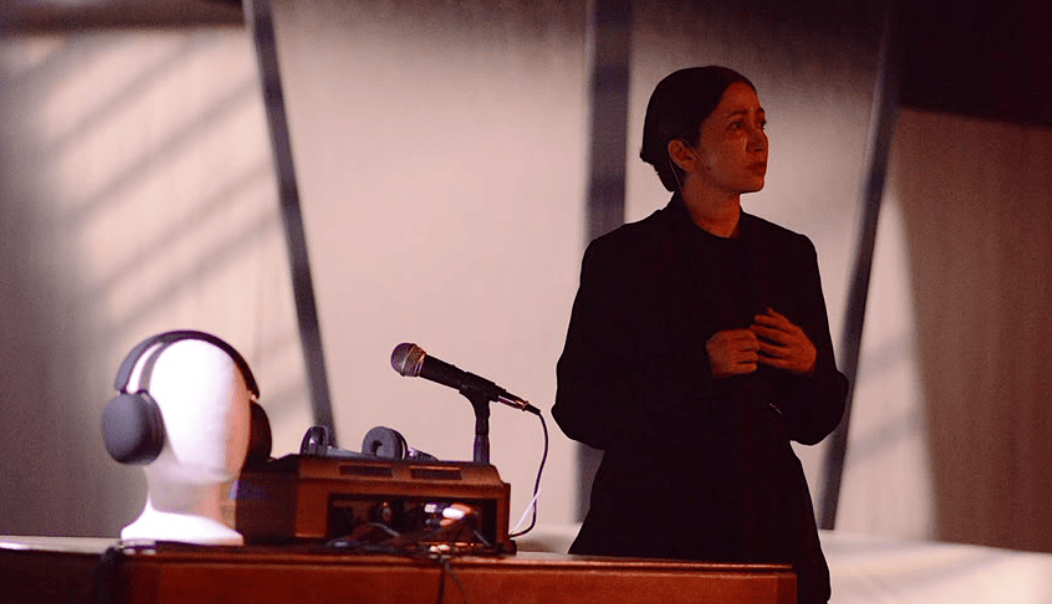
Inside The Studio, set designer Adry Nasution, with advice from Danny Koshy, has created an uncanny landscape from angular panels of varying heights and depths. Their muted, wood-toned surfaces appear subtly tilted and warped, while textured and translucent sections catch the light. Geometric pieces hang overhead like fragments of an unfinished ceiling, making the space feel at once enclosed and strangely expansive. A desk crowded with recording equipment and a pale sofa on a low platform hint at Constance’s professional world as a child psychologist, but the surrounding architecture resists any sense of realism. A transparent panel suggests an almost invisible boundary, while shifting beams of light cast patterns and shadows across the walls, at times duplicating shadows or silhouettes. The stage feels less like a fixed location than an expression of Constance’s unsettled inner world.

Sofia Jane appears dressed entirely in black, a departure from the white outfit seen in the production’s promotional materials. She moves around the space, at times seeming to wander as though searching for something. At the centre of the room sits a table laden with sound equipment, including a microphone, recording devices and a sculpted white head wearing headphones. The object serves as a visual reminder of the play’s preoccupation with listening, recording and the voices that inhabit memory.
Sound is integral to Thrown. Irena Taib’s composition and sound design weave together haunting, understated music, distant whispers, recorded voices and occasional bursts of crackling static. The effect is intimate and disquieting, as though fragments of thought are constantly surfacing and disappearing around the room. The original production used binaural sound technology, with audience members wearing headphones to hear voices moving around them, creating the sensation of being inside the protagonist’s head. That approach is not replicated here, so the experience is necessarily different. Nevertheless, the JCPAC production makes a concerted effort to evoke a similar sense of proximity through its soundscape, with sound engineer Derrell De Costa supporting the effect. This distinction matters because the play depends so heavily on sound to blur the boundaries between the person speaking, the people being remembered and the person listening.
Datin Sofia Jane’s performance is what carries the production. Adopting a clear, confident, almost British accent, she initially presents Dr Constance Ellis as an authoritative, mature professional. She begins recording almost like a late-night radio presenter, but appears uncertain about the purpose of the exercise and whom she is addressing. Is she speaking to herself in the future, or leaving a message for someone else? Even the pronouns become a source of hesitation. She considers whether to address a singular “you” before eventually settling on “we”.

This uncertainty establishes the peculiar logic of the play. It is tempting to interpret Constance’s recording as an attempt to preserve her memories before they disappear, perhaps in anticipation of some form of cognitive decline. Yet Gray’s script never settles into a straightforward account of her condition or her life. Constance moves between personal recollections and the stories of people she has encountered through her work, until the distinction between the two becomes increasingly difficult to establish.
As the performance progresses, Sofia Jane seems increasingly absorbed by these memories and voices, almost as though she is being taken over by them. She shifts between different identities, revealing a more vulnerable and uncertain figure beneath the psychologist’s professional authority, at times disturbed, and at others, even breaking down into tears. Some recollections feel distinctive, while others are strangely familiar, inviting the audience to recognise fragments of their own experiences. There is something haunting about watching an apparently composed adult become unsettled by the possibility that the experiences shaping her identity may not all belong to her. The play offers no easy answers about whether memories define us through what actually happened, what we believe happened or how we interpret those experiences over time.
Much of this is a credit to director Gavin Yap, who approaches the stage as a psychological landscape rather than a literal representation of Constance’s surroundings. He handles Sofia Jane’s performance with considerable sensitivity, allowing her to find the poetry in Gray’s text and move between its different voices and emotional registers without making the transitions feel overly theatrical. The audience may be lost in the story, but the production itself never feels directionless. Yap gives the performance rhythm and intention, even when the narrative refuses to provide a clear path.

His direction also makes the soundscape an active part of the storytelling. Voices and fragments of recollection seem to emerge from different parts of the theatre, surrounding the audience and unsettling the sense of where a speaker is located. Together with Taib’s sound design and Lim Ang Swee’s lighting, these elements place the audience inside Constance’s shifting consciousness, allowing its confusion and disorientation to be experienced rather than simply explained.
Lim Ang Swee’s lighting design further unsettles the space. Light and shadow respond to Sofia Jane’s movements, sometimes appearing to mirror her, sometimes enclosing her within sharply defined shapes. Precisely angled beams seem to trap her in an invisible box, while flashes of strobe lighting disrupt the audience’s vision. At moments, she paws at the transparent panel, as though encountering a barrier between herself and something just beyond reach. These visual details reinforce the impression of a mind navigating an environment that cannot quite be trusted.
One particularly memorable sequence takes the audience to the beach, where Constance recounts an experience involving a rough sea and ominous sky. There is a strange mixture of childhood wonder and underlying unease in the recollection. She repeatedly reassures the listener that everything will be all right, but the repetition does little to dispel the uncanny feeling. Instead, it raises an uncomfortable question about the promises adults make to children, and whether anyone can truly guarantee that things will be fine.
Through the interplay of voice, sound and movement, Thrown gives memories a curious temporal quality. They become places that can be revisited rather than events safely confined to the past. The audience is carried through different moments and perspectives, almost as though travelling through time, as if she is inside our head, and our minds somewhere onstage. It is an intriguing theatrical effect, even if the script occasionally makes it difficult to establish exactly where one memory ends and another begins.

That is ultimately both the strength and limitation of Thrown. Its fragmented writing and shifting perspectives evoke the unpredictable nature of recollection, but can leave the audience struggling to find a firm narrative thread. The play is more interested in atmosphere, sensation and emotional recognition than in resolving its mysteries. By the end, there may be more questions than answers, and the title itself remains elusive. Perhaps it refers to being thrown into adulthood, back into the past or into circumstances that shape us before we are ready. The production offers no definitive explanation.
Yet there is something compelling about the way it lingers. Sofia Jane’s measured, soothing delivery has an almost therapeutic quality, drawing the audience into a strangely calming experience even as the material becomes increasingly unsettling. It is rather like attending a therapy session in which the memories being uncovered belong to several people at once, and the person guiding the process is not entirely certain of her own recollections.
Thrown may not be the easiest production to make sense of, but its dreamlike atmosphere, thoughtful soundscape and Sofia Jane’s absorbing performance give it considerable emotional pull. Not every moment lands with equal force, and the narrative’s elusiveness may frustrate audiences looking for clarity. But as an exploration of the unstable territory between memory and identity, it leaves enough behind after the lights go down to make the journey worthwhile, one that we continue to puzzle and ponder over, as we untangle our own memories emerging in the wake of such an oneiric experience.
Thrown plays from 20th to 29th November 2026 at The Studio@JCPAC (Jeffrey Cheah Performing Arts Centre), Sunway Square, Kuala Lumpur. Tickets available here
Production Credits:
| Playwright Jodi Gray Director Gavin Yap Producer Trina Tan Cast Sofia Jane Music Composer / Sound Designer Irena Taib Set Builder / Designer Adry Nasution Set Advisor Danny Koshy Lighting Designer / Operator Lim Ang Swee Costume Designer Shaleen Cheah Sound Engineer / Operator Derrell De Costa Production Manager Sandie Lee Stage Manager Tarrant Kwok Assistant Stage Manager Nicole Cheah Props Master Eddy Sih Technician Boy, Sky, Luqmannulhakim Kadir, Da Liang, Asyraf Stage Crew Malini Additional Guest Voices Jo Kukathas, Anne James, Mia Sara Shauki, Layla Sari, Irena Taib, Tarrant Kwok |

