
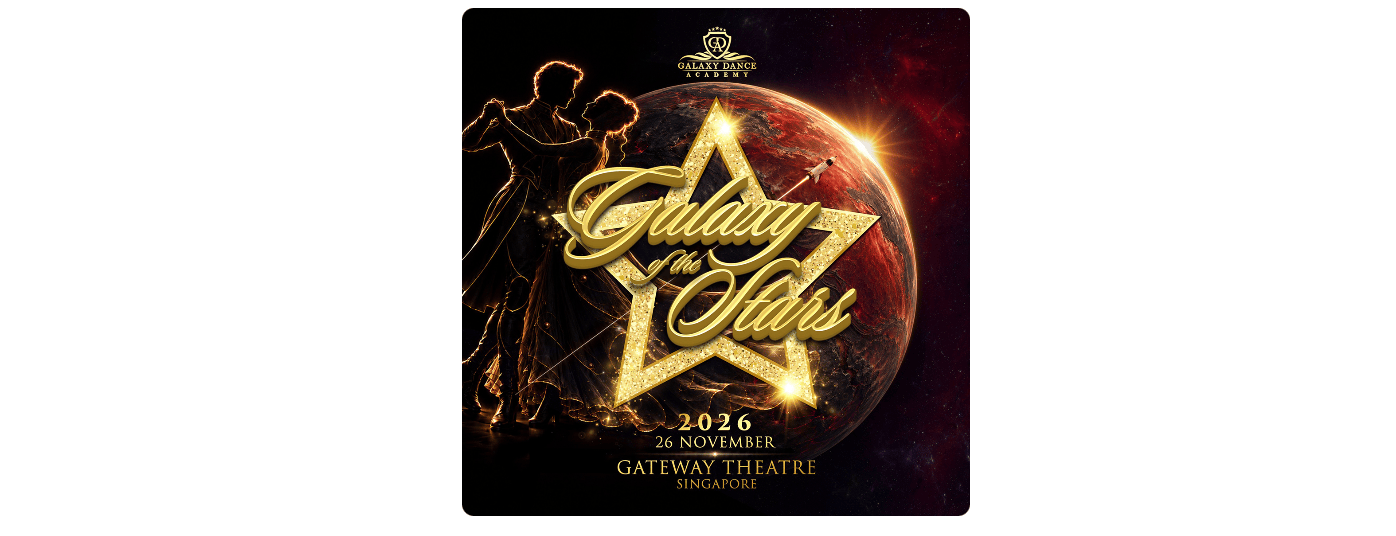
Galaxy Dance Academy’s 2026 Galaxy of the Stars was a fun, colourful evening of ballroom and Latin dance, wrapped in an interplanetary adventure. More than just a conventional dance recital, it was an inventive way of presenting the academy’s work, using technology, imagination and theatrical storytelling to bring together a rather diverse group of performers.
Staged at Gateway Theatre, the production used AI-generated video sequences and backdrops to take the audience on a journey through 28 faraway worlds. The academy’s leads and teachers played the roles of astronauts, guiding their mega spaceship from one destination to another, with each planet introducing a different dance style, musical theme or theatrical interpretation. It was a clever way of giving the evening a narrative thread, turning what could otherwise have been a long succession of dance performances into a journey of exploration. The stage itself was relatively bare, so the GenAI visuals did much of the work in establishing the atmosphere and transporting the audience from one planet to the next. It was a rather refreshing and innovative approach to putting together a dance showcase, and gave the production a distinctive identity.
There was also quite a substantial cast behind the production. Some 118 students, ranging from just five to 76 years old, took part in the 28 acts, after four months of preparation and rehearsals. And these were not professional performers brought in to fill the stage. They were largely ordinary people: children, working adults, parents and retirees who make time for dance lessons around their everyday lives, giving the evening a rather different purpose from a professional dance production or competitive DanceSport event.
With 28 acts, there was certainly plenty to see. What was particularly noticeable was the sheer variety of performances. The programme moved between traditional ballroom, Latin rhythms, contemporary dance, musical theatre, novelty numbers and more theatrical show pieces. There was no attempt to make every number look or feel the same, and that made for an entertaining evening.

The opening sequence, Can’t Stop the Feeling, was a cheerful little number featuring children and younger students in an assortment of colourful outfits, bringing plenty of youthful energy to the stage. This was followed by a Beetlejuice-inspired duet, an entertaining combination of comedy, romance and theatrical flair. There were also more traditional ballroom moments, such as the men in suits and ladies in white dresses dancing to Moon River, and a foxtrot that brought a touch of old-fashioned elegance.
Other numbers leaned heavily into visual themes and costumes. There were Spanish-inspired pieces with dramatic black costumes, colourful carnival outfits, jungle-themed performances and even a pop-inspired number at Dubhe that stood out as one of the better pieces of the evening. On another planet, a Phantom of the Opera-inspired tango brought a more dramatic, theatrical quality to the programme and was another highlight. Chinese fan work added a different visual dimension to one of the waltz-themed performances.
The Chicago-inspired Cell Block Tango was another particularly enjoyable number, with its strong characterisation and stage presence. Finishing with When You’re Good to Mama was especially effective, bringing a good dose of musical theatre attitude and personality to the stage as the ladies moved in sequence. It was one of those performances where the dancers clearly understood that it was not just about executing the steps, but also about selling the character and the story.

One of the more interesting aspects of the production was how well the different levels of dancers were integrated into the programme. There was a healthy mix of experienced performers, competitive dancers and professional coaches alongside complete newcomers, including young children and older adults who were perhaps less confident or still finding their feet on stage. Rather than making the difference in ability too obvious, the programme balanced these groups quite thoughtfully. The stronger dancers were given opportunities to shine, but the less experienced participants were also given their own moments in the spotlight.
You could see that the choreography, music and arrangements were tailored to suit the different groups. The beats per minute were adjusted accordingly, with slower tempos and more manageable arrangements for some of the older or less experienced dancers, while the more advanced groups were given faster, more demanding material. It was a sensible approach that allowed everyone to participate without making the less experienced performers feel out of their depth. Importantly, it did not make the evening feel like a series of watered-down performances. Each group had its own character and purpose within the larger programme.
The pacing was another notable feature. The numbers were generally quite short, sharp in their flow, with one performance moving quickly into the next. The overall tempo of the evening was fast and furious, but in a good way. There was very little opportunity for the programme to drag or for the audience to lose interest. Each act made its point, delivered its particular style or theme, and moved on. The academy seemed quite disciplined about sticking to the timing rather than stretching performances unnecessarily. The result was a show that kept moving and rarely had a dull moment.

It also meant that the audience got to see just how many different styles, musical interpretations and performance formats the academy could put together. Rather than concentrating on a handful of elaborate productions, Galaxy opted to give us a succession of bite-sized performances, each with its own identity. It was an effective way to showcase the breadth of what the school teaches and the range of talent within its student body.
Towards the latter part of the evening, however, the team began bringing out the big guns. What a Wonderful World, set to a waltz beat, was one of the loveliest moments of the night, with Mikhail naturally taking centre stage in an emotional duet. It was a welcome change of mood and one of the evening’s standout performances. Despite the deceptively slow music, you could appreciate the precision, control and strength required to make the choreography look so effortless. There is something about watching an experienced performer command the stage with such confidence and ease. It was a reminder that beyond teaching and choreographing, the academy’s principals are accomplished performers in their own right. In many ways, this was perhaps the most life-affirming sequence of the night.
The mood shifted dramatically with Requiem for a Dream. Moving into much darker territory, the contemporary number used shadows, dramatic movement and intense choreography to explore themes that suggested darkness, struggle and addiction. This was where the academy brought out its heavier hitters. The movements were more ambitious, the emotional intensity considerably greater, and the dancers had the experience and technique to carry the weight of the piece. It was arguably one of the most compelling performances of the night, and a noticeable step up in terms of artistic ambition and execution.

The subsequent Canis Majoris number continued the sense of scale, with Mikhail and two other dancers taking on a much bigger performance. By this point, it was quite apparent that the academy’s more experienced dancers and teachers were being featured across several acts, helping to anchor the programme and provide some of its strongest moments. It was also a nice way to build towards the end of the evening, allowing the audience to appreciate the difference between the students’ performances and the level of artistry and technique that the academy’s professional team brings to the stage. Meanwhile, the students themselves were in the audience, cheering their teachers and mentors on. It was a nice reversal of roles and a reminder that there is a real community behind the school.
The grand finale on Andromeda, featuring numbers like Billie Jean and Fergie’s A Little Party Never Killed Nobody (All We Got), brought the evening to a suitably celebratory close. Having everyone return to the stage for the final number was a lovely touch. It was a chance for the entire cast, from the youngest students to the more experienced performers and teachers, to share the spotlight one last time. After following the journey through all those planets, it was a fittingly energetic way to bring the spaceship home.
Founded in 2009 by Mikhail and Olesya Eremeev, the academy has its roots firmly in the competitive DanceSport world. The couple have represented Singapore on the international circuit, earning championship titles across the region and reaching the world’s top seven at the 2019 WDC World Professional Showdance Championship in Vienna. Their professional credentials are considerable. But this showcase was not just about displaying their champions or demonstrating technical excellence. It was equally about giving ordinary students, young and old, experienced and inexperienced, the opportunity to perform alongside them.

There is something rather encouraging about seeing someone who may have started dancing as an adult, or a child still learning to find their confidence, sharing the same stage as a world-class coach. The more experienced dancers and teachers provide the inspiration and set the benchmark, while the newcomers get to experience what it feels like to be part of a proper production. And after four months of rehearsals, having 118 students finally perform in front of an audience of 467 must have been quite a rewarding experience for everyone involved.
Galaxy of the Stars was an entertaining voyage through the galaxy, full of enthusiasm, variety and some genuinely memorable moments. Its greatest achievement was perhaps not any single performance, but the way it brought together such a wide spectrum of dancers and abilities into one cohesive evening. There were stars of different sizes and brightness along the way, but everyone had a chance to shine. And sometimes, that is the most important part of the show.
Photo Credit: James Fong
Galaxy Dance Academy is located at 9 Purvis Street, #02-01/02/03, Singapore 188588. Find out more and sign up for classes here

