
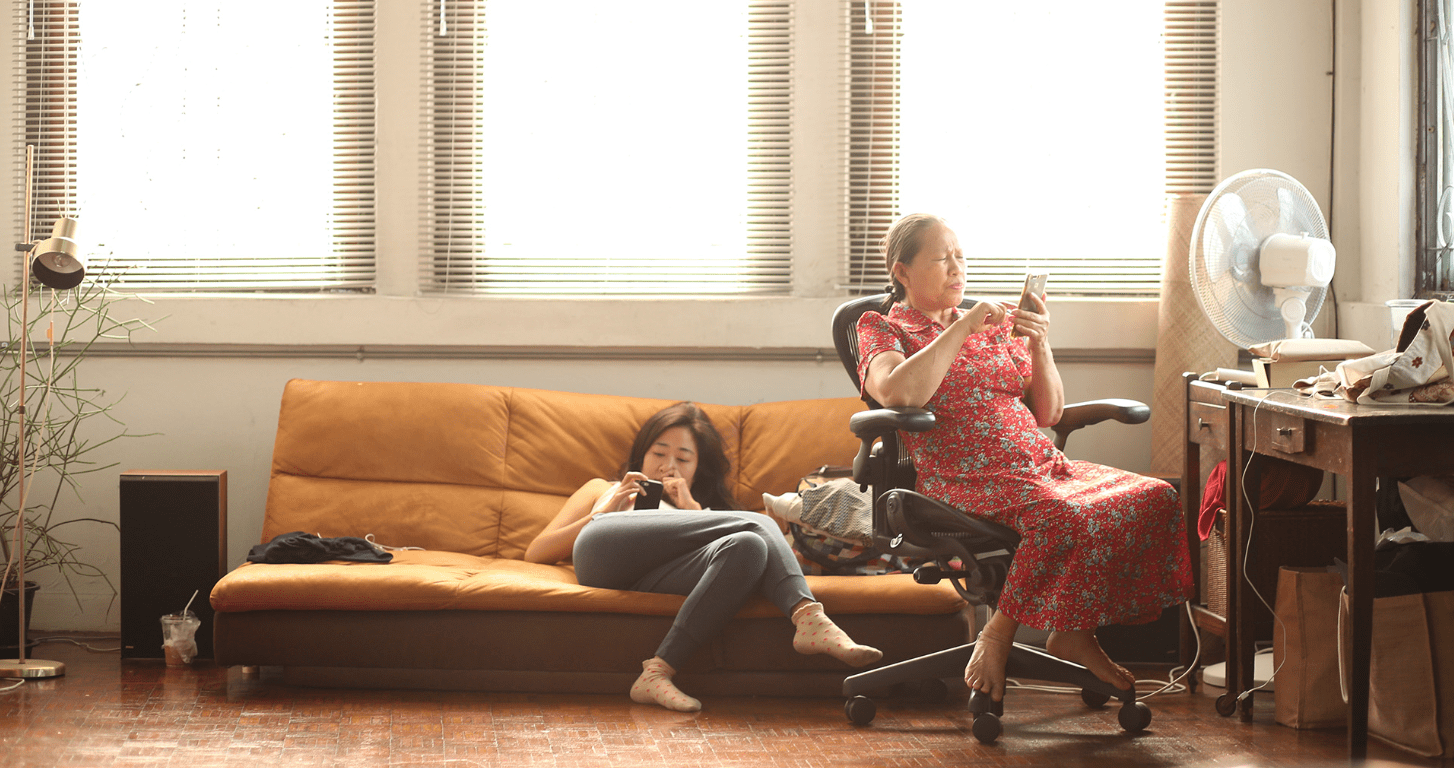
In INTERMISSION, traditional Thai music and contemporary dance practice intertwine to examine the body as a political site and the sociopolitical power of dance. Stuck in the state-enforced past and unable to see the future of his own country, choreographer Thanapol Virulhakul proposes Thai postmodern dance as a method to navigate Thailand’s socio-political power structure that infiltrates all areas of a citizen’s life. A single dancing body portrays how political power relates to each individual.
Bringing together veteran Thai folk music master Champa Saenprom and contemporary dancer Vidura Amranand, Thanapol directs them to diverge and merge, and dig deep and assert the potential of art as resistance against the powers that be. Speaking to Thanapol, we found out more about the concept behind the work, Thai politics, and the Thai dance scene. Read the interview in full below:

Bakchormeeboy: What is the origin behind the name of the work, “INTERMISSION”?
Thanapol: It came from when I thought about the political situation in Thailand, which has resulted in the stagnation of time. It is hard for me to envision the future of Thailand as a citizen of this country. I feel like the flow of time in Thailand does not run as regularly as it should do. Additionally, my personal fascination with time within the context of performance led me to explore the elements of time in my previous works. An intermission popped up in my mind; a period during a lengthy performance when time is suspended. It exists within the performance event yet is not considered part of the actual performance. This notion resonated with my perception of Thailand being in an intermission phase, a liminal time.
Bakchormeeboy: Could you explain your working process? How do you begin conceptualising the work, and then at what point do you start thinking of music and movements, or is it a more collaborative process with your creative team?
Thanapol: I always start the working process in a lab to explore the possibilities of this performance. I invited two performers, Vidura (a contemporary dancer) and Champa (a veteran northern-style folk singer), in a game-like structure that I devised to witness their interactions.
Within the lab, I found out that two of them are totally embodying different time and space in their bodies. Champa grew up in the rural area of northern Thailand when the country was under development, while Vidura grew up abroad in Canada and the United States, not in Thailand. This led me to question where could they truly meet on equal footing without any advantage from both of their backgrounds?
Soon after I realised the dance technique Vidura embodied, which was rooted in the “post-modern dance movement” she encountered during her studies at Sarah Lawrence College in New York. The missing puzzle piece I was searching for started to fall into place; the time that never exists in Thai history of Dance. I wonder: What if Thailand had its own version of postmodern dance? What would it look like? How would it fit into the dance history and social context of Thailand?
From these questions, I started to research more about the dance history in Thailand, and compare it with the developments in New York during the 1970s. As part of my process, I often gaze out of the dance studio windows to look further established dance techniques in the art fields and observe the movements of ordinary people in society. Far beyond discovering pedestrian and gestural movements, there are specific embodied practices taught or enforced within the Thai educational system. So I decided to use these distinct dance forms and their contexts as the key materials for my work foundation.
The key aspect was imagining that I had only experienced and learned these unique movements, making them my sole dance technique. What can I do with it to create Thai postmodern dance? And yes, the process to create this work is more collaborative in the sense of trial and error on various possibilities. I would ask the team to try on things, play some choreographic games, react to prepared prompts, etc.
Bakchormeeboy: Knowing how sensitive tackling such an issue can be, was there any difficulty or fear in presenting such a work, especially when it comes to backlash and criticism?
Thanapol: Fear is in the air in Thailand as it is a part of me on many levels, both consciously and unconsciously, But as an artist and a Thai citizen, I believe that this very fear and difficulties have driven me to create works that initiate a dialogue with the established powers, particularly concerning body politics and biopolitical matters.
Bakchormeeboy: How much support is there for contemporary dancers in Thailand? Is there a robust scene where dancers can find a way to succeed, or is it very much a struggle for artists?
Thanapol: I would say none. If you look at the dance ecology in Thailand, nothing seems to nurture a dancer or a dance artist to survive at all. There is no support from the government, even though they have an organisation to take care of contemporary art, but accessibility to resources doesn’t seem to be as good as it should be. Most of us have another job to earn a living; forget about being a dance artist full-time.
Bakchormeeboy: Dance is a very pure form of expression, but how effective do you think it is in terms of actually creating change?
Thanapol: I believe that even though dance is a very pure or more abstract form of expression, within its fabric it embodies indescribable parts of each society, especially socio-political contexts that are engraved in the body. Shortly speaking, the body is one of the political sites, where choreography acts as a form of governance. Each body, as a citizen, adheres to a set of rules, regulations, cultural norms, and systems—essentially living under this choreographic framework continuously. We live under this form of choreography all the time. As a dance artist, I think dance can create change and engage in a dialogue that challenges established choreography or dance forms. It serves as a means to negotiate, exploring new pathways and perspectives while pushing the boundaries of the established choreography of power aforesaid
Bakchormeeboy: At the heart of it, even if audience members don’t fully understand the circumstances of Thailand, what kind of impact do you hope to have on them?
Thanapol: When they experience the performance that was created within a country deprived of freedom of expression due to peculiar laws that contradict human rights, I hope the audience can, at the very least, be deeply moved and feel something profound.
Bakchormeeboy: How do you feel your work ties back to the festival’s theme of ‘Some People’?
Thanapol: The work is quite heavily leaning towards its locality contexts, which automatically ties the work with the theme “Some people” Within this work, it will be the first time for an international audience to experience various overlooked dance forms that exist and have been practiced in Thailand. Even in Thailand, these forms of movement are never considered a part of the Thai dance landscape, especially as an art form, but it’s funny enough that most of these dance genres have been widely practiced, taught, and even supported by the Thai government.
INTERMISSION plays from 2nd to 3rd June 2023 at the Drama Centre Black Box. Tickets available here
The 2023 Singapore International Festival of Arts runs from 19th May to 4th June 2023. Tickets and full details of programme available here
 Bakchormeeboy