
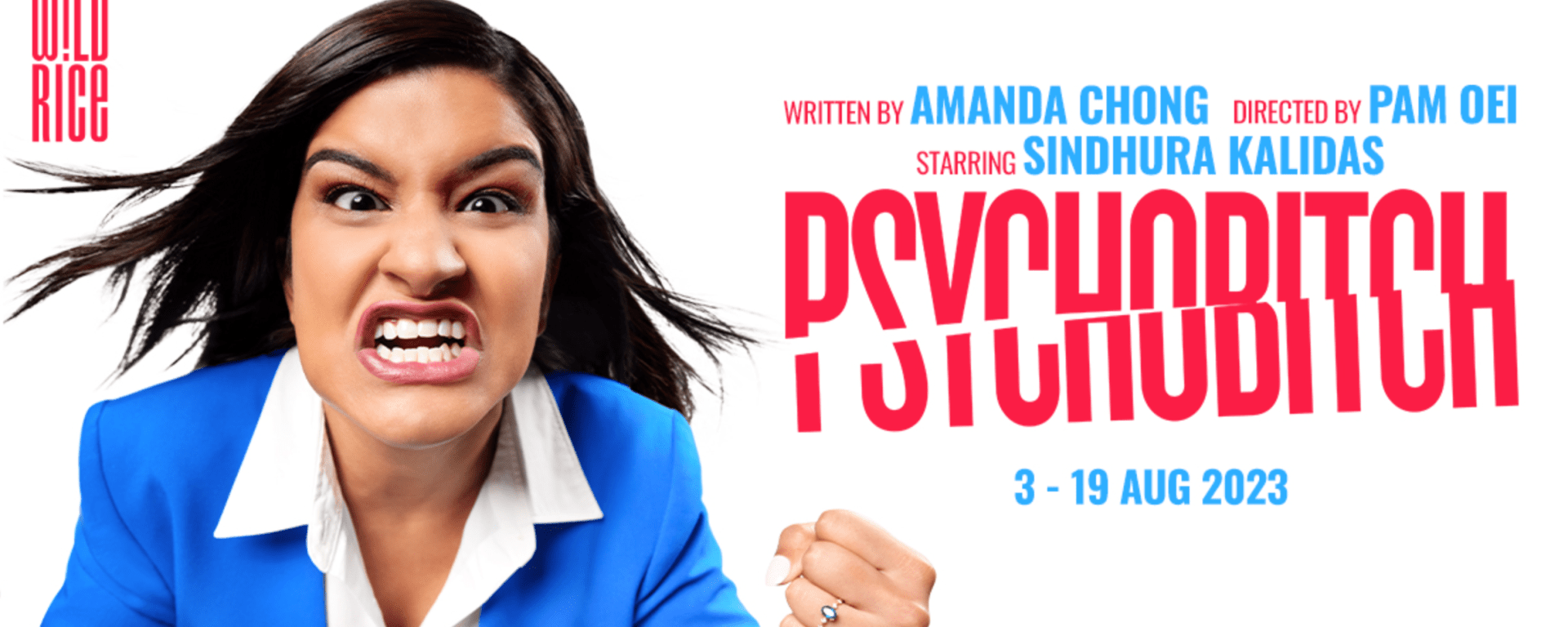
With a title like ‘Psychobitch’, you can be sure that playwright Amanda Chong has no qualms about turning heads and making a statement when it makes it formal premiere this August.
Presented by Wild Rice, Psychobitch is now receiving a full-scale, professional production after a dramatised reading last year, as part of The Necessary Stage’s Playwrights’ Cove developmental playwriting programme, and promises raw emotion, plenty of humour, and more than a few relatable moments likely to strike a chord with anyone who’s ventured into the shark-infested waters of the Singapore dating pool.
Speaking to Amanda herself, who prior to this, has been better known for her poetry, philanthropy and law career, she tells us more about her segue into theatre and the power of writing. “I did purposely choose the provocative title Psychobitch, because I wanted people to come in with this preconceived notion of what a play would be like, and then subvert that initial thought over the course of watching it,” says Amanda. “Audiences watching the show may come in and clearly see our protagonist Anya Samuel as the titular ‘psychobitch’, but we slowly end up deconstructing that term, and end up feeling something completely different instead.”
“I don’t want to make it didactic though, because I’m not here to tell you what to think, and I don’t want to infantilise my audience,” she adds. “This isn’t a fable with some moral at the end of it. There are enough complexities and tensions and contradictions to reflect on, without shoving a message down your throat. I have respect for my audience that they get to decide what direction they want to think in, and use the play as an opportunity to expand the mind rather than narrow it.”
Directed by Pam Oei, Psychobitch stars Sindhura Kalidas as Anya Samuel, a type A personality, over-achieving journalist with absolutely no chill. But even though she seems to have it all, when her tech CEO fiancé accuses her of being “too emotional” and tasks her to explain the four times she has cried in public since they started dating, Anya prepares an entire slide deck to defend herself and plead her case, all in a bid to save this relationship.
As ridiculous as it sounds, Psychobitch is quite literally based on Amanda’s own experiences, where she did have a boyfriend who demanded she justify her emotions, to which she responded with a 30-page, colour-coded presentation. “In the moment, it was very intense and serious, but when I look back at it, it’s really just so funny,” she says. “It’s tremendously healing for me to be in the theatre and hear the audience reacting at certain junctures, because it’s like an entire room of people empathising and commiserating and crying with me as we relive what happened to me together, and few things in the world more magical than that.”
“I was mentored in poetry by Cyril Wong, and he said something that has remained ingrained in me till today – the greatest gift for audiences is emotional honesty,” she continues. “It’s tough, taking something so real and raw out of yourself, but also, in a strangely paradoxical way, the more specific you are about your own pain, the more universal it becomes, as compared to being vague and general where the experience becomes reduced to a cliché instead. I’m someone who has a lot of emotions, I mean I wrote a whole play called The Feelings Farm after all. I have self awareness about these feelings and very analytical about them, and that’s why in every work I create, I put a lot of vulnerability on the line, and you see that come out quite clearly in Psychobitch.”

Besides her own experiences being an inspiration, Amanda also specifically wrote the play for Sindhura to perform in, and someone who she counts as not only among her closest friends, but also immensely talented. “Sindhura was telling me that there really aren’t enough complex, meaty roles for brown women in local theatre, and that got me thinking, why not I write you a role then?” says Amanda. “It’s a win-win situation – she gets a good role, and I’d have ended up creating work for her that I’ll then get to enjoy watching her perform onstage because I respect and love her ability to perform as a good actor.”
“The moment I wrote my first scene, I sent it over to her to make sure she was ok with it. There are so many challenging scenes where there can be as many as three characters at once that she has to juggle, but she assured me she could handle it,” she continues. “It’s especially exciting because it’s written like how friends would tell you stories, and they use their own voice to imitate other people involved, rather than just using reported speech, so you end up having the audience really entering that memory fully with her. And most of all, I trust Sindhura entirely, where I basically know her entire dating history, and we even went to Vietnam together once on a cathartic, soul-searching post-breakup trip.”
Amanda is also a very sensitive writer, and does her due diligence considering she’s a Chinese woman writing an Indian character, and fully accepts that it is an area she needs to consult with the ‘experts’, or actual Indians who can help her make her play even more authentic. “When you’re telling stories that matter you have to be sensitive and nuanced, and that means you have to listen to the people you’re writing about, and respect the community,” says Amanda. “I did interview Sindhura on what it means to be a Tamil woman, and her own experiences being in a mixed race relationship, while I’d also get my Tamil Christian friends in church to vet the script, like if the Tamil hymns used in the show were correct or how certain things would be said. I want to do justice to and honour the community, and that comes from doing what I can do maintain that authenticity.”
“I think the moment I decided the character was going to be Indian, there was already an added weight to the power structures she has to deal with, and it became a lot more fraught and had more things to unpack,” she adds. “We want to create a universal story, but that story also happens to be told by a brown woman who’s the star of the show. You don’t have to be brown or to be a woman or Christian for this story to resonate with you, because there is something real and authentic to this story that is in itself universal, beyond her gender or the colour of her skin that you can and will connect to.”
Amanda isn’t one to limit herself to any one specific type of writing, which explains her ability to traverse multiple mediums. “I was always an ardent fan of local theatre since I was a teen, so that’s maybe 20 years I’ve been watching theatre now,” says Amanda. “The more you watch and read, the more you develop a sense of taste as to what you think is good, and that determines what you end up putting into your own work, and what you’d steer away from. And what I’ve found is that I’ve always resonated with emotionally authentic narratives, with characters so fully fleshed out that you feel they could be your friend.”
“On a larger scale, writing is a necessity for me. It’s the way I process my emotions and the world around me, the way I take the pain of something that happened to me and turn it into something beautiful,” she continues. “For me, it’s a deeply sacred and spiritual act, and I do it because I want to be able to create emotionally resonant work with the set of experiences I’ve been given, in all the joys and tragedies and pain, and hopefully provoke people to think more deeply and provoke change.”
Amanda recalls her own writing journey starting way back since she was a teen, looking up to local playwrights like Jean Tay (Boom, Everything But The Brain), a female writer in an era where most of the major playwrights were men, along with her wit, sophistication and authenticity. Meanwhile, her love for SingLit also extended into poetry, with admiration for poets such as Cyril Wong. And of course, Amanda also harbours deep admiration for writers who manage to juggle multiple mediums, such as Alfian Sa’at, who even allowed her to expand and perform his play Yesterday My Classmate Died into a 2 hour work during her teenage years.
“It just seems like something so kind to allow a child to do to your work you know, and he even came down to watch the production when we put it up,” says Amanda. “And it makes sense in a way, that poets naturally segue quite well into playwriting too, since poetry is all about having awareness of cadences of language and rhythm, which comes into my own playwriting, or how poetry is focused so much on imagery, while Psychobitch, as a monologue, is also heavily reliant on words to illustrate a memory, all to tell a story and be selective about the details that you don’t go overboard and allow your audience enough space to imagine.”

In short, Amanda showcases strong control and mastery over her words and knowing exactly what kind of effect she hopes for them to have on her readers, something that became crystal clear when she won first prize at T:>Works’ 2021 24-Hour Playwriting Competition with her play #WomenSupportingWomen. But even with that raw talent, Amanda didn’t have any formal playwriting training, leading her to seek out mentorship and guidance – in the form of Playwrights’ Cove.
“Haresh (Sharma) is a really generous mentor, and I ended up tapping on his wealth of experiences working on one-person shows, always asking him questions and for advice,” says Amanda. “And it was very flexible too, because while most of the participants were working on plays with multiple cast members, I was doing a monologue, and Haresh let me adjust some of these playwriting exercises accordingly to help me with my own script. There was great stimuli, where I thought about new angles and content, and most important for me was being part of a group of young playwrights also getting their start in the scene, which helped create this sense of community, critiquing each other’s work and growing together and developing our craft.”
While the previous dramatised reading version of Psychobitch was already very impressive, even with about 6 hours of rehearsals, this time around, with Pam Oei at the reins and Wild Rice’s backing, Amanda is excited about what she’s brought to the table. “Yagnya (the previous director) was lovely to work with because she’s a Tamil woman, and you can see how there are certain things she gets that I don’t that she directed for Sindhura last time,” says Amanda. “With Pam, I have so much admiration because she’s this actor with such a commanding presence onstage, where the moment she speaks you pay attention, or already gear up to laugh if she’s in comedy mode. It was important to still have a female director, because there are so many experiences in the play associated with being a woman, and I believed that Pam, as a veteran performer who has also done one woman shows, could really mentor Sindhura.”
On the differences between the poetry and playwright community, Amanda expresses how there are both pros and cons, but immense appreciation for both. “One thing poetry trains you in is the realisation that there will be people who simply won’t connect with your work, and not to take it personally,” says Amanda. “You learn to choose to filter the feedback that you really need, from people who know their stuff, who’re really experienced, and for anyone who’s just starting out in the field, the more expert feedback, the better.”
“I think that appreciation also stems from how I identify as a perfectionist. There’s a line in Psychobitch that goes ‘I make pursuing excellence an extreme sport’, which is something I do need, not necessarily to be the best, but the best I can be,” she adds. “I have this desire to do well in things I’m passionate about and finding meaning in, whether writing or law, and will put my 200% into it. I still have to brace myself for when people don’t receive my work well, because it sometimes still feels like I end up disappointing people which puts a weight on my shoulders and is very mentally taxing. I’m just glad I have a very good support circle around me who I can be completely authentic with and are still there when I’m at my worst, who’ve seen the real me and helped me through these challenges in life.”
“Admittedly, it’s a lot more lonely being a poet than a playwright, because when I put out poetry, it’s really the result of me sometimes quite literally sobbing on the floor in my bedroom. But it ends up being read by family or a small group of friends, and then strangers in the privacy of their rooms who may message you to say they liked it,” says Amanda. “But it’s not a communal experience, unlike in theatre, where everyone comes together to make what you imagine into reality.”
“There is so much generosity in that from other artists and designers, the actor the director, banking their own skills on your story and using their talents to elevate it, and then when audience members comes in, they also experience that show together. There’s nothing quite like being there in the room with them, seeing how they’re reacting and how they come back to talk to me after the show.”

On whether the battle of the sexes still exists in Singapore, Amanda draws from her experiences being a sex crimes prosecutor for about half a decade, and expresses how it’s unfortunately still very much a problem. “The sheer number of sex crimes we see could be a barometer of how we are as society, where so many women still deal with harassment or even assault. A lot of the time, it stems from this belief that women are ‘inferior’, whether physically or in terms of status, and therefore men can take advantage of them and exploit them,” says Amanda. “And that’s why I’m so concerned with putting these issues and experiences of women onstage. If this can happen even to privileged women, then what about those less so? I honestly would like more men to come and watch Psychobitch, and really partake in these conversations around gender and society.”
“It really is quite scary that there’s this backlash and we’re seeing a rise in more vocal ‘incels’ around the world. That’s why it’s even more important for us to speak out and even louder about it,” she adds. “As of now though, I’m focused on portraying problems with men from the perspective of women, with both #WomenSupportingWomen, Psychobitch and a third play in the future. These women endure the oppressive dynamics of men, but in Psychobitch at least, Anya also gets to tell the story from her point of view, and by doing that, it gives her some kind of agency and choice. In being so confessional onstage, in treating the audience like her confidant, I hope audiences see something in themselves in her, maybe even cry, even if they’re men!”
Ultimately, beyond the accolades, the fact that she’s a writer, and her decorated career, who exactly is Amanda Chong? “As an artist, I do think it’s important to have a clear sense of your self and what you want to say. I think that anchors you a lot, because you know your voice and what’s the point you want to get across,” says Amanda. “I do recognise that we’re always evolving and changing as people, but there’s a part of me that has always been the same ever since I started this journey as a writer, and that’s wanting to give my best to my readers and my audience by being emotionally authentic. And the one thing I do want Psychobitch to have audience members thinking about is how deeply ingrained this desire to be fully known and fully loved is within every human being, whether we try to find it in romantic relationships or elsewhere.”
“I have so many rich beautiful experiences of unconditional love from family, friends and faith, and I don’t think I would have experienced any of that if I hadn’t gone through these terrible relationship experiences. And I guess that’s what I hope for everyone around me too, in that I hope they can feel safe and comfortable enough to be fully themselves, and to never have to struggle to ever feel worthy of love,” Amanda concludes. “I’m reminded of this Bible verse, Isaiah 61:3, ‘he will give beauty for ashes’, where even though it was painful back then, I see the beauty in it now, and there is no better redemption arc for me than to be in the theatre and see my words come to life, and to feel the entire audience rooting for this version of myself when I hear the laughter and the tears.”
Photos courtesy of Amanda Chong
Psychobitch plays from 3rd to 19th August 2023 at the Ngee Ann Kongsi Theatre. Tickets available from SISTIC

