
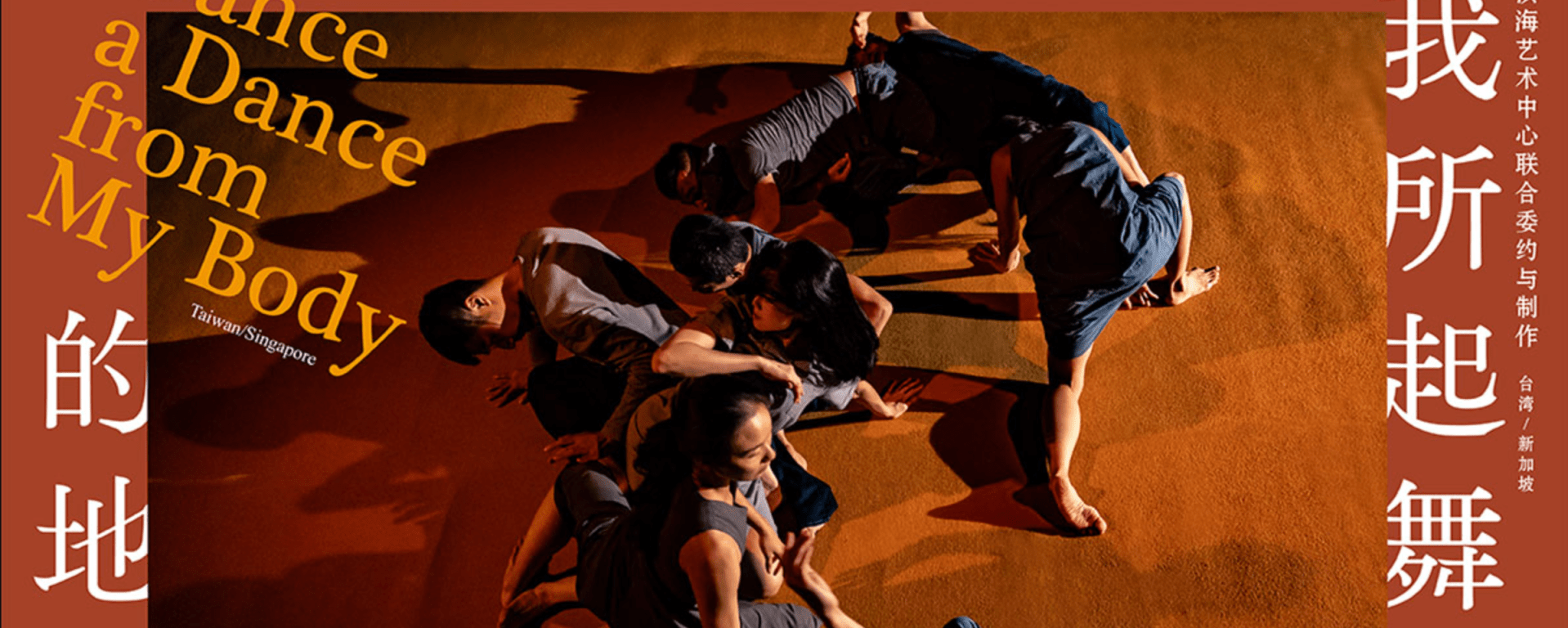
For a co-production that’s been engineered by two of the biggest arts centres in their respective cities, the Esplanade – Theatres on the Bay and National Kaohsiung Center for the Arts Weiwuying, choreographer Chou Shu-yi has been given plenty of free rein to explore a rather unique collaborative style of work for his upcoming production Dance a Dance from My Body, which makes its premiere at the 2024 Huayi – Chinese Festival of Arts.
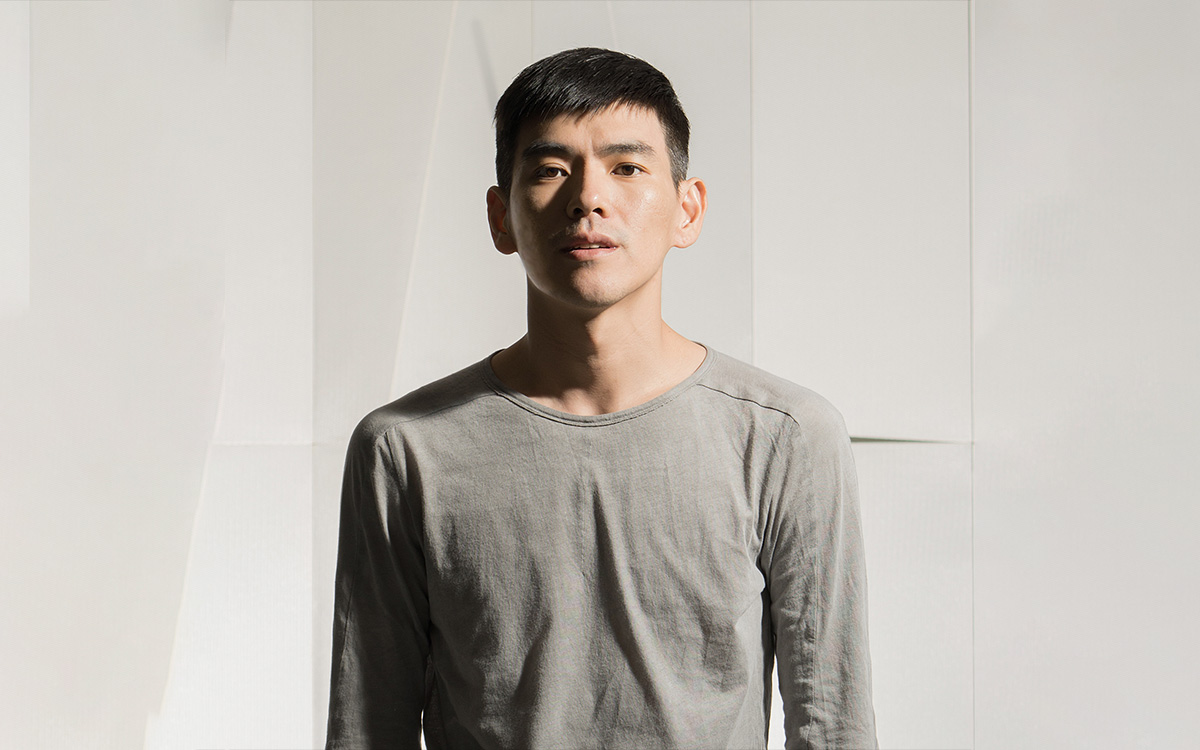
An Artist-in Residence at National Kaohsiung Center for the Arts (Weiwuying) since 2020, Chou is no stranger to Singapore, and last presented Almost 55 at the 2020 edition of Huayi, just before the pandemic hit the world in full force and we went into lockdown. But even during that short time here, Chou made his presence felt, guest teaching a few classes at local companies such as Sigma, when his idea for Dance a Dance From My Body emerged.
“I was thinking a lot about how an Asian person is perceived in different places, and whether there are perceivable differences, and what they are,” says Chou. “When I returned to Taiwan, I thought about a potential collaboration with Singapore, where I would be exploring the links, parallels and differences in experience between the two regions through dance.”

From there, Chou scouted out Taiwanese dancers Cheng Chih-chung, Liang Chun-wen, Yang Ya-chun, Yu Yen-fang, and brought them to join Singaporean dancers Chiew Peishan, Chua Chiok Woon, Hong Guofeng, Ng Zu You, and Tung Ka Wai in an intense, two phase development process, with all the collaborators initially rehearsing intensely for eight hours daily, five days a week in Singapore.
“All these dancers come with their own background and practice, but come into the project as individuals, with their own stories. A huge part of the developmental process was bridging the gaps with language and training, and a lot of time was spent getting to know each other, and experiencing all those differences firsthand,” says Chou.

Chou cherishes individualism and stories – Almost 55 was after all, a full-length autobiographical solo work performed by and charting the life of dancer Qiao Yang, using dance to chart key moments in her life and career. In the case of Dance a Dance From My Body, Chou uses his experience to lead his dancers in a process of self-discovery; among the dancers for example, are Cheng Chih-chung (Taiwan), Liang Chun-wen (Taiwan) and Tung Ka Wai (Singapore), who identify more as theatre practitioners, and Chou instead allows them space to explore the unique possibilities their bodies offer, rather than comparing them to the professional dancers or seeing them as limited.
“Each of these dancers come in with their own stories, and through the conversations and rehearsals, I prioritised them getting to showcase and share such experiences, and how they felt in foreign places, or differences in something as innocuous as say, how we learn numbers when we were younger,” says Chou. “One thing that stood out to me and underscores a lot of the process is ancestral history, where they consider the source of their values and beliefs, stemming from their parents or even further back, to our forefathers in China, which then became a key element whenever we exchanged stories.”

Migration and the ebb and flow of identity then becomes the driving force behind the work, as it explores the splits and divergence, where the individual body carries an entire line of familial history and its evolution across time and space. It is only by understanding our relationship with land and the past that we can imagine our futures through the movements of our bodies and our lives.
“Singapore is interesting because of the multicultural society, where there is some exposure or awareness of say Malay or Indian dance, while in Taiwan, our diversity is more of Chinese dance or more Western forms. I believe our identities, as well as our Asian dance vocabulary, is very mixed up, where every individual crafts their own identity from their experiences and influences,” says Chou. “It can be difficult to figure out our own voice and point of view when we’re so much more comfortable trying to adhere to something someone else has already created, so I hope that we have more conversations about this, which I emphasised during the development process in the hopes all my collaborators become a little more clear about their own vocabulary and language of dance.”
And much like how identity is ever changing, so is the idea of language, acquired from birth and changing as we grow, and as we meet others, learn to bridge those gaps with language and open-mindedness. That is Chou’s hope for audience members watching the show, to consider how we can look outward towards Asia and beyond, and not constantly navel gaze and focus on tribalism.
“I do hope that this method of cultural exchange can be adapted and applied to other similar collaborations in future between other regions or cities, and that I get a chance to facilitate another one like this someday,” says Chou. “Something that came up during rehearsals, especially with the Lunar New Year around the corner, is this idea of the ‘dragon in your heart’. Each person’s ‘dragon’ is different, and represents the choices you make and directions you go in. My hope for everyone is that this new year ushers in opportunities for people to discover what that identity is, and allow them to be bolder and more sure of themselves moving forward.”
Dance a Dance From My Body plays from 23rd to 24th February 2024 at the Esplanade Theatre Studio. Tickets available here
Huayi – Chinese Festival of Arts runs from 16th to 25th February 2024 at the Esplanade. Tickets and full programme available here
 Bakchormeeboy