
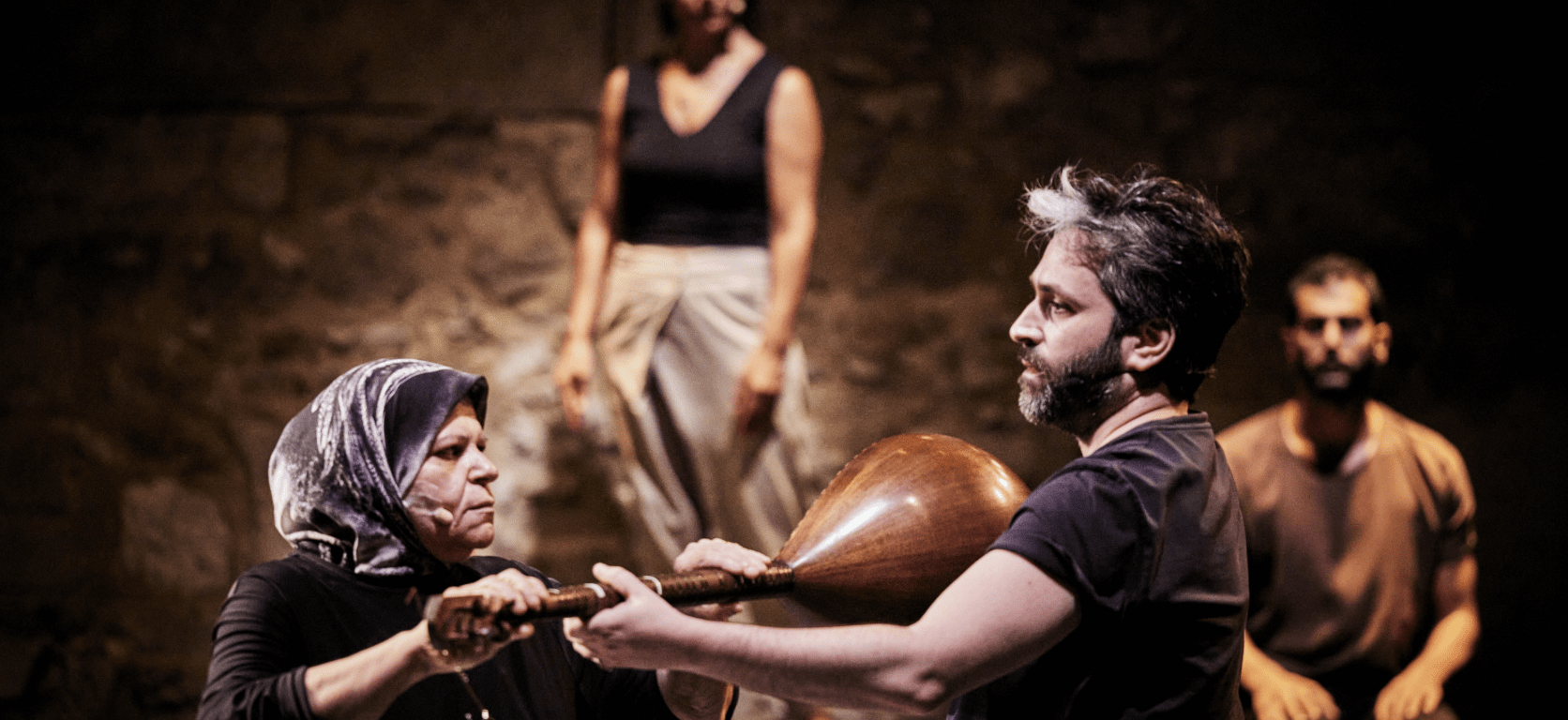

Personal tragedy against international conflict highlights the inconceivable human losses sustained in war.
Personal tragedy set against the backdrop of national collapse — Told By My Mother, by Lebanese choreographer Ali Chahrour, is an aching testament to the unimaginable losses endured in times of war. No parent should ever have to bury a child. Yet in conflict, this reversal of nature becomes grotesquely common, and it is precisely this rupture that Chahrour renders so vividly on stage.

Rooted in his own family history and the trauma of war-torn Lebanon, Told By My Mother is a work of grief, ritual, and memory. It follows two interwoven stories: Fatmeh, who has never stopped searching for her disappeared son Hassan, and Leila, who clings to her son Abbas, desperate to keep him from being drafted. The stories echo and loop, names overlap, timelines blur, until we’re no longer certain where one ends and the other begins. It’s less about linear narrative than emotional truth, less about individual lives than collective mourning.
On a bare, elevated platform atop the Victoria Theatre stage, five performers unspool this grief with music, movement, and myth. There are no illusions here, no scenery, no distractions, only bodies and voices drawn taut with sorrow. The performance begins with performer Hala Omran offering a ritualistic invocation, speaking directly as a prayer to god. It’s sacred, almost liturgical, setting the stage for what feels less like theatre and more like a communal act of remembrance. Omran sings and speaks of Hassan and his mother, of his vanishing after travelling to Syria. Her voice rises over the harrowing music of Ali Hout and Abed Kobeissy (of Two or The Dragon), whose fusion of Arabic tradition and contemporary rock creates a soundscape of sorrow and resistance. This feels like a reminder of how their culture has become stained and marked not inherently, but historically, by violence and loss, with the music feeling like a mourning song for a country’s stolen sons.

In contrast, Leila lives not in grief, but in dread, watching Abbas teeter on the edge of being taken from her. Their scenes together are painfully tender, as if every shared moment is a quiet rebellion against the inevitability of war. The choreography is gentle but loaded, as if each step could be the last. Leila Chahrour, playing both mothers, delivers a haunting performance, with her face hollowed by sorrow, her movement slow, ritualistic. Abbas Al Mawla, playing both sons, shifts between stillness and convulsion, sometimes collapsing entirely, overcome by forces unseen. The two of them share an unspoken love, their eyes looking at each other, an invisible bond connecting them, all the more painful then when we understand the amount of devastation the mothers feel towards their sons. At times, Chahrour himself takes to the stage, a solo where his movement is formless and aching. There is no traditional structure to these dances; only feeling, spilling out through limbs and silence, abstract yet powerful in its message, lilting, floating, a strange in-between from the numbness of having gone through far too much.
Toward the end, the performance takes on a surreal tone. The ensemble hums what is described as the oldest, haunting lullaby in Sumerian, an invocation that reaches across centuries. Is it a prayer? A plea for peace? Or simply a tether to something ancient and human, amid the chaos of the present? All this while Leila recounts a dream, the others gathered around her in a tableau that feels mythic, sacred. She becomes almost a seer, speaking truths that echo far beyond the stage. She lays a black cloth over Omran, who lays on her lap, as if sending the body away, knowing she can no longer hold on.

The show’s power is slightly undercut by the scale of the venue. In a space too large, the intimacy is diluted. This is a performance that demands closeness to see the tremble in a mother’s hands, the vacant stare of unbearable loss. What it needed was a smaller space, and a full audience to sit with the pain, feeling every ache of a heartbeat. Nonetheless, even in the emptiness of the theatre, you hear, listen to the mothers in speaking not only for themselves, but for a nation that has long been caught in cycles of mourning. It is a show that doesn’t offer resolution or catharsis, mourning what cannot be recovered, a grief that is intimately tied to Lebanon’s history, a country so scarred by civil war, foreign occupation, political corruption and terrorism. These stories are not imagined, but lived.
Its final image lands like a blow to the chest, as we hear a somewhat muffled recording: the real-life Fatmeh and Hassan, singing together at home, just days before his disappearance. It is a final trace of joy, love and what has been lost. This is a show that remembers, fiercely and without compromise, portraying a mother’s grief, while also occupying the space of being a defiant, furious cry against the machinery of war, and a reminder that every martyr, every missing person, every dead body, was once someone’s child.
Featured Photo credit: Christophe Raynaud de Lage
Told By My Mother ran from 16th to 17th May 2025 at Victoria Theatre.
The 2025 Singapore International Festival of Arts runs from 16th May to 1st June 2025. Tickets and more available here
Production Credits:
| Ali Chahrour | Director, Choreographer, Producer, Scenographer & Performer Ali Hout, Abed Kobeissy (Two or The Dragon) | Music & Performer Hala Omran | Performer & Singer Leila Chahrour | Performer Abbas al Mawla | Performer Chadi Aoun | Assistant director, Production manager & Communication officer Christel Salem | Production manager Guillaume Tesson | Scenography, Light design & Technical director Pol Seif | Light manager Benoit Rave | Sound designer Isabelle Aoun | Copywriting |
 Bakchormeeboy