
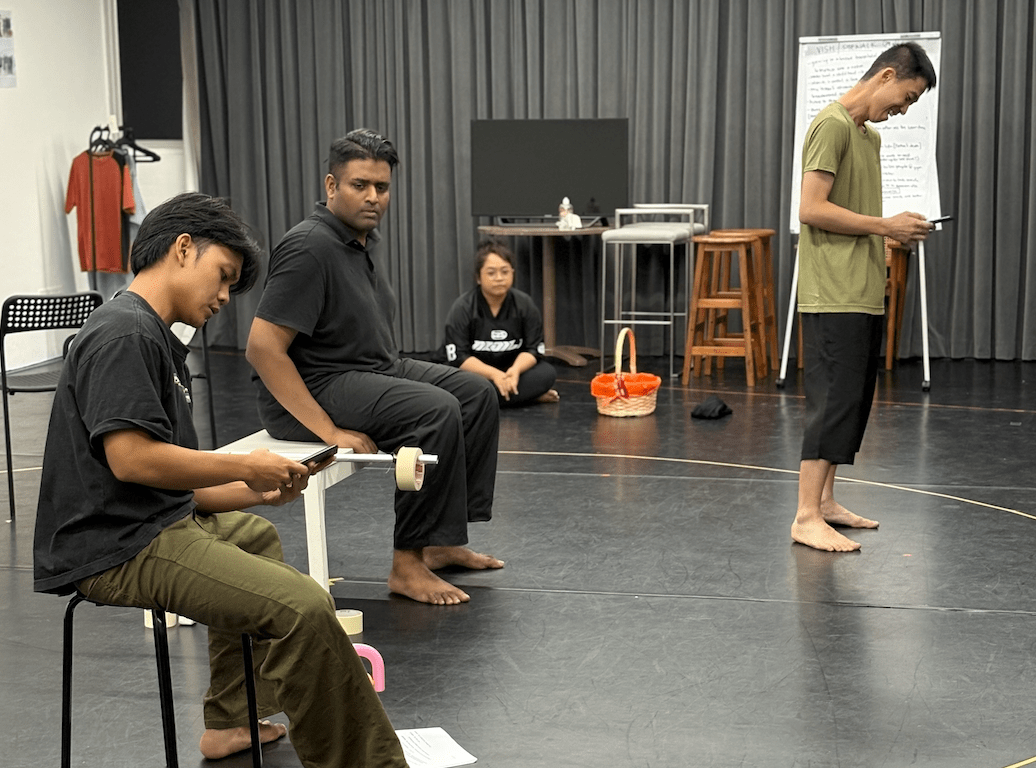
What makes a man today? That is the central question at the heart of The Necessary Stage’s new play No Man’s Land. Co-directed by Alvin Tan and Sim Yan Ying “YY”, and written by Danial Matin, the new work is a devised, interdisciplinary production exploring the tensions, confusions, vulnerabilities, and inherited weight of masculinity; what it means, how it’s shaped, and who, if anyone, owns it.
YY, who is steering the project alongside Alvin, notes that the collaborative process has reached its third phase, with choreography around 60% done. It isn’t just the timeline that she’s tracking though, but also it’s the energy in the room, how different practices and sensibilities are layering together. “Alvin and I have been talking for a while about working in a truly collaborative, live environment,” she shares. “This is the first time we’re co-directing something in this way. It feels like the right time, and the right team.”

The origins of No Man’s Land trace back to separate but converging conversations. YY had already been in dialogue with Danial about a new interdisciplinary project that would weave together theatre and dance. The project’s themes were personal for everyone involved. Alvin observed that YY, who had long focused on women’s stories in her work, was now turning her curiosity toward men, not to simply critique them, but to understand. “She was asking: Where are men coming from? Why do they act the way they do? And what would a rigorous look at male behaviour actually look like?” he reflects. “And that got me thinking how masculinity isn’t something we want to erase. There’s something in it worth retrieving. Not all of it is toxic. We talk about dismantling patriarchy, and yes, but then what happens to men? Where do they go?”
Says YY: “Precisely because I was working on a lot of female-centric projects, I want to explore the other side of it. Gender is not binary; you can’t really advocate for gender equality if you only talk about women’s issues. Men also play a significant role in upholding or challenging systems of inequality. If feminism is about freeing people from limitations, then even things like how men are conditioned to suppress emotions matter, and you can’t have one without the other. In daily life, the close male figures around me often have such different ideas about how to move through the world as men, and I’m really curious how each of them got there. It’s a mix of upbringing, environment, and the information they consume.
“Some of them do perpetuate harmful patriarchal ideologies, and that’s intergenerational. It’s not just about the women around them but about how they see themselves. I see vulnerability and insecurity expressed in harmful ways, like anger that comes up without knowing how to regulate it. Men often aren’t taught how to negotiate and talk about these feelings, so they resort to immature patterns,” she adds. “But there’s a solution. These aren’t things that are intrinsic to being a man, they’re things you can work on. And if we’re intentional about the next generation of men, we can help subvert that pattern.”

Danial, who proposed the title No Man’s Land, says the metaphor felt layered and resonant. “Masculinity is so often associated with aggression, war, violence,” he explains. “And this phrase ‘no man’s land’ just opened up all these meanings. It’s a contested space, a space between, a zone of confrontation and possibility, and relates to men feeling disenfranchised as they search through new meanings and possibilities of masculinity. The characters in this piece, like so many men, are all trying to stake a claim on masculinity, to find their way through it and find a sense of dignity. Willingly or unwillingly. And that liminality, that in-between where they both belong and don’t belong, becomes a space of opposition and confrontation is precious.”
“Compared to the previous works I’ve written, being a devised work, it’s very different, where it comes with its own set of challenges. When I write scripts, I usually have the structure, the plot, and so on, but for this project, it was also an opportunity to explore different forms of writing. Instead of typical dialogue, I’ve been experimenting with texts that are delivered over screens, or fragments of text, playing with different text forms,” he adds. “Thematically, it’s also been a challenge. Masculinity is such a huge topic. It touches on gender, culture, sexuality, and so many intersecting ideas. The question became: how do I match the content to the form? What combinations and possibilities can we explore? Eventually, I had to settle on different versions of the text, while also making sure to give space to Hafeez and our sound designer. Some parts are better served through movement and sound. So, really, it’s about how we collaborate and work across disciplines.”

In many ways, the project is exactly that: a liminal space, both in its form and process. As Alvin puts it, “We keep coming back to interdisciplinarity as a form; it’s closely tied to the idea of masculinity, and the energies of both genders need to be present when doing interdisciplinary work. It’s about how we structure things, the fluidity of ideas, and the mix of energies involved. So, the kind of content and form we’re hoping to work with really depends on bringing in the right people with that kind of energy. I’m curious about that — the distinctions and the conversations around patriarchy and masculinity.”
“We’re always demonising patriarchy, but where does that leave men? When YY was talking about healthy masculinity, it dawned on me that there’s value in being a man. We’re not here to eradicate or erode men into becoming women. It’s not about emasculating or forcing homogeneity. There’s something in masculinity that we need to retrieve, or tweak; it’s not all bad, and I want to investigate that more,” he adds.

As part of that process, dancer Hafeez Hassan, who had previously participated in the Where Are You? (Singapore) process in 2021, came to mind, and was also roped into the process. “He was one of the first people I thought of to collaborate with,” YY says. “He’s humble, grounded, and such a sincere soul. And we knew he’d been leading The Brothers Circle for a while. He’s been deeply invested in these conversations and it made sense to have him onboard to help choreograph.”
For Hafeez, No Man’s Land came at the right moment. “During COVID, I had the space to reflect,” he shares. “It was very hard for me. Most of the boys in my circle, I realised we didn’t have spaces to really talk. I created one for myself during that time. So when YY approached me about this, it felt timely. In Singapore, these kinds of conversations about masculinity are still very young. I do see some change, the men in my circles are becoming more vulnerable and allowing themselves to be more accountable to others, and we can see they’re even comfortable with expressing themselves and connecting, to the point of physically hugging. But the more platforms we have for these voices, the better, and how it extends even to our process of being open with each other.”

That openness is evident in how the four creators share creative leadership. In early phases, they let the performers guide the room. “When we were staging a naturalistic dream scene, Hafeez said, ‘Hey, why not have them do some bench presses?’ So, while we look at the broad strokes, people’s ideas can come in with a lot of detail and smaller parts. Our role is to figure out how we can support all of that, because we’re all aiming for a shared alignment in the style of the show — and that takes time. Are we going for something naturalistic? Stylized? Maybe the ideas we have can fall within a broader performative vocabulary,” YY explains, recalling her own devising process with other work.
“Our role isn’t just about deciding where to go, but it’s also about seeing how ideas can meld and blend together. Maybe what Hafeez is interested in can connect with what Danial’s working on, process-wise.We’d just observe, see where the energy went. It’s rare to work like this, and when it happens, it’s thrilling. I really see the value in these collaborative processes. Some artists approach projects just wanting to deliver their own vision, to take and use you as a resource. But we need more ongoing conversations, and collaborators need to recognise the importance of those conversations, even though they’re time-heavy.”

Hafeez, coming from a movement background, had to adapt his process for a cast that includes non-dancers. “It’s been a challenge in a good way,” he says. “I’ve had to deconstruct my creative process, moving away from a purely mechanistic or “dancey” approach and leaning more into pedestrian, gestural movements. Ultimately, it’s about relaying the message clearly. When creating a piece, I always ask: what is the message the audience needs to receive? I check in with Alvin and YY to make sure we’re going in the right direction and that we’re on the same page. In the brothers’ circle, I drew on some of those elements. We do an exercise called soul gazing, where it’s basically a staring game for two minutes. It’s an easy way to break the ice, and once the connection and expression start flowing, a lot unfolds. I used that exercise with the cast during our first rehearsal, and it opened up a lot.”
“I do think I’m generous when it comes to creative differences because I need the cast to feel relaxed with one another and, most importantly, safe. Some of my facilitation tools are meant to create that comfort. When it comes to patriarchy, I’m also looking at it from a more mechanical perspective, like thinking about puppets or robots, how men are objectified in terms of labor and how they function within a hierarchy. From that angle, I’m exploring the idea of men as tools for maintaining certain systems.,” he adds. “There’s also a cultural layer. For example, I’m a silat practitioner, so I’ve incorporated some silat gestures into the work to bring in that cultural vibe. I want the audience to understand that there’s a layer of patriarchy even within cultural practices.

These practices aim to create safety, but also vulnerability. As YY explains, “If feminism is about freeing people from the limitations of gender, then it can’t be just about women. Men also suffer under patriarchal expectations, like not being allowed to cry, or needing to dominate. I see it around me, in men I love. Suppressed emotions turning into anger. There’s a solution. These aren’t just male traits; they’re socialised.”
Alvin relates it to his Peranakan upbringing, where matriarchal structures and patriarchal powers often coexist in tension. “The woman may run the domestic space, but she’s still working within a male-dominated hierarchy,” he reflects. “Sometimes she even reproduces that oppression downward. It’s not simple. It’s not linear. And that complexity of how power works, and how it affects men and women differently, is something we want to sit with. I see how much patriarchy and men have enjoyed privilege over centuries, how behaviour evolves, and how it impacts women. Then, how women inherit certain patterns in response to patriarchy.”

“Especially in my own Peranakan upbringing, the patriarchy still overrides the women, but the women hold power in the domestic domain. Yet whatever power they manage to amass doesn’t revise the overall dynamics. Instead, they sometimes use that power to oppress those below them, like a second wife over a third wife. Not all cases are like that, of course, but there’s this idea that patriarchy and the power struggles it creates feed into women as well. It makes me realise how enduring and profound the impact has been over centuries,” he adds. “I feel deep compassion for the men caught up in this. Seeing how all this came about, the gendered and social expectations, the pressures placed on them, and the pressures they inflict on themselves, the insecurities, the competitive worldviews, and how they perpetuate certain values and behaviors that they don’t know how to disengage from or disrupt. We need to start seeing how men have been behaving, or work on ourselves to make corrections, even if some men aren’t willing to.”
Hafeez articulates masculinity in terms of “functionality” and “service.” As a student of biomechanics and silat practitioner, he sees lessons in biology and movement. “Masculinity, to me, is about functionality and service. Functionality leans more toward the realm of biology. I’m such a geek for human movement; I’ve been going down the rabbit hole of biomechanics. When I look at animals, like male and female cheetahs or gorillas, they look quite similar,” he muses. “For me, the whole journey has been about finding balance between structure and expression, between connection and the yin and yang. If we, as a species, could work toward finding balance and function, I believe society would be a better place.”

For YY, the process has been personally revealing. “Defining masculinity is always challenging for me. I do think about how masculinity can easily succumb to societal expectations, and depending on social influences and upbringing, we develop ideas about what constitutes “being a man,”” she says. “For me, the ideal version of masculinity is the coexistence of strength and vulnerability. A man can hold space, support others, stand up for people, and sometimes protect, but also be honest about his own fears, limitations, and where he needs to improve. So often, society expects us to act or be a certain way, but that expectation negates the vulnerabilities and authenticity underneath. Just talking about feelings or struggles, these aren’t new concepts to us. My view on healthy masculinity hasn’t necessarily changed, but this process has made me more aware of how I still hold onto certain patriarchal ideas, even some traces of toxic masculinity.”
“Just the other day I caught myself judging a guy at the gym for lifting lighter weights, and I had to stop myself, like, why did I think that? Maybe he’s injured. Maybe he’s just resting. These biases live in all of us,” she adds. “In my own family, there’s still this idea of what it means to be a “strong man.” I got married recently and moved house, and my dad gave my husband a toolkit, the hammer, the screwdriver, saying, “Now it’s time to learn how to be a man.” As if that toolset is the representation of masculinity in the household. I mean, I’m learning how to use a drill myself, and I can use a screwdriver too! So I want to be mindful of what kinds of expectations I pass down, subconsciously or not.”

Danial speaks about “moral courage”, the ability not just to self-reflect, but to call out toxic behaviour in your peers. “Once you see it, do you have the guts to confront it?” he asks. “Awareness is one thing. Action is another. Once you can recognize that certain expressions of masculinity and patriarchy are absolute or harmful: do you have the courage, the moral bravery, to confront your friend when they express something that’s not right? Do we have that conviction?
“In our discussions, we’ve also been asking: which versions of masculinity do we idolise? Building on what Alvin said about awareness, which version of masculinity do we look up to, try to follow, or even idolise in a sense? There are so many different versions that exist across cultures. Sometimes it feels like we’re stuck in a very binary Western versus Asian framing, and inadvertently we end up following one dominant model. But we need to open up and see other versions of masculinity that may not automatically align with how we see ourselves, or how young boys around the world see themselves,” he adds. “Take someone like Andrew Tate, for example. That influence feels very strange, especially in spaces that lean more traditional, often excluding even a trace of femininity. But if you look at some revisionist readings of gender in Asian cultures, traditionally men had roles in society that weren’t necessarily seen as backward or oppressive, there was a sense of harmony, where each role had its own goals and contributed to the larger picture. So this contestation between different versions of masculinity, and the way we put some of them on a pedestal, I want people to be conscious of that.”

The work is also partially devised by the exceptional cast including Michael Tan, Neo Hai Bin, Shahizman Sulaiman, Suhaili Safari and Vishnucharan Naidu. “It’s about finding the right people, so we interviewed cast members carefully before selecting them. It was rigorous because we wanted people who aligned with our thinking and sensibilities. People who are okay with proposing and tweaking ideas, not being over-possessive about them, and being willing to let someone else take an idea and grow it. We’re very blessed to have that,” says Alvin. “Our team also come up with their own ideas, and when someone else is helming a session, the others aren’t just waiting; they’re thinking and observing how they can contribute.”
“We considered their skills and talents. Shahizman is a dancer who can act, possessing both technical precision and a unique artistic voice. As a choreographer himself, he’s amazing. Acting-wise, he has a natural charm and energy. Hai Bin and Suhaili are seasoned, trained performers and creators. Vish, an artist-educator, brought another angle, as well as his Bharatanatyam practice. Michael adds an intergenerational perspective, and is so humble and ready to go, he’s got this playful energy where he’ll roll on the ground if he has to. He’s such a giver and unafraid to say surprising things, and he brings Hokkien and dialect too,” says YY. “It was important for us to meet them where they were at, not just create characters from scratch, but use their interests as jumping-off points. Even after they came on board, the four of us had individual meetings with each of them to hear how they were feeling, their interests and preoccupations. We didn’t just have one conversation; we looked at what their energy was, what they were interested in, and how much mileage we could get from that to weave into a character. The characters are bespoke, tailor-made, something they inhabit.”

Reflecting on the state of masculinity today, Alvin and YY conclude by sharing their thoughts on the way forward. “Overall, I do feel men are stepping up more. These days, most places are dual-income, so both parties have to work; it’s no longer just women doing all the household chores. Even simple things like that show change,” says YY. “But it’s mixed. There are still men in my life who seem unable to express emotions in healthy ways, sometimes showing bursts of anger or manipulation. When I think about issues like domestic abuse and male violence, well it’s still prevalent, even here in Singapore. We still see cases of perverts or peeping toms. These groups of men still exist, but there’s also change if you look beyond your close social circle. There’s a lot of work that still needs to be done. Moving forward, for us to be empathetic listeners across communities and gender is key.”
“For me, meeting people like Hafeez has been really encouraging, and it’s a kind of testimony. In my generation, it’s a lot harder to find these kinds of men, and it fills me with so much hope that a healthy masculinity is emerging,” says Alvin. “I still wonder, how do we nurture self-awareness or self-reflexivity? That requires a certain amount of healthy self-doubt, and not doubt that lowers self-esteem, but the kind that keeps you from absolutism. What irritates me about some ideas of masculinity is how inflexible they can be, how they’re conflated with “integrity” or “principle.” Sure, we want to believe in principles, and my generation often operated that way, but I think it’s good to work on being receptive in conversation and dialogue. At the same time, we need to think about when we should truly listen to someone whose convictions are different from ours. And at the end of the day, it’s about self-awareness. The ability to hold space for uncertainty. To question your own assumptions. That’s not weakness, it’s strength. And that’s what we’re trying to model here.”
Photo Credit: The Necessary Stage
No Man’s Land plays from 12th to 15th June 2025 at the Esplanade Theatre Studio. Tickets available from BookMyShow
 Bakchormeeboy
2 thoughts on “No Man’s Land: An Interview with the creative team behind The Necessary Stage’s new show tackling modern day masculinity”