
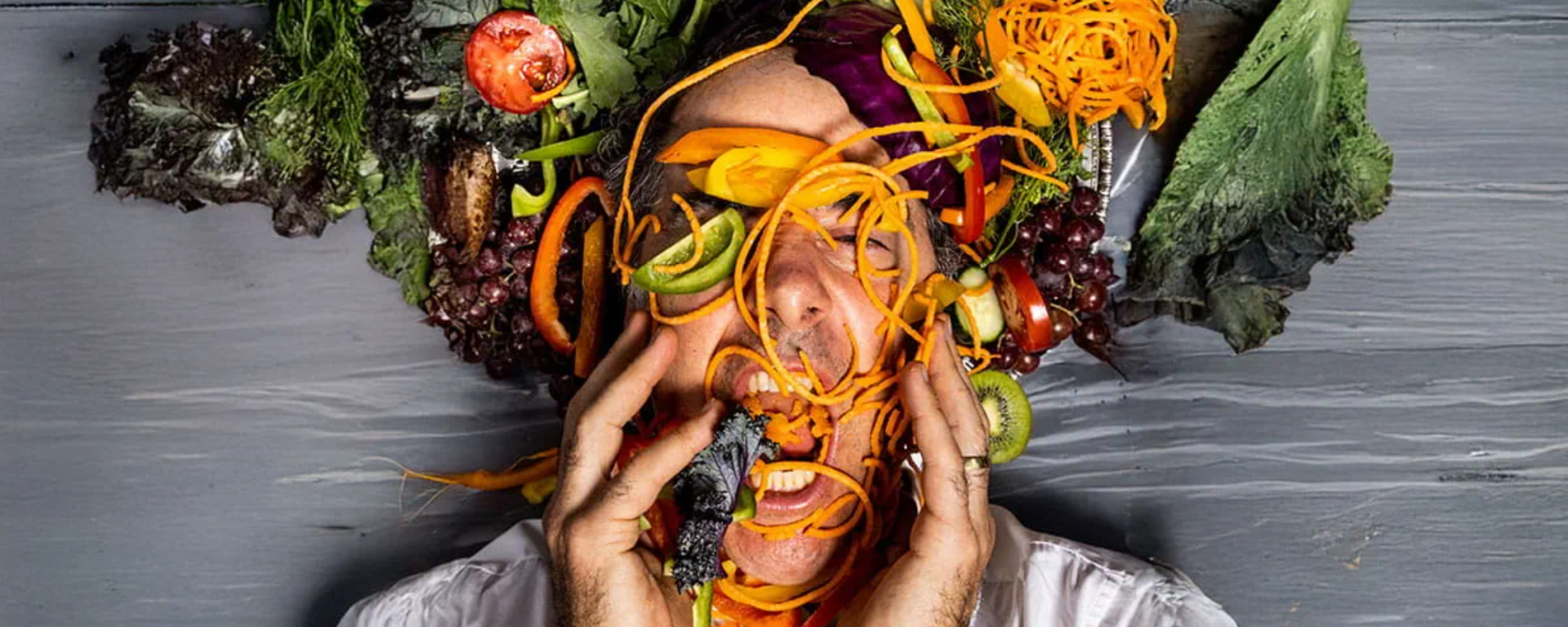

Geoff Sobelle serves up food for thought, elevating the act and art of consumption.
Geoff Sobelle is nothing short of a master of theatrical magic and clownery. And considering how skeptical today’s audiences are, and how easy it is to see through most performers’ sleight of hand, that’s high praise for an increasingly rare talent in entertainment. But more than just parlour tricks, Sobelle’s work comes with an emotional slant, often filling us not only with wonder for the miracles he pulls off onstage, but also, a sense of admiration and wistfulness for the world we live in.
This is exemplified in FOOD, a genre-defying, multi-sensory theatre piece that invites audiences not just to witness a performance, but to inhabit an idea. As the lights dim on the cavernous Singtel Waterfront Theatre, what unfolds is not an immersive dining experience, but something more profound and provocative: a meditation on consumption in all its forms; personal, cultural, historical, and ecological.

At the centre of this culinary theatre-in-the-round is a comically oversized banquet table, where selected audience members are seated, with plates and cutlery before them. The rest of the audience encircles the stage, creating an immediate sense of intimacy and participation with our shared spectatorship. Suspended above the diners is a chandelier assembled from domestic kitchenware; translucent plastic spoons, forks, spatulas and more, forming an arresting visual that immediately cues us into the evening’s theatrical language: playful, surreal, and steeped in symbolism.
Sobelle enters in a classic waiter’s uniform – black vest, white shirt, and with silent charisma begins to establish a world. He lights a single candle, sets it down, and drags it precariously across the entire table using a table runner. It’s a simple, almost absurd act, but the tension it creates from fear of the flame toppling over is palpable, and its success feels magical. This moment encapsulates what Sobelle does best: grounding theatrical spectacle in the mundane and drawing out wonder from the seemingly trivial.

From that first gesture, we are gently nudged into reflection. Sobelle invites us to think back to our last meal, then further back to childhood, to memory, to inherited traditions. The lighting dims, the mood shifts, and suddenly the entire room seems to breathe in sync, lulled into a shared meditative state. Without ever being didactic, Sobelle casts a spell that reminds us how our relationship to food is never just about sustenance, but about story, ritual, and memory.
What follows is the dinner party proper, with Sobelle showing off an impeccable sense of timing and physical comedy. He plays the maître d’, sommelier, and kitchen hand, roleplaying a restaurant experience with guests. He invites them to pretend-sip wine and describe its bouquet with over-the-top flourish. He allows audiences t share their favourite hawker dishes, and delivers on those desires. He jokes, improvises, and disarms the room with charm until everyone begins to laugh together, rather than at one another.

Then, the show begins to reveal its deeper intentions. Responding to a request for something “farm-to-table,” Sobelle stages a modern day miracle he ‘grows’ a baked potato from scratch, layering soil on the table, watering it, waiting. At another point, donning a fisherman’s jacket, he strides across the table in search of an Arctic fishing hole, eventually reeling in a fresh cod, still flopping after plating it. These visual gags are not just clever, they’re astonishingly well-crafted stage magic, full of childlike delight and absurdist poetry.
But the show’s turning point comes in a striking shift of tone. After building up this convivial, comical meal service, Sobelle unceremoniously clears the table. Glasses are dumped. Bills are plonked down. Food is whisked away. Drinks are poured into a slop bucket. And he has yet to eat.

What follows is a harrowing, nightmarish sequence, a grotesque, twisted mukbang where Sobelle devours the leftovers. It begins innocently enough: he eats an apple, down to its core. Then another. Then an entire bowl of them. Cherry tomatoes follow. Whole carrots. Raw eggs. Rice by the bowl. Squirts ranch dressing directly into his mouth. He chokes and gulps, at one point ripping the head off a fish, causing blood to spatter across the table. He ends by guzzling a bottle of wine while lying flat on the table, the bottle upright in his mouth. He even eats the tip notes left by guests, and a lit candle.
This extended sequence is difficult to watch, due to its violence, its emotional confrontation, and overall visceral absurdity. It’s a stunning indictment of excess, unchecked consumption, how easily we disconnect from what we eat and how it got to us. The audience is unsure whether to laugh, gasp, or recoil, perhaps the point of this entire sequence, as we reflect on how we have forgotten how to eat mindfully.

After this orgy of overindulgence, the show shifts once more, and gestures for us to go back to basics, where it all began. The tablecloth is ripped away to reveal a bed of soil beneath. Thunder rumbles. A storm brews. It feels like we’re witnessing a kind of theatrical apocalypse, or Genesis. From this raw earth, a new world emerges. Sobelle, now barefoot and reborn, takes his time to build, revealing livestock, wheat fields, an oil well. He begins slowly building a house that turns into a village that becomes a hamlet that becomes a town. Audience members are enlisted to help, transforming the stage into a communal settlement, moving vehicles around the dirt road, before skyscrapers burst forth from the ground, like fresh saplings.
There is something deeply moving in this return to simplicity, to earth, to hands-in-soil creation. We end on a poetic, reflective note, as one audience member reads from a script, a first-person monologue tracing humanity’s long arc: from foraging and hunting to farming and domesticating, from scarcity to abundance, from hunger to plenty. It’s both elegy and celebration, recognising how far we’ve come, and how precarious our relationship with food and the planet remains.

By the end, FOOD has become more than a performance. It’s an embodied conversation about memory, ritual, desire, and the astonishing ingenuity of the human spirit. It doesn’t moralise, but it does linger. You leave not just entertained, but stirred—haunted by images of gluttony, soothed by the quiet beauty of soil, and filled with renewed reverence for the everyday miracle of the meal.
Sobelle proves himself to be a master of stagecraft and of invisible sleight-of-hand that seems to rearrange time and space. In FOOD, he conjures magic not just through tricks, but through emotion, ideas, and shared presence, drawing you in, convincing you to play along, and perhaps, begin to believe. This is theatre at its best: risky, raw, reflective, and, above all, human. We came hungry, and left emotionally satiated.

Featured Photo Credit: Maria Baranova
FOOD plays plays from 6th to 10th August 2025 at the Singtel Waterfront Theatre. Tickets available here
The Studios 2025 – Sustenance runs from July to September 2025. Full programme and more information available here
Production Credits:
| Creator, Performers & Co-Director Geoff Sobelle Co-Creator/Magician Steve Cuiffo Co-Director Lee Sunday Evans Sound Design Tei Blow Original Lighting Design Isabella Byrd Lighting Design Devin Cameron Chandelier Creation Steven Dufala Props Creation Jessie Baldinger, Julian Crouch, Steve Cuiffo, Nathan (Pierre) Lemoine, Raphael Mishler, Connor O’Leary, Geoff Sobelle, Matthew Soltesz, Christopher Swetcky Associate Sound Design Ryan Gamblin Creative Stage Manager Lisa McGinn Assistant Stage Manager Kelsey Vivian Production Manager/Technical Director Chris Swetcky Creative Producer Jecca Barry |
 Bakchormeeboy