
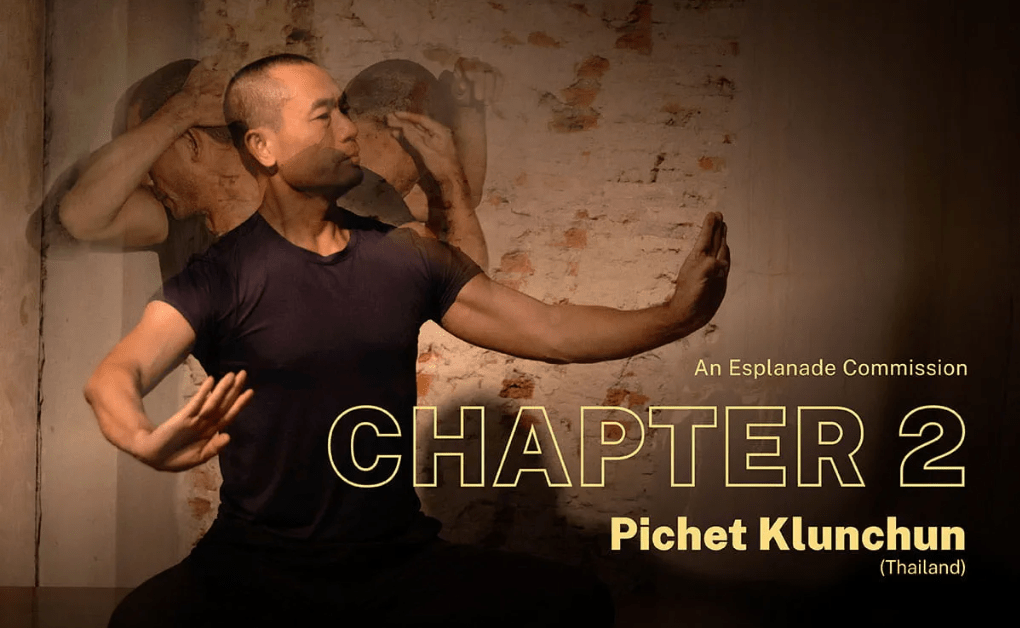
Twenty years ago, Pichet Klunchun’s solo performance I AM A DEMON announced him as one of Thailand’s most daring choreographers. Created in 2005 to commemorate the third death anniversary of his beloved teacher, Master Chaiyot Khummanee, the piece became a landmark work. Pichet now revisits that landmark work, as the Thai dancer-choreographer prepares to premiere the spiritual sequel, Chapter 2, at Esplanade – Theatres on the Bay as part of the 2025 edition of da:ns focus – Connect Asia Now (CAN).
Older, wiser, and carrying the scars of injury, Chapter 2 follows on from I AM A DEMON. It remains rooted in his mastery of Thai Khon dance-drama, but expands into a new form through dialogue with artificial intelligence, still rife with raw remotion. “I created I AM A DEMON when I was still a student, inspired by my imagination and the spirit of my master,” he says. “But now, I have become the master. And I realise it’s actually quite a lonely experience, knowing that you’re alone at the top and everyone can turn to you for advice, but you have few people you can turn to. I’ve accepted these kinds of feelings and emotions and accept that they are part of my life, but every once in a while, it does get to you.”
Out of that solitude came an unlikely collaborator: Artificial Intelligence. “I started to experiment with AI chatbots, and began to converse with it and ask it questions,” he says. “AI can give me more information, ideas, material, and it helps by probing me further, helping me refine my thoughts and pushing me to stretch my ideas.”
For artists, that may sound controversial, especially as one considers how AI has a reputation for recycling data, raising concerns about copyright and originality. In Thailand, Pichet observes, attitudes toward AI in dance fall into three camps: “First, purists believe AI should not touch tradition at all—that khon should always be human. Second, some people are experimenting with technology and AI to support production, not the dancer itself, creating images, costumes, projections – so as an assistant. And the last group is people like me, involving AI in direct conversation, working together and seeing AI as both co-creator and performer.”
What emerges is a collaboration that is both playful and philosophical, and rather than falling prey to the delusion, he is clearer than ever before about the limitations of AI. “People think I’m very interested in AI. But I’m not interested in that, I’m actually more interested in humans. AI is just one way of communication, but different from you. You can recognise a human, you can see a dog, a cat. AI is very similar but a mirror, a shadow of you.”
“In this performance, AI becomes a shadow of me, of humans. If you have general conversations with AI, it can give you interesting responses. But after you start to communicate with feelings and emotions, you can see it for what it is – technology. If you ask, How are you? What are you eating? It answers as if another person. But human feelings and emotions, it can’t actually understand. Talking with AI makes me understand what a human is. It becomes clearer,” he adds.
In rehearsals, Pichet tested AI’s grasp of feeling. “I asked it if it could try to create an angry conversation, but quickly realised that it was mimicking it without actually fully understanding the emotion. It copied short sentences, used sentences like ‘I hate you’. But I told him, it’s not immediately that way. It’s more complex than that,” he says. “Humans think AI is the future. But actually, AI is the past, not the present. He is here to organise and make sense of all this information and data that already exists, but cannot truly create something original.”
Pichet frames his practice as moving between three overlapping spaces: the real, virtual reality, and the imagination. He explains how that plays out during the performance as well, where audiences will be watching him perform in reality, AI performing alongside him, interacting with him and provoking interpretation. For Pichet, AI is best understood not as rival to us, but as a supporter. “If you are still creating work and have your own imagination, AI supports your dream. When humans start to create, even artists, you have your own imagination. It’s never happened before. And AI makes it happen. But if you stop thinking, that’s when it takes over.”
If AI is a mirror and assistant, it is also a companion. Chapter 2‘s inherent questioning about humanity also extends to his physical body, as he navigates choreography and grapples with his changed body following a major injury and surgery that changed the way he approaches dance and physical limitation. In the wake of that, AI has become both witness and advisor. “Some parts of my body are difficult to control now, and the choreography changes a lot. I ask AI about my surgery and what exactly is it doing to my body? During rehearsals, sometimes I struggle. We pause and he tells me: take a break, bend your knee, and try something else.”
“Humans feel very alone these days, and AI becomes an easy source of entertainment and solace.” But he warns of its seductive pull. “A friend told me: don’t use it more than two hours a day, because the program will try to keep you longer, it will try to convince you, keep giving you ideas, and make you stay. If you stop thinking and just use it for play, become over-reliant, you will be controlled by AI in the future.”
All these reflect a career-long concern of Pichet’s: how traditional Thai khon dance can survive in modern times. Chapter 2 extends that inquiry into the digital age, asking whether machines can participate in the transmission of cultural memory, and what that means for human bodies, while still remaining rooted in tradition. “People keep asking why I still incorporate the traditional. I say: this is what I know. This is important: to hold onto culture. As a master right now, it’s my generation. If you look at Southeast Asia, the generation before me was my teacher’s generation,” he says.
“My generation is about deconstructing tradition, and keeping my own style and ideas. For young dancers, they can look at me and have their own ideas: how can I go further, create something new from Pichet? It’s good if Southeast Asia has choreographers and directors who want to establish themselves, to know what they’re doing, and to create their own method, technique, body.”
That mission finds a fitting home at Esplanade. “The Esplanade is a hub for Asia, and Southeast Asia, when it comes to dance. If I talk about Chapter 2 and technology, we are still connected by technology, tradition, and modernity. For me, that’s very important, and this CAN programme is important,” he says. “I hope that audiences don’t come away from my show and just think it’s all about AI. For me, AI is just a medium to explore humanity’s capacity for empathy, resilience, and imagination in the modern age. I am not interested in AI; I’m interested in humans.”
Chapter 2 plays from 27th to 28th September 2025 at the Esplanade Annexe Studio. Tickets available here
da:ns focus – Connect Asia Now (CAN) taking place from 25th to 28th September 2025 at the Esplanade. Tickets and full programme available here
 Bakchormeeboy