
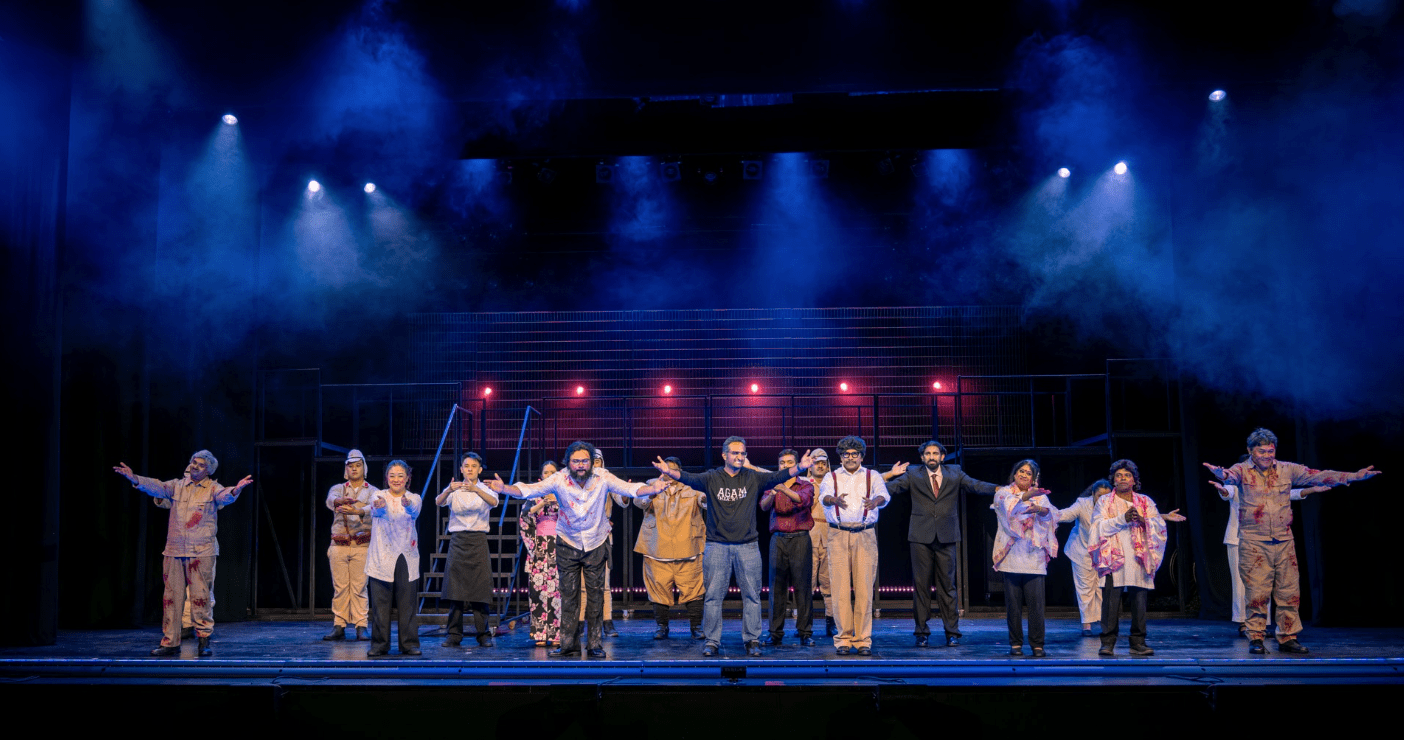
AGAM Theatre Lab ventures into dark comedy with this original wartime epic that balances humour, humanity and heartbreak.
Playing as part of the 2025 Kalaa Utsavam – Indian Festival of Arts, AGAM Theatre Lab’s new original work Mission Malligapoo opens with a directive, as the overhead PA announces “Welcome aboard Mission Malligapoo,” and before you know it, the audience is subtly enlisted. It feels as though we have already agreed to go along with this mission, forming an immersive framing that sets the tone for what follows – a tribute to our forgotten forebears who paved the way for our success today.
Co-directed by Subramanian Ganesh and Karthikeyan Somasundaram, Mission Maligapoo is set in Singapore in 1942 during the Japanese Occupation, unfolding as a densely populated, ensemble-driven work that prioritises understanding people before progressing plot. Each of its many characters is introduced through language, personality, and everyday behaviour, allowing us to grasp who they are before history bears down on them.

The first half moves almost like an Indian variety show in structure; episodic, busy, and intentionally crowded. Sundaram (Ponkumaran Selvam) dances his way into the story. Sultan the barber (Awad Salim bin Ramli) is established alongside his granddaughter Anisa (Sabarna Manoharan). Mei Ching (Jasmine Kuah) and Wei Liang (Chee Yuan) appear as young and hopeful, while Ying Hua (Eleanor Tan Geok Kim), Wei Liang’s mother, is defined by fierce protectiveness. She blames her husband’s opium addiction for abandoning the family and channels that resentment into an almost suffocating desire to secure her son’s future.
The Indian aunties Mariyamma (Kalah Rajesh Kannan) and Visalatchi (Rohshini Thiagarajan) bring visual flair and kinetic energy. Their confrontations with Ying Hua evolve into a lively auntie feud rooted in clashing trades, values, and ideas of territory. When their sons, Muthu (Seshan Veerappan) and Wei Liang, are drawn into the conflict, chaos feels inevitable. These scenes are humorous, but they also establish a fragile social balance that war will soon rupture.
As directors, Subramanian Ganesh and Karthikeyan Somasundaram keep the ensemble in constant motion without losing narrative clarity. Seena Thaana (Mohan Vellayan), who works closely with the British, is framed as both insightful and opportunistic. His task as translator for a visiting Chinese envoy becomes a subtle but effective device: the translations are clearly skewed, until it is revealed that the envoy understands English perfectly, suggesting the inaccuracies may have been a deliberate test of loyalty and power.

A quieter, lyrical moment arrives with Mei Ching and Wei Liang gazing at the moon and speaking of hope. They make a wish, believing they see a shooting star, only for it to be revealed as a falling bomb. The shift is abrupt and devastating, capturing how swiftly optimism and peacetime can be overtaken by violence.
As the two young men decide to join the resistance, the production pivots decisively. The visuals of war, shaped by Alberta Wileo’s lighting design, Ren Kang’s sound design, and Hologrix’s multimedia, are effective without being gratuitous. Mei Ching’s mourning for her father grounds the spectacle emotionally. When Japanese flags unfurl across the theatre, the fall of Singapore is unmistakable. Soldiers break down doors, resistance is met with death, and Mei Ching is taken away. She simply disappears.
From here, the mood of war and terror accelerates. Ying Hua is visibly battered by circumstance, her fear embodied in her expressions and physicality. Singaram (Veeraraghavan), an actor who constantly yearns for applause, keeps performing even as the world collapses. Sigamani (Thiruselvam), the star reader, flees with the masses. Veera Singam (Karthikeyan Somasundaram) steps into leadership, rallying ordinary people toward an almost impossible resistance.

After intermission, the narrative contracts. With the introduction of Paandi Thurai (Vadi P.V.S.S.), the group is reduced to five. The scale shrinks, and the questions sharpen: what can so few people really do? The play becomes markedly human here, focusing on relationships, conviction, and consequence. One character holds fast to her beliefs and dies for the cause, forcing the central question into the open: what is courage? The title’s symbolism then comes into focus. Malligapoo, referencing the jasmine flower, is small, but its scent travels far. Resistance, the play suggests, need not be large to matter.
The banquet sequence reintroduces dark humour. Disguised as Japanese soldiers, dancers, and servers, the group infiltrates an extravagant celebration hosted by Purushothaman (Raguvvaran Naidu). Farce and danger sit side by side: Wei Liang is comically wedged between his mother and his girlfriend, while Singaram cross-dresses and finally gets the stage he craves. When Mei Ching kills and studies himself in the mirror, the moment is unsettling — pride and horror coexisting.
Questions of loyalty and duty dominate the final stretch. Sundaram leaves. Soon after, all six are captured. The lighting effectively heightens tension, but this is where the production falters. The torture sequences drag, repeating emotional beats without deepening them. The scripting and pacing struggle here, stretching out the show into nearly three hours, where you feel the length of each additional minute. By the end of the show, the final reveal reframes the journey. Sundaram steps forward as narrator, with this entire story drawn from his diary entries. History, the play reminds us, is remembered before it is recorded.
Original works of this scale are rare, and AGAM Theatre Lab’s willingness to attempt one that is multilingual, tonally complex, and historically charged is in itself commendable. The production takes clear creative risks, experimenting with form, humour, and ensemble storytelling, while trusting the audience to move between laughter and loss. Its comic instincts remain sharp, particularly in moments where absurdity collides with danger, even as the ambition occasionally stretches the material beyond its ideal length.
As such, Mission Malligapoo works in that it treats history as lived memory rather than fixed record, culminating in the revelation that what we have witnessed emerges from Sundaram’s diary entries. In choosing to revisit the Japanese Occupation through dark humour, intimacy, and human contradiction, AGAM Theatre Lab resists safe retellings and opts instead for something that, while messier, also often feels more resonant. Even when uneven, the production is generous in spirit and bold in intent, reminding audiences that theatre still has the power to take risks, ask difficult questions, and leave a lasting imprint.
Photo Credit: AGAM Theatre Lab
Mission Malligapoo played from 21st to 22nd November 2025 at the Singtel Waterfront Theatre. More information available here
Kalaa Utsavam – Indian Festival of Arts 2025 plays from 21st to 30th November 2025 at Esplanade – Theatres on the Bay. Full lineup available here
Production Credits
 Bakchormeeboy
One thought on “★★★★☆ Theatre Review: Mission Malligapoo by AGAM Theatre Lab”