
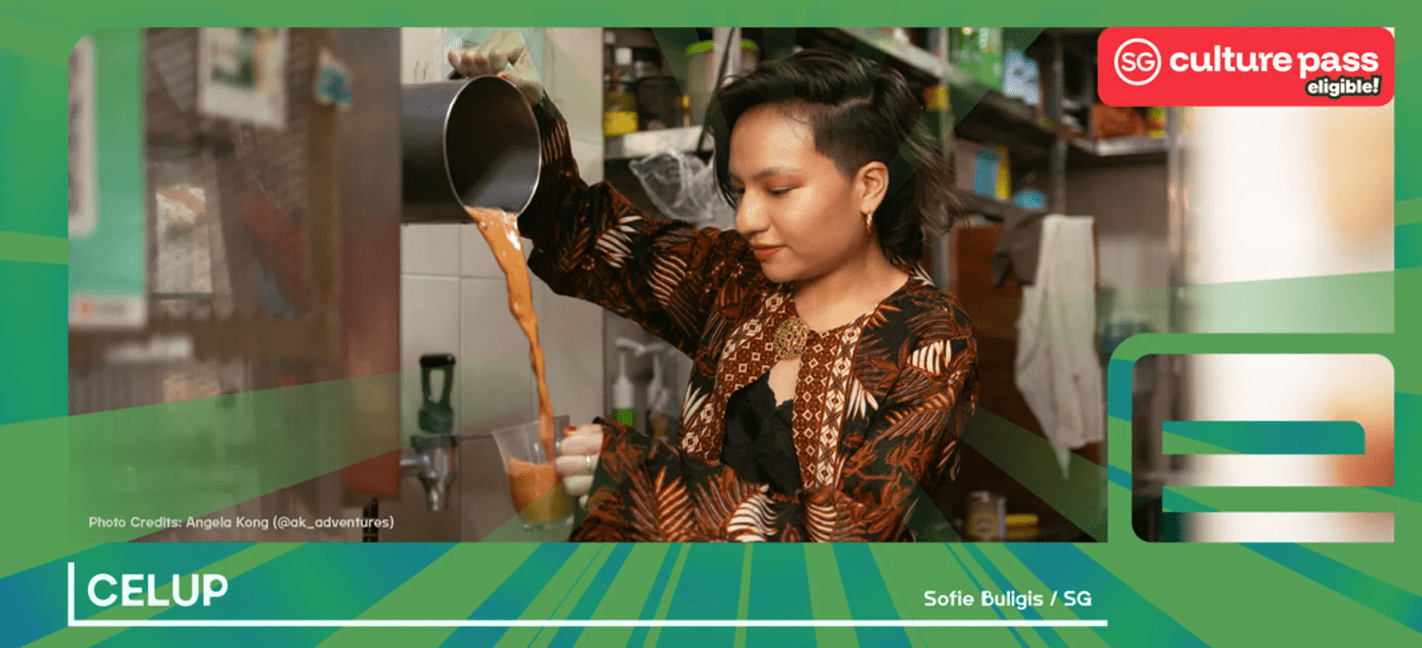
“You very celup sia.” The moment her partner said it, Sofie Buligis laughed, but she also felt something click into place. “I was like, yeah, I am,” she remembers. “My friends and family have called me that, and actually it’s quite a snappy name for a show.” That idea became Celup (literally, ‘to dip’, and loosely translates to a desire to be more ‘mixed’) her one-woman performance debuting next January, a piece that grew out of what she calls “being Malay but not Malay enough,” a feeling she’s carried since she was a child.
Playing as part of the Singapore Fringe Festival 2026 (organised by The Necessary Stage), Celup is a tight, 45-minute presentation that sees Sofie exploring her feelings and experiences of being an atypical Malay girl. “It was very clear to me that I wanted to make a piece about being Malay but not Malay enough,” she says.

From the start, she knew the work had to be funny. “Expect a lot of humour,” she insists. “My chosen tool of choice to attack issues like this is comedy, and I think I’m not an artist who wants to make doom and gloom. Some of the issues I talk about are quite deep and dark; internalised racism, harmful stereotypes, but I still want the audience to leave feeling very fuzzy and good about themselves, and ultimately emerge hopeful and thoughtful.”
Her history with Malayness is long and tangled, shaped by a mixed family whose internal diversity was often flattened by the state’s racial categories. “A lot of my family are Javanese or Boyanese but simplified to Malay,” she explains. “In fact, my own grandma is Indian-Chinese, but became categorised as Malay because the immigration officer saw her and thought that was her race.”

“So that made me think…am I in the same boat? I think that I’m quite racially ambiguous. Plus, I think about how even within our easy CMIO boxes, there are so many sub-categories within each race. So I’m interested in the fluidity of all that, like Chindian, or Malay-Indian, and what goes behind those big labels.”
She remembers, with jolting clarity, the moment she first realised she didn’t fit the mould. “My first Malay supplementary class in primary school, the one that people go to if they aren’t as well-versed in the language, I will always remember that feeling of not knowing what everyone else seemed to,” she says. “I was like, ‘Oh… how do you know C is pronounced ch and not ke?’ I felt very alienated in the room.”
The culture shock extended even to the canteen queues. “All the Malay kids would ask, ‘this one halal or not?’ and for me, that was all new to me because it was a non-issue in my own family. That signalled to me that maybe things were a bit different, and maybe for my family, they had thought it was all too complicated for a seven year old to process, just try to fit in.”

When she was younger, she attended a kindergarten that primarily schooled Chinese students, but remembers a Malay teacher who kept telling her she “needed to learn Malay”—a refrain that echoed an expectation she could never quite meet. “I’ve been living in that celup bubble for all my life at that point!” she says.
Now, as an adult, she still feels how narrow the template of race can be. “No matter how Malay you feel, you feel pressure to adhere to a set of standards of how to be and act,” she says. “Growing up, a lot of stereotypes come into play about what a typical Malay person is. And even as an adult woman I think there is a perceived ‘right’ or ‘typical’ way to be Malay, which can be quite harmful. Even my friends, who are Malay, sometimes go, ‘Oh, I didn’t know you were Malay.’ That’s how I know there’s a typical way of being Malay in the minds of people. Interrogating identity always just came naturally to me”

Part of Sofie’s drive to make Celup came from noticing this gap in representation. “A lot of people don’t necessarily know me out there,” she admits, “but a lot of Malay people would get it. There is Malay theatre happening, but not a lot of Malay theatre about not feeling Malay. We use the word celup among ourselves, maybe non-Malay people might have heard of it, but for me, this is important because I don’t think there are many works of theatre that’s explicitly about being celup. I want even the makciks to come in and rethink about their own identities as Malay women.”
The process of making the show has been just as revealing. Director-dramaturg Crenshaw Yeo (whom Sofie describes as a “banana” – yellow on the outside and white on the inside) has been central. “Crenshaw has been instrumental in developing the script,” Sofie says. “When we do reads, she’s always given very frank feedback which is so important to me as the writer. I feel like I’m generating new ideas and tightening the script in the most entertaining, clearest way possible.”

She also refuses to claim the spotlight alone, and gives credit to the rest of her team she’s working with and also bouncing ideas off. “It’s not a one-woman show—nothing without Crenshaw, my stage manager Jasmine Khaliesah, lighting by Nurin Hazira, multimedia by Sharin Zulkinia. In fact, a lot of them are a little bit celup, and it’s made for a very exciting rehearsal room, because all of us have different stories about being Malay and not quite fitting into the box.”
As with her past work, Sofie leans on her strengths as a facilitator. “I didn’t want to yap at my audience for 45 minutes straight,” she says. “It was crucial to bring them on a journey with me. My previous shows have been more cabaret-inclined, interacting with the audience, and it makes for a better viewing experience.”
In Celup, the audience joins her in an absurdist “Celup Support Group,” where “we’re celup today but tomorrow we can be more Malay,” a line she delivers with a wink. One of the show’s playful conceits sees her going on a quest, all in the name of becoming more ‘Malay’. “So in the show, I’m given all these tasks to try to be more Malay, from participating more in tradition or reviving that gotong royong community spirit,” she says. “And while yes, these are all valid ways of being Malay, I also think there’s a million gazillion other ways of being Malay.”

A recent conversation with her father affirmed everything she’s trying to say. “My dad told me, ‘There are a lot more celup non-halal Malays than we might realise.’ He said it’s great I’m making this piece because a lot of people like us are in the closet- these ‘celup Melayu‘, a bit more haram—not brave enough to admit it to themselves or their family and friends.”
It makes sense that Sofie would be the one to tell this story. Her practice, shaped by her mixed heritage, is “a reckoning with her past and a love letter to her community—messy, multifaceted, and worthy of deeper understanding.” And in the end, Celup is exactly that: a reckoning, a love letter, and a space where people like Sofie, people who have lived in the “celup bubble”, can finally breathe.
“This is a piece for all the other celup girls out there,” she concludes. “The core of Malay identity is something I’m still struggling to find, and even at the end, I’m not offering an answer, because I don’t have one. It’s different for everyone, and there’s no one true way.”
Photo Credit: Angela Kong (@ak_artventures)
Celup plays from 22nd to 24th January 2026 at Practice Space. Tickets available here
Singapore Fringe Festival 2026 runs from 15th to 25th January 2026. Tickets and more information available here
Support the Fringe by donating to The Necessary Stage here
 Bakchormeeboy