
One girl’s whimsical quest to reconnect with her Malay roots leaves more pressing, problematic issues unanswered.
Celup, Sofie Buligis’ interactive one-woman show, is a playful, ambitious, and at times perplexing exploration of identity, belonging, and what it means to be Malay in contemporary Singapore. From the moment the audience enters, they are greeted by kueh kueh on a table, a P. Ramlee playlist, and Sofie in a sleeveless black top and pants. She immediately sets a warm, mischievous tone, teasing the audience about the kueh they cannot eat, and inviting them to play along as she tries to identify each one. It’s a small but telling moment: playful, interactive, and full of charm, establishing Sofie’s energy as the show’s engine.
The show’s premise is rooted in themes of identity and belonging. Sofie embarks on a humorous yet heartfelt quest to become “a little more Malay,” wanting to understand the jokes she was left out of or finally getting a true blue Malay experience. Through the course of the performance, she reflects on her kekok accent, the cultural baggage that comes with her ethnicity, and the internalised racism faced by many in the Malay community. These reflections are woven through playful tasks and audience participation, allowing the show to raise big questions about identity and belonging with humour and heart. The term celup, she explains, traditionally means “to dip into something,” but in contemporary usage refers to someone who is “brown on the outside, white on the inside”, a Malay person who does not conform to stereotypical expectations. Sofie riffs on her own name, contrasting it with the more typical Malay names ending in “ah,” signalling early on her awareness of non-conformity and cultural expectations.

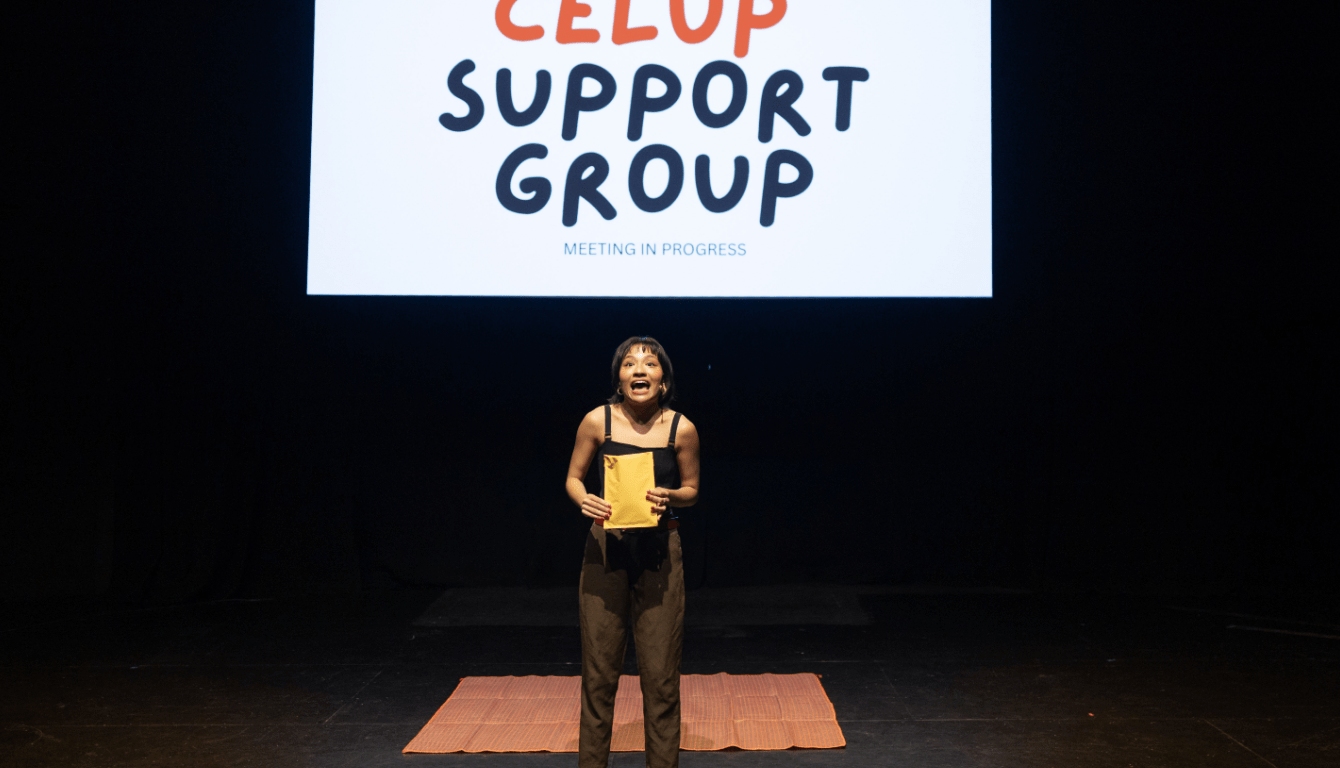
Onscreen, a large sign welcomes us to the “Celup Support Group.” The concept is cute, but underdeveloped. It functions largely as a support group for Sofie herself rather than as a context for broader engagement, despite the fact that the audience likely includes self-identified celup. There’s potential for deeper exploration here, particularly in examining why belonging and cultural identity matter, but the play never quite does a deep dive into it, or dares to interrogate audience members on the more problematic aspects of being celup. Playfully, Sofie also references ministries and government support for celup individuals, lightly satirical yet never contextualised or questioned, hinting perhaps at the authorities’ own narrow views of ethnicity and race.

This leads into the show’s most inventive conceit: CelupGPT (complete with a green ketupat logo), a government-issued AI chatbot delivered as plug-in earbuds and showing up onscreen, designed to measure and improve her Malay-ness. The AI assesses her at a mere 10% and promises to raise her score through a series of tasks, poking fun at the absurdity of reducing identity to quizzes, behaviour, and food.
The first task: language. Sofie learns obscure Malay slang like batu ronson, with correct answers acknowledged humorously by CelupGPT with “ah ah siol.” This segment is playful and witty, highlighting the performativity inherent in language and cultural knowledge, where simply knowing the linguistic norms and code endears one to a community.

Secondly, Sofie reconnects with her love of Malay food, declaring that her stomach is “not celup,” and invites audience volunteers to prepare her grandmother’s sambal belacan by pounding ingredients together. There’s charm and insight here, particularly in observing that many recipes rely on feeling rather than exact measurements. However, the sequence drags: audience interactions are shallow, with surface-level questions like “Are you celup?” or “Why do people think you’re celup?” serving more as filler than meaningful exploration.
Interspersed throughout are playful video sequences by Sharin Zulkinia, including broader explanations of celup identity, and an extended segment on Bhai Sarbat in Kampong Gelam, the iconic teh tarik/teh masala shop founded by a Sikh owner. While this offers interesting commentary on cultural hybridity, drinking teh at Bhai Sarbat also feels like a shallow performance of Malay-ness, highlighting the tension between authentic identity and performative gestures.

Finally, Sofie escalates the interactive element in the third task with a mock Malay wedding, asking the audience to hold bunga manggur, play bride and groom on the pelamin (deliberately choosing two females), and read “nosy guest” lines. The multiple-choice quizzes format are recycled from earlier, asking questions like “Who to salam?” or “What to do if Grandma wishes you to find a husband?” While humorous, these segments drag and could have benefited from more direct and dynamic interactivity. A costume change into a gorgeous red sarong kebaya seems to reflect her new score rising to 98%, and with that, Sofie is ready to fully embrace her Malay identity.

This shift triggers her to fantasise about being a “manis” (sweet) Malay girl, now calling herself Salma, and imagines dating a motorbike mat named Amirul. She is suddenly confronted by the horror of ‘conventional’ Malay expectations: raising multiple children, wearing a tudung, and leaving her free-spirited life behind. The abrupt tonal shift exposes deeper tensions in her character: the desire to be included, yet discomfort with conformity, but these contradictions are never fully unpacked. When CelupGPT calls her out for the double standards, Sofie repeatedly claims she is not superior, glossing over her own internalised biases and the subtle hierarchies embedded in her ambivalence toward “typical” Malay traits.

As she reflects on her parents’ biases, including her father valuing her mother for not possessing “typical Malay” traits, or always being encouraged to surpass the other Malays, we wonder at the effect of holding onto such inherited complexes. But these are never explored further, where the play refuses to dig deep into what it means to “be Malay” when CelupGPT compares Singapore’s non-existent definition to Malaysia’s simple rules. Insisting on the occupying this in-between category, and re-appropriating the inability to be defined, Sofie ends the show on a lengthy, impassioned monologue, removing the sarong kebaya, shutting down CelupGPT, and triumphantly celebrating and accepting her unique celup identity in a ‘girl-power’ moment.
Yet, doesn’t that mean that she has instead refused to grapple with the difficulty of what it means to be a Malay, preferring to stay in her safe zone of just being celup, choosing her own rules rather than really coming to terms with the complexities of Malay identity? It’s an uncomfortable, all-too-neat conclusion that feels surface-level, where the emotional heart of her own feelings of exclusion are never fully explored.

Ultimately, the show’s dramaturgy is hampered by staying in a “safe zone,” where audience participation is heavily controlled and hand-held, and some of the deeper questions about identity, belonging, and blurred lines are only lightly touched on. Sofie is a charming and engaging performer we’d like to see more of onstage, and the show has clear moments of potential insight and warm humour. With further dramaturgical refinement, one hopes that the team takes some time to further improve the piece, one that has potential to resonate with the Malay community, and really, anyone who’s ever felt out of place in the world.
Photo Credit: Angela Kong / IG: @ak_artventures
Celup played from 22nd to 24th January 2026 at Practice Space. More information available here
Singapore Fringe Festival 2026 ran from 15th to 25th January 2026. More information available here
Support the Fringe by donating to The Necessary Stage here
Production Credits:
| Playwright/Performer/Producer Sofie Buligis (she/her) Director Crenshaw Yeo (she/her) Multimedia Designer Sharin Zulkinia (she/her) Lighting Designer Nurin Hazira (she/her) Production Stage Manager Izz Sumono (she/her) Sound Operator and Production Assistant Aisyah Hanafi (she/her) Captioner Joanna Ong (she/her) |
 Bakchormeeboy