
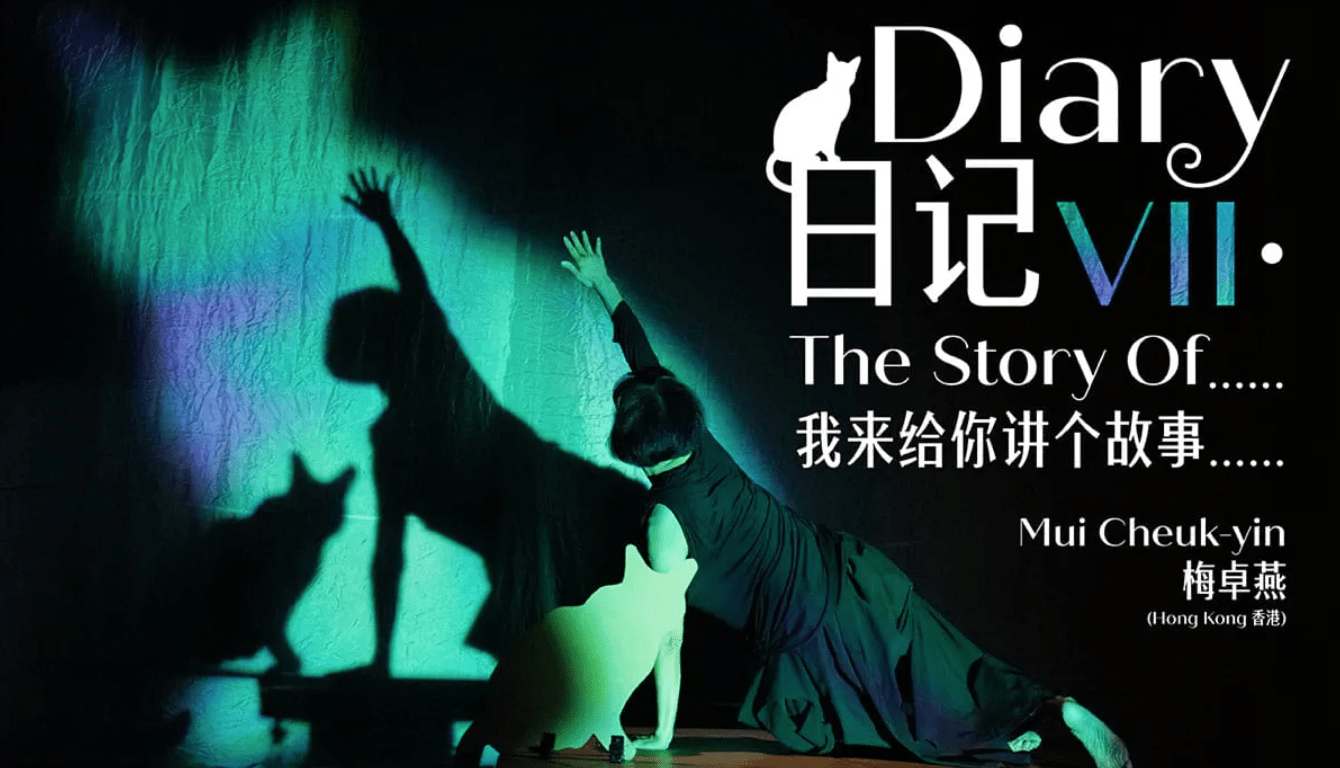
Mui Cheuk-yin transforms a chance encounter with a stray cat into a profound reflection on migration, memory and the circular nature of time.
Diary entries often feel like streams of consciousness, a flow of thought. So for a dance piece to take inspiration from one, that results in a performance where there is no dramatic overture, no attempt to overwhelm. Instead, the theatre fills with the unmistakable soundscape of Hong Kong’s pedestrian crossings: the insistent beeping of the red man, the tonal shift as the green man appears, the quicker pulse as it begins to blink. It is ordinary, everyday, almost invisible, until it is framed in a theatre and becomes memory itself.
Conceptaulised, choreographed and performed by veteran Hong Kong dancer Mui Cheuk-yin, Diary VII・ The Story Of…… is the latest iteration of her Diary series, and this time, deals with cats, and the philosophy of life. When she steps onto the stage, it feels as though we have all turned the first page of her diary together. A rope lies stretched across the floor; she gathers it slowly into a loop, as if collecting loose threads of recollection. At its end sits a box. From here, she recounts, through voice, gesture and restraint — the encounter with a black cat on a street corner. She fed it. It did not leave. When she walked away, it followed. Coincidental and fated, the relationship began not with sentimentality, but with quiet recognition.

Dressed in black, Mui’s body merges with the shadows cast across gauze and floor, blurring the boundary between dancer and feline presence. The lighting, designed with striking sensitivity by Lee Chi Wai, becomes an active dramaturgical force rather than a decorative element. Shadows carve out cardboard silhouettes of cats; light allows them to appear and vanish at will. At times Mui seems to inhabit the cat’s consciousness, testing space with tentative, elastic movements; at others she observes from a distance, as though studying an instinct she admires. When she waves a piece of cloth, it is like watching memory being turned over, hazy yet precise, intimate yet unreachable.
The rotating turntable, part of Yuen Hon Wai’s deceptively simple set design, quietly marks the passage of time. With each revolution, a day seems to pass, but not in a linear, forward-thrusting way. Time in this work feels circular rather than progressive. Encounters return. Absences linger. Sounds repeat. The diary structure reinforces this: we are not moving toward a climax so much as revisiting emotional coordinates. The turntable suggests recurrence: wandering, settling, losing, remembering, beginning again. When Mui sits upon it and allows herself to be carried by its motion, she appears suspended between past and present, as if memory itself were turning her. Even the sonic landscape contributes to this cyclical sense: pedestrian crossings, airplane departures, trains passing, all signals of movement, yet none necessarily signify arrival.

Equally compelling is Mui Cheuk-yin’s physical presence on stage. There is no urgency to impress, no athletic display for its own sake. Her movement is distilled, deliberate, economical, the embodiment of an artist who understands that restraint can carry more weight than speed. When she shifts her spine subtly forward to test space, or pauses mid-step as if sensing something invisible, the gesture feels lived rather than performed. At moments she almost disappears into stillness, allowing the shadow or silhouette to speak louder than her body. That confidence in yielding focus reveals the maturity of a performer who no longer needs to assert virtuosity. Instead, she offers attentiveness. Her age is not hidden, but integral to the work. The themes of migration, separation, and endurance resonate differently when carried by a body that has itself moved through decades of change. When she counts a heartbeat, or lowers herself to the floor beside the cardboard box, the weight of time is visible in the musculature, in the breath. The feline qualities she adopts: alertness, elasticity, sudden withdrawal, are not mimicry but absorption, as she channels a state of being where she is cautious, adaptive, alert to threat, yet open to tenderness.
Sound designer Leung Po Wing threads the performance together with extraordinary detail. The roar of an airplane taking off, the muffled hum inside a cabin, the sharp chime of the seatbelt sign; these are not abstract effects but recognisable sonic imprints for anyone who has watched loved ones depart from Hong Kong airport. Mui speaks of her grandparents, parents, uncles and aunts leaving for the United States, France, England, Australia and beyond. Migration becomes an inherited condition. The stray cat, wandering, displaced, surviving, quietly expands into metaphor. Yet the work resists heavy-handed symbolism. Even in loneliness, there is warmth. Even in abandonment, there is resilience. Mui’s costume, designed by Kay Wong, supports this duality: understated and fluid, allowing her to slip between human and animal states without theatrical excess. There are seamless transitions between light, sound, rotation and projection, so that the mechanics of theatre remain invisible, leaving only the sensation of memory unfolding.

Midway, absence enters. The cat no longer appears. Mui searches, street by street, her movements edged with uncertainty rather than melodrama. Was it caught? Run over? Fallen? The not knowing lingers heavier than any confirmed loss. Cardboard boxes return to the stage, symbolising both makeshift shelter for animals and also the unmistakable image of Hong Kong’s elderly poor who collect and stack them to survive. The metaphor widens again: displacement is economic, generational, cyclical. A music box plays, its delicate melody looping as though attempting to contain grief. The rumble of passing trains suggests transition without arrival. A spectral cat emerges in dreamlike projection, hovering between memory and afterlife. When “500マイル” by Leyona drifts through the theatre, nostalgia washes over the space; later, the haunting strains of “The Sound of Silence” by Disturbed accompany choreography that reaches upward, outward — no longer searching the ground but claiming air. The silk screen descends and rises to reveal what feels like a cat playground beyond this world: silhouettes dancing freely, as if liberated from the dangers of streets and scaffolding. It is not sentimental heaven, but a space of imaginative release.
Together, the circularity of time and the maturity of her physical language deepen the emotional texture of the work. Loss settles, while joy is fleeting, flickering. Even the ending, with the faint sound of kittens drawing her forward, does not feel triumphant so much as gently renewing. In this sense, Diary VII resists spectacle, and trusts accumulation, and for the audience to sit with repetition, with quiet, with the spaces between sound cues. And perhaps that is where its greatest strength lies, where in its refusal to rush experience, much like a diary entry written not for publication, but for preservation.

As the seventh chapter in an autobiographical cycle begun in 1986, Diary VII brings out a body of dance theatre where the impulse to create feels distilled and urgent. The choreography asks of us to pay attention to a heartbeat, to a street sound, to the weight of cardboard, to the space between leaving and staying. The cat becomes many things: companion, migrant, alter ego, city, memory. By the time we hear faint kitten sounds at the close, drawing Mui toward a new beginning, the diary has come full circle. Loss does not end the story but simply turns the page. What lingers is the image of a black cat under a streetlight, and the recognition that encounters, human or otherwise, are fleeting and profound, and that to record them, as Mui does here, is itself an act of care.
Diary VII ・ The Story Of…… played from 27th to 28th February 2026 at the Esplanade Theatre Studio. More information available here
Huayi – Chinese Festival of Arts 2026 runs from 27th February to 8th March 2026 at the Esplanade. Full programme and tickets available here
Production Credits:
| Concept/Choreographer/Script/Dancer Mui Cheuk Yin Lighting Designer/Production & Stage Manager Lee Chi Wai Stage Assistant To Chi Sing Deputy Stage Manager/Tour Manager Ho Tak Ching Set Designer Yuen Hon Wai Costume Designer Kay Wong Sound Designer Leung Po Wing Producer Chung Siu Mui |
 Bakchormeeboy