

by D.Y.
Mandarin adaptation of acclaimed Florian Zeller play finds heartbreaking new resonance; spotlighting the Asian sensibilities of a family at war with Alzheimer’s disease.
In theatre, there are few plays that break the trust between audience and performer in its storytelling; And with an unassuming title such as ‘The Father’, the audience is lured into a false sense of familiarity. But, when the naturalistic, kitchen-sink set (designed by Wang Jia Di) begins to shift ever so slightly on its revolve, so do the audience’s assumptions of what is to come.
Through the lens of the titular ‘Father’, Andre (played by King Shih-chieh), Florian Zeller’s play depicts the shifting realities of Alzheimer’s disease and its impact on the psyche of both the individual and their family. What begins as a charming, light-hearted conversation about caregivers (that Andre has scared off) then descends into a debilitating flurry of fragmented memories, familial heartache and vacillating love.

As the revolving stage turns to reveal an almost-uncanny apartment to what was there before, audiences lean in intrigued (almost as if in a game of ‘spot the difference’) to notice minuscule changes in the colour of furniture, positioning of the antiques and the various paintings on the wall. Then, as Andre’s condition worsens at an accelerating rate, so does the emptying of the kitchen sink; spotlighting a confused hollowness in Andre’s life after a monumental decision made by his daughter, Anna (Tian Shui). ‘The Father’ therefore is a play that is at once challenging and relatable, provoking audiences to search for the truth enshrouded by Andre’s illness and to confront the difficult nature of caregiving for someone who is losing themself.
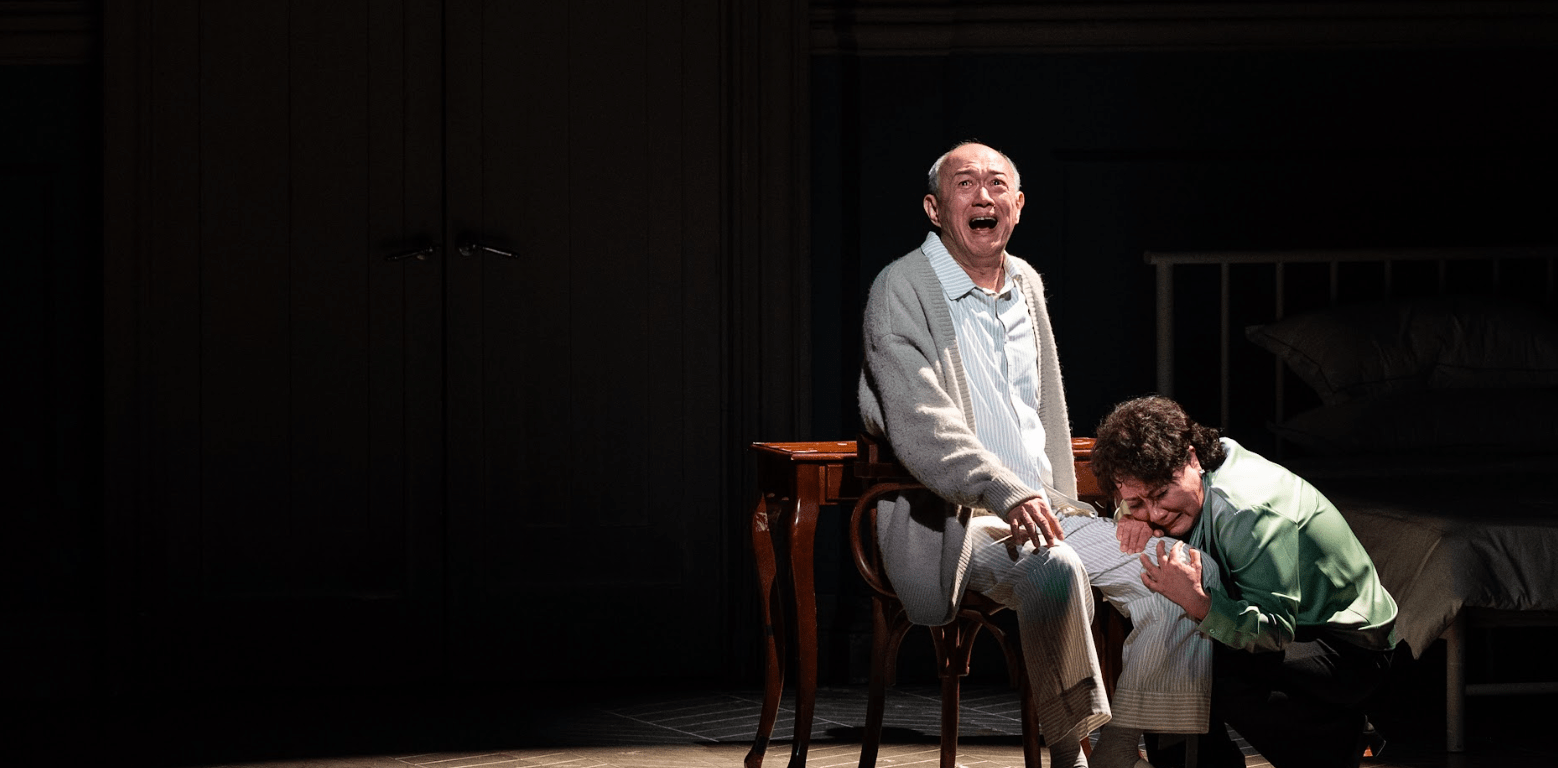
In this Mandarin-speaking adaptation, King takes on the mantle of Andre masterfully. Carrying a carefree charisma from the offset, King highlights a deep understanding of his responsibility to the production; inviting audiences to experience Andre’s fluctuating waves of memories alongside him. Then, as the play moves, King’s Andre sheds his charm gradually, unravelling an inner battle with reality, his caregivers and ultimately, his degrading memory.

Weaving in between the doors of Wang’s set, King’s Andre feels spiritual, lingering in the edges of the ever-changing Parisian apartment as its only constant. Yet, between an earlier lively vitality and his descent into an empty, ghostly presence lies the true brilliance of King’s Andre as a father losing not only his individuality, but his family to his illness. Despite a vocal slur, the humanity in King’s Andre transcends his words, making the audience feel a deep sympathy and a shared sorrow for his loss of memory.
Accompanying Andre is his daughter, Anna, played predominantly by China National First-Class Actress, Tian Shui. The father-daughter pair share a palpable chemistry as a relationship intertwined with both a daughter’s love and a caregiver’s burden. Although Andre’s cantankerous tendencies often result in cutting insults, the beauty of Tian’s performance lies in the little, fleeting moments of joy she finds in her father’s antics, his fictional stories and his characteristic stubbornness. It is exactly in such moments that make Anna’s darker confessions and revelations all the more heartwrenching. For instance, in a particularly disturbing monologue, Tian exhibits a full command of the Esplanade in her storytelling, highlighting a thrilling desperation in her recount of a violent dream.

Completing the ensemble is a host of characters, played by Wang Yenong, Xie Chengying, He Mengjie and Zhao Haitao. While they all fulfil their roles with an ease, Zhao is a clear highlight as Anna’s husband, Pierre. Initially unbothered, Zhao’s Pierre becomes an increasingly menacing presence throughout the play with his outsider perspective that slowly transforms into intrusive opinion and at one point, suspected violence. It is a terrifying performance to watch as it points to a realistic risk of indulging in a pragmatism, devoid of empathy, when challenged by caring for a loved one with Alzheimer’s.

Tying these performances together is remarkable direction by David Jiang Weiguo, whose direction is at once, imaginative yet precise. Although ‘The Father’ has been performed in many different countries, with as many different languages, Jiang has continued to find a fresh Chinese perspective complementary to the novel approach of Zeller’s play. Playing with the father-daughter dynamic, Jiang’s direction clearly speaks to the pillared idea of Filial Piety entrenched in Chinese communities. He then goes a step further, asking how hard this pillar can be shaken before it reaches its crumbling point.

While the set design is a technical feat on its own, Jiang’s collaboration with props designer, Liu Yipeng, is equally impressive in its attention to detail. Utilising clever motifs like the withering potted plant and the slight shifts of the revolve to achieve sharp angles and positioning, it is easy to think of Jiang’s direction as simply an hyper-intellectual one. Yet, in his navigation of emotionally-difficult scenes, he also highlights a humanistic approach in directing emotion, central to communicating the challenging themes of this play.

Supporting Jiang’s direction are the exceptional lighting and sound design by Chen Lu and Gu Ying respectively. In many ways, the orchestral sound of Gu’s design feels almost innate in depicting Andre’s deteriorating mind. It is at once tense, ghastly and thrilling; keeping the audiences at the edge of their seats as they focus in on piecing together Andre’s story. Chen’s lighting is also a clear winner; with a clear understanding of restraint and excess to craft beautiful mise-en-scenes with shadows as well as a particularly memorable lighting sequence that reflects the enervated Andre losing himself in the maze of an apartment that he ought to be familiar with.

While it is easy to be impressed by the technical and creative tricks that Jiang’s production plays with; at its core, this production has triumphed in creating a definitive ‘父亲’ amidst its many global counterparts; with a distinctly Chinese flavour. Armed with outstanding lead performances and a complete satisfaction of the senses, Jiang has created a masterpiece that not only evokes a profound sense of devastation for Andre’s eventual circumstance but also prompts intellectual consideration from a holistic standpoint.

‘父亲’ is thus no doubt a must-watch, not just for audiences to passively learn from its devastating ending; but for audience to challenge themselves in reflection: Because when push comes to shove and duty dissolves into burden, ‘The Father’ then stares down at its audience, asking who will you eventually choose to love? Will it be your family or your lover? Or perhaps, the only right answer is to escape this dichotomy, choosing instead to love yourself while you still can.

Photos by Jack Yam, courtesy of Esplanade – Theatres on the Bay
Le Père (The Father) plays from 6th to 8th March 2026 at the Esplanade Theatre. Tickets available here
Huayi – Chinese Festival of Arts 2026 runs from 27th February to 8th March 2026 at the Esplanade. Full programme and tickets available here
Production Credits:
| Produced by Shanghai Dramatic Arts Centre Executive Producer Zhang Huiqing Supervisor Tian Shui Artistic Director Yu Rongjun Co-Supervisor He Nian Project Producer Tang Shi Playwright Florian Zeller (France) Director David Jiang Weiguo Script Translator Shen Wei Cast King Shih-chieh, Tian Shui, Zhao Haitao, Xie Chengying, Wang Yenong, He Mengjie Scenic & Production Designer Wang Jiadi Revival Director Xu Zidong Lighting Designer Chen Lu Props Designer Liu Yiping Sound & Music Designer Gu Ying Technical Designer Hu Jisheng Costume & Makeup Designer Lü Simo Costume & Makeup Supervisor Leng Jia Stage Manager Zhu Xingyu Assistant Lighting Designer Wu Yuheng Lighting Technician Zhang Zhaolai Assistant Stage Manager Wang Yangzi Props Operator Lu Zhenyu. Zhu Chenqi Set Operator Zheng Gang , Li Jun, Wang Xiuwen, Wang Qiang, Yang Pengtao Logistics Xu Wenxian |
 Bakchormeeboy