
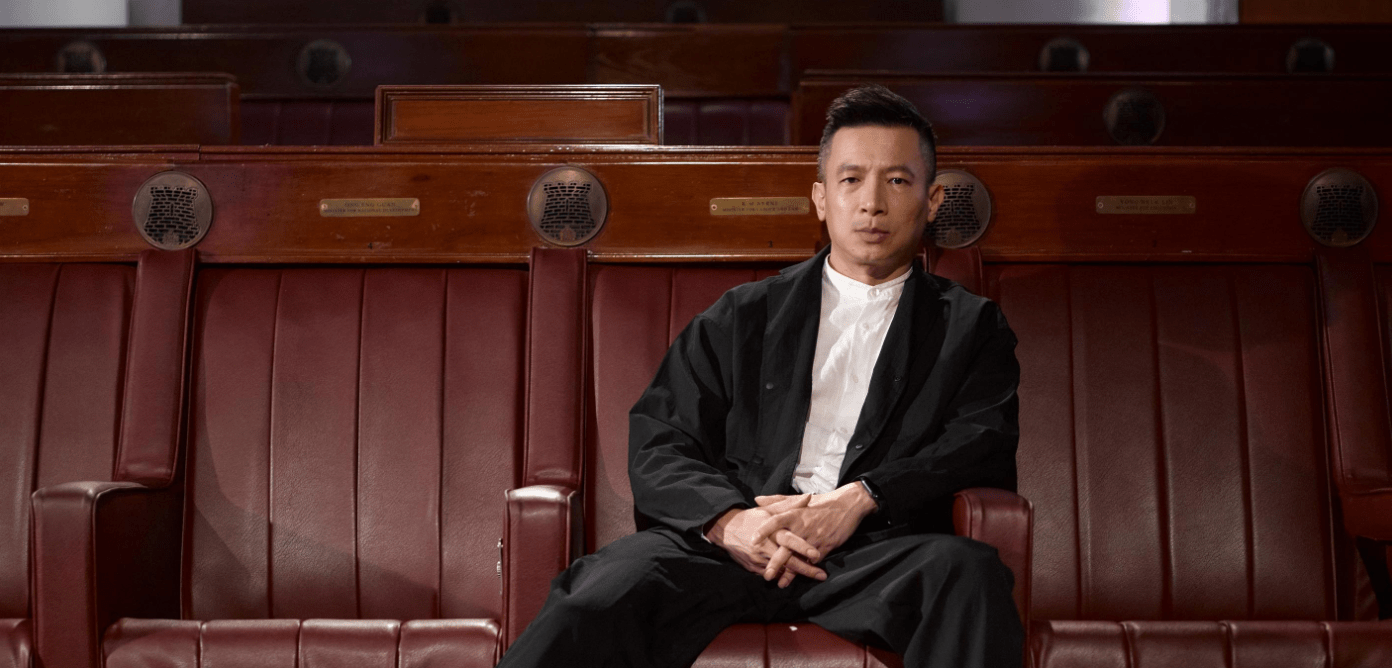
“Let’s play” sounds like an unexpected invitation at a time like this. In recent years, Singapore’s arts ecosystem has felt increasingly brittle, one defined by closures, stagnant funding, and a growing sense that artistic labour must constantly justify itself in numbers, outcomes, and economic value. Against this pragmatic backdrop, theatremaker Chong Tze Chien has emerged from the wings and prepares to stage his first act as Festival Director of the Singapore International Festival of Arts (SIFA), armed not with the language of scale or spectacle, but with something far more disarming.
“‘Let’s Play’ is not just a theme to characterise my vision of SIFA,” Chong insists. “It’s a call to action.”
The phrase functions on several levels at once. There is play as activity; something participatory, social, and open-ended. There is play as drama, as performance, as the act of stepping into another world. And there is play as a mode of discovery. “It’s an invitation to partake in something fun and adventurous,” he says, “a way and means to discover something new outside of the immediate and everyday experience.”
This is an idea that may seem frivolous to the general public but for Chong, this instinct is fundamental. “Play is something we do as children, and the young at heart,” he reflects. “But as adults, we lose that sense of adventure. We stop tapping into imagination, into discovery.” An arts festival, in his view, should be one of the few moments in a year where that instinct is not only permitted, but actively cultivated: “a constant encounter, a constant sense of activities together that centres around an overarching experience.”
Yet play, as Chong frames it, is inseparable from another word he returns to repeatedly: legacy. Running from 15 to 30 May 2026, this edition of SIFA marks the beginning of Chong’s three-year tenure, a consciously structured arc he describes in dramaturgical terms. “As a storyteller and a playwright, I’m telling a story over three years,” he says. “This is Act One.”
The timing is deliberate, considering SIFA has now been around for 49 years. As SIFA approaches its Golden Jubilee in 2027, Chong has chosen Legacy as his first thematic anchor. The idea of legacy is explored through productions like Last Rites, which gathers veteran Asian performance artists to imagine their final act, or A Light Between Rains, a speculative procession that celebrates community, creativity, and the living threads that connect us all.
“It’s about roots,” he explains, “and about looking back and looking forward at the same time.” For him, legacy is not a static inheritance but a living question: what from the past still matters, and how might it be re-encountered now?

This philosophy finds its most visible expression in the return of the Festival Village, a feature long associated with the Singapore Arts Festival of the 1980s and 90s. “Everyone who is old enough to have experienced it. remembers it fondly,” Chong notes. But the revival is not intended as a simple exercise in nostalgia. “The question was: how do you manifest the theme in a concrete way?” he asks. “How does the audience encounter it, physically and socially?”
The Village, positioned as an outdoor hub for conversation, food, and performance, is designed to re-establish what Chong calls the “festival vibe”, with the sense that something is happening, collectively, beyond the walls of individual venues. “The vibe starts at 6pm,” he says. “You makan, you hang out, you watch performances in bite-sized portions, both in terms of duration and in how they tickle your palate.”
The Village also hosts more hands-on experiences, from The Lighthouse, an immersive light exploration for children and families, to interactive movement projects where festival-goers can experiment with rhythm, gesture, and ensemble play. This emphasis on atmosphere speaks to a larger anxiety Chong holds about the contemporary arts calendar. “The festival vibe has been diluted over the years,” he observes. “It’s a very crowded calendar now.” In a city where international productions and local commissions circulate year-round, SIFA can no longer rely on novelty alone.
“Someone might be watching a show at Victoria Theatre or the Esplanade that’s commissioned by the festival,” he says, “but they don’t associate it with SIFA. They associate it with the venue or the company.”
For Chong, this dilution raises an existential question. “Fast forward to today,” he says, “what is the role of the festival now?” It cannot simply be “another festival,” nor merely a funding opportunity for local artists. “Our budget hasn’t increased in so many years,” he points out, “and other theatre company budgets have caught up. Some companies even have bigger commissions.”

What, then, distinguishes SIFA? Part of the answer lies in structure. Chong has reorganised the festival into five interrelated pillars: the Festival Stage, Festival Play!Ground, Festival House, Festival Late Nites, and the Festival Village. Each is calibrated to reach different audiences, price points, and modes of engagement, while contributing to a single, extended experience. “I’m trying to maximise your night out,” he says. “You don’t have to go out and do just one thing before heading home, but five things, all interrelated.”
You could spend an entire evening at the festival without paying a cent, moving between outdoor performances from 6pm to 11pm. Or you could anchor your night around a ticketed indoor work, then return to the Village or Late Nites afterwards. “And that’s okay too,” Chong adds. “The worst thing for me is when people feel the arts are not for me.”
Play, in Chong’s vision, is also mobile. This year’s Festival Play!Ground will not only open the festival at the Village, but travel as a roving component to Punggol Coast, bringing with it a parade and other commissioned works. Commissioned works will respond to the local environment in Punggol, creating site-specific experiences that reflect both the community and the festival’s spirit of playful exploration. Chong likens it to “almost a travelling circus,” a way for the festival to act as its own ambassador.
For some, last year’s neighbourhood programming raised questions about whether bringing SIFA into the heartlands risked diluting its artistic identity. Chong pushes back against this framing. “In the early 80s, this wasn’t strange at all,” he says. “There was a festival fringe. There were international roving acts all over the island.”

Punggol, with its young families, new university, and emerging digital district, felt apt. “There’s new energy there,” Chong notes. The artists commissioned for the Play!Ground are also expected to respond to each new environment. Play, here, becomes adaptive: reshaped by context rather than imposed upon it.
If play risks being mistaken for lightness, the Festival Stage complicates that assumption. Leading the international line-up is LACRIMA by French director Caroline Guiela Nguyen: an epic, multilingual work set within the haute fashion industry. Chong describes it as “cosmopolitan,” but also as a deliberate attempt to “bring back spectacle,” both practically and emotionally.
Other major works deepen this gravity. A reimagined Hedda Gabler by the National Theatre Company of Korea transposes Ibsen’s proto-feminist classic into a Korean patriarchal context under the leadership of its first female artistic director, Park Jeong Hee. Meanwhile, Hamlet by Teatro La Plaza from Peru is performed by a cast of actors with Down syndrome, who fold their own lived experiences into a play-within-a-play that re-examines the question of being. These are not distractions from play, but its extension, as Chong and the team test how far play can stretch into discomfort, labour, and representation.

Local works, too, reflect this seriousness. A co-commissioned restaging of Strangely Familiar by T.H.E Dance Company explores the intersection of digital and lived realities. More significantly, Chong has introduced a new two-year model for developing local commissions. “It’s to take pressure off the work,” he says, drawing from his own experience as a commissioned artist. Rather than rushing towards a finished product, artists are given time to explore, reflect, and evolve.
Underlying all of this is Chong’s deep unease with how success is measured. “Numbers are a vicious cycle of entrapment,” he argues. “We trap ourselves into thinking everything has value because we can put facts and figures to it.”
He traces this impulse to a broader, post-industrial fixation on quantification. “We talk about resale value, upgrading a meal—everything has become transactional,” he says. “That language has shifted the way we think about what is of value to us.”
When applied to the arts, this framework is fundamentally flawed. “Is the arts as essential as health and defence?” he asks. “You can’t put a number on wellness; it’s intrinsic to everyday behaviour. But if we think of the arts as outside of that, we will always reduce it to a luxury.”
“I wish we could talk about things beyond numbers,” Chong admits. “Maybe I’m naïve. But maybe after the first edition, people might think: maybe this is essential after all.”

Play, in Chong’s conception, is not passive consumption. The festival parade involves volunteers and members of the public co-creating what they perform. Beyond performances, initiatives like Diversity Futures connect emerging artists across Singapore, Korea, and Hong Kong, embodying the festival’s role as a space for exchange, learning, and long-term collaboration. Forums and think tanks, such as a multi-day gathering focused on disability and access in Asian arts, are designed to generate new practices long before audiences enter the theatre.
“How do we usher disabled audiences into theatre spaces?” Chong asks. “How do we cater to their needs as they’re watching the shows?” These are infrastructural questions, not symbolic ones, and they require sustained commitment beyond a single festival edition.
Chong is under no illusion about the scale of the task. “To change the status quo, to shift paradigms, any shift now is monumental,” he says. “Even a small one.” His hope is modest, but pointed: that by the end of his tenure, something, anything, will have moved.
After three years, he will return to being an artist. “It would be sad if I went back to the same way of working,” he reflects. “At least this gives me and others a chance to change how we work.”
In a society often described as practical to a fault, Chong’s insistence on play as healing, as necessity, and as collective practice may feel optimistic, even risky. Whether a festival can truly shoulder that burden remains an open question. But by foregrounding play not as escape, but as encounter, SIFA under Chong’s direction dares to ask something quietly radical:
What if play is not the opposite of seriousness, but the condition that makes healing, imagination, and change possible in the first place? And if so, are we ready to play? Those are questions that will only be answered as Chong’s SIFA lands this May, and we wait with bated breath to see how his tenure plays out.
Images courtesy of Arts House Group
SIFA 2026 runs from 15th to 30th May 2026. More information and tickets to be released here
 Bakchormeeboy