
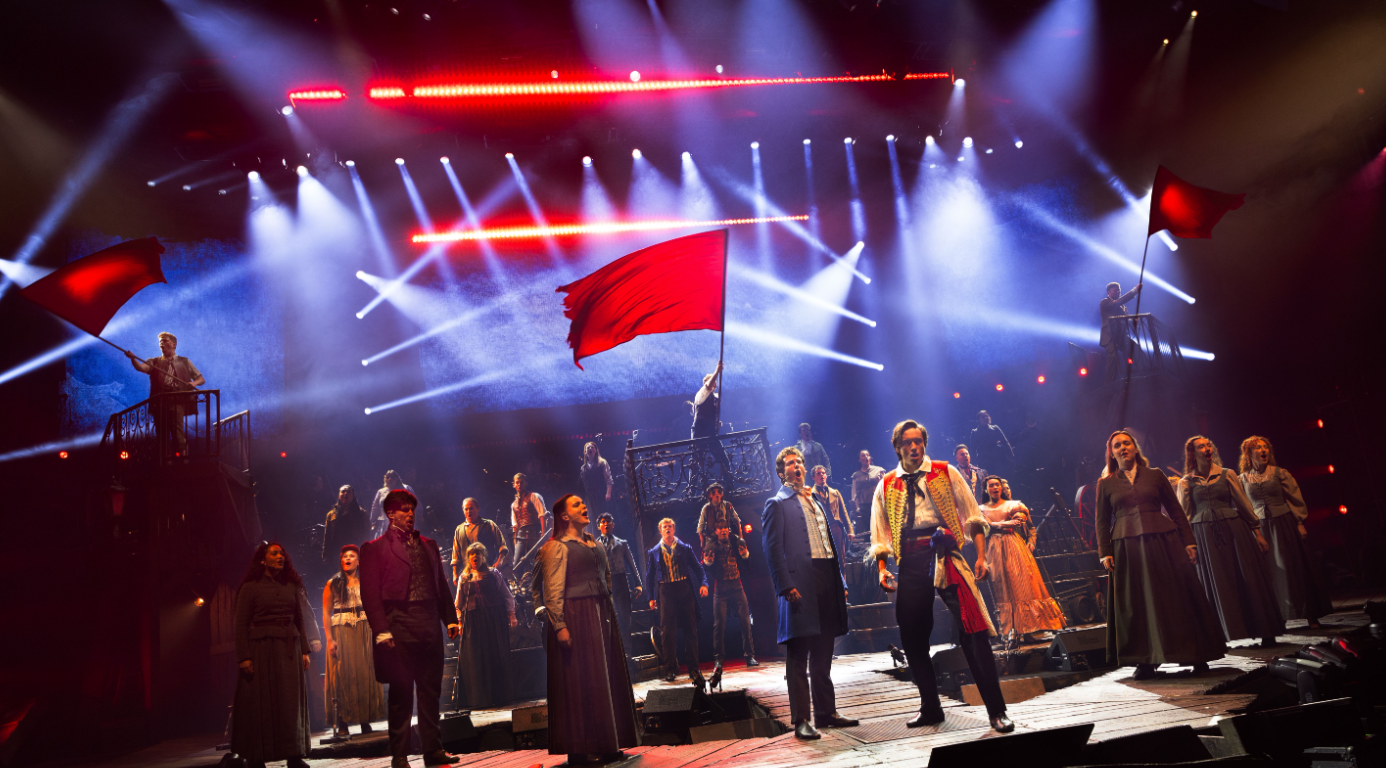
Spectacle meets soul in epic, transcendent reimagining of the musical theatre classic.
Few musicals possess the cultural and emotional magnitude of Les Misérables. From its origins on the West End and Broadway to its global tours and cinematic adaptation, the work of Claude-Michel Schönberg and Alain Boublil, drawn from Victor Hugo’s monumental novel, has endured as a defining pillar of musical theatre. In its 40th anniversary iteration, producer Cameron Mackintosh presents Les Misérables – The Arena Spectacular, a reimagining that expands the musical’s scale while preserving, and in many ways intensifying, its emotional immediacy.
Staged at the Sands Theatre at Marina Bay Sands, this production deftly negotiates the demands of arena-style spectacle within a more intimate architectural frame. The result is a synthesis of concert and theatre: a full orchestra placed prominently onstage, a visually expansive design augmented by projections and live close-ups, and a staging language that privileges both grandeur and psychological proximity. The sound, with a full orchestra under Adrian Kirk’s direction, is notably rich, sonorous without excess, allowing the score’s sweeping leitmotifs to resonate with clarity and power.

At its core, Les Misérables remains a profoundly human narrative: the journey of Jean Valjean, an ex-convict seeking moral redemption in a society governed by rigid justice, set against the turbulence of post-revolutionary France. The musical’s through-composed structure ensures that character and theme are inseparable from music; each principal number functions not merely as spectacle, but as psychological and moral revelation.
The production’s scenography is striking in both conception and execution. What initially appears as a desolate mound of rubble transforms, with quiet ingenuity, into an architectural centrepiece, from an arched bridge, to a barricade, forming a living structure that evolves alongside the narrative. Its apparent simplicity belies its versatility: layered platforms, concealed entrances, and sculptural depth allow for a fluidity of staging that supports both intimate soliloquy and massed choral movement. Lighting design further articulates space and tone, with multitudes of lighting fixtures rendering scenes with painterly precision and evoking the texture of 19th-century Paris with remarkable dimensionality, while providing spotlights that amplify the mood – a standout scene is when the rebellion is felled, and lights representing bullets synchronise with each actor’s fall.

Integral to the production’s success is its ensemble, whose vocal and dramatic cohesion lends the work its epic breadth. The opening “Look Down” establishes not merely atmosphere, but thematic foundation, a world defined by hardship and inequity. “At the End of the Day” builds with inexorable tension, channelling collective frustration into a visceral outcry, while “Lovely Ladies” juxtaposes levity with underlying despair. The revolutionary chorus, “Do You Hear the People Sing?”, emerges not as a simplistic anthem, but as an earned articulation of hope and defiance, its reprise imbued with poignancy and cost. And in “One Day More,” the musical’s structural and emotional architecture converges: individual narratives interweave in a fugue-like crescendo, crystallising the stakes of each character with breathtaking clarity.

Of its main cast, Gerónimo Rauch’s Jean Valjean anchors the production with a performance of remarkable depth and control. He charts Valjean’s transformation with meticulous attention to psychological nuance, his vocal phrasing imbued with both authority and vulnerability. In “Who Am I?”, Rauch strips the character to his moral essence, delivering a moment of existential reckoning that is as intimate as it is profound. His portrayal ultimately affirms Valjean not merely as a symbol of redemption, but as a fully realised human being shaped by suffering, compassion, and choice.

Opposite him, Jeremy Secomb offers a formidable Javert: unyielding in conviction, yet subtly fissured by doubt. His “Stars” is rendered with austere beauty, the character’s rigid worldview expressed through controlled, almost devotional vocalism. Yet beneath this precision lies an undercurrent of instability, which surfaces with devastating effect in his final soliloquy, a moment that transforms Javert from antagonist to tragic figure, undone by the collapse of his own certainties by the time he dies.
Among the younger cast, Will Callan’s Marius is distinguished by sincerity and emotional transparency. His “Empty Chairs at Empty Tables” evolves from quiet restraint to unguarded grief, articulating loss with a clarity that lingers. Harry Chandler’s Enjolras commands the stage with charismatic authority, embodying the idealism and resolve of revolutionary leadership; his presence lends weight and credibility to the students’ cause.

Na-Young Jeon’s Fantine, though brief in stage time, is rendered with striking poignancy. Her physical and vocal transformation, from dignity to destitution, is acutely observed in both voice and physicality, culminating in a deeply affecting “I Dreamed a Dream” that resists melodrama in favour of quiet devastation. Lulu-Mae Pears’ Cosette, by contrast, offers tonal lightness and lyrical clarity, her soprano lending warmth and innocence to “A Heart Full of Love.”
Providing necessary tonal contrast are Lea Salonga and Red Concepción as the Thénardiers, whose performances are as theatrically exuberant as they are sharply observed. Salonga’s casting carries particular resonance given her celebrated history with Les Misérables, and she embraces this grotesque, comic turn with evident relish, her deliberately grating vocal tone, exaggerated physicality, and razor-sharp timing revealing a performer in complete command of her craft. Both she and Concepción are further elevated by striking costume and styling choices, unkempt hair, heavy, exaggerated makeup, and tattered layers that vividly externalise the characters’ moral decay. Together, they form a dynamic double act, matching each other in energy and precision, their biting humour undercut by an unmistakable sense of opportunism that ensures their comedy never feels merely superficial.

It is, however, Nathania Ong’s Éponine that emerges as one of the production’s most extraordinary achievements. Ong’s interpretation is both technically assured and emotionally expansive; her “On My Own” is a masterclass in musical storytelling, each phrase shaped with deliberate sensitivity to text and subtext. She traces Éponine’s unrequited love with restraint and dignity, allowing the character’s inner life to unfold with devastating authenticity. By the time of “A Little Fall of Rain,” her performance has accrued such emotional weight that the character’s fate feels not only tragic, but inevitable, a culmination of quiet suffering rendered visible, and living proof of the talent that Singapore has to offer, both here and on the global stage; her performance is one of the biggest reasons to come see this show.

Les Misérables – The Arena Spectacular achieves a rare equilibrium: it amplifies the scale of the musical without diminishing its emotional core. The production honours the integrity of the original while recontextualising it for contemporary audiences, reaffirming its enduring relevance. By the time the full company converges in the finale, the effect is nothing short of transcendent, a convergence of narrative, music, and performance that encapsulates the essence of the work. This is not merely a revival, but a reassertion of Les Misérables’ place as one of the great achievements of musical theatre. An experience of exceptional artistry and emotional power, this stands as one of the definitive stagings to encounter both for longtime admirers and those newly discovering its world.
Featured Photo Credit: Danny Kaan
Les Misérables The Arena Spectacular World Tour runs from 24th March to 19th April 2026 at the Sands Theatre, Marina Bay Sands. Tickets available here
 Bakchormeeboy