
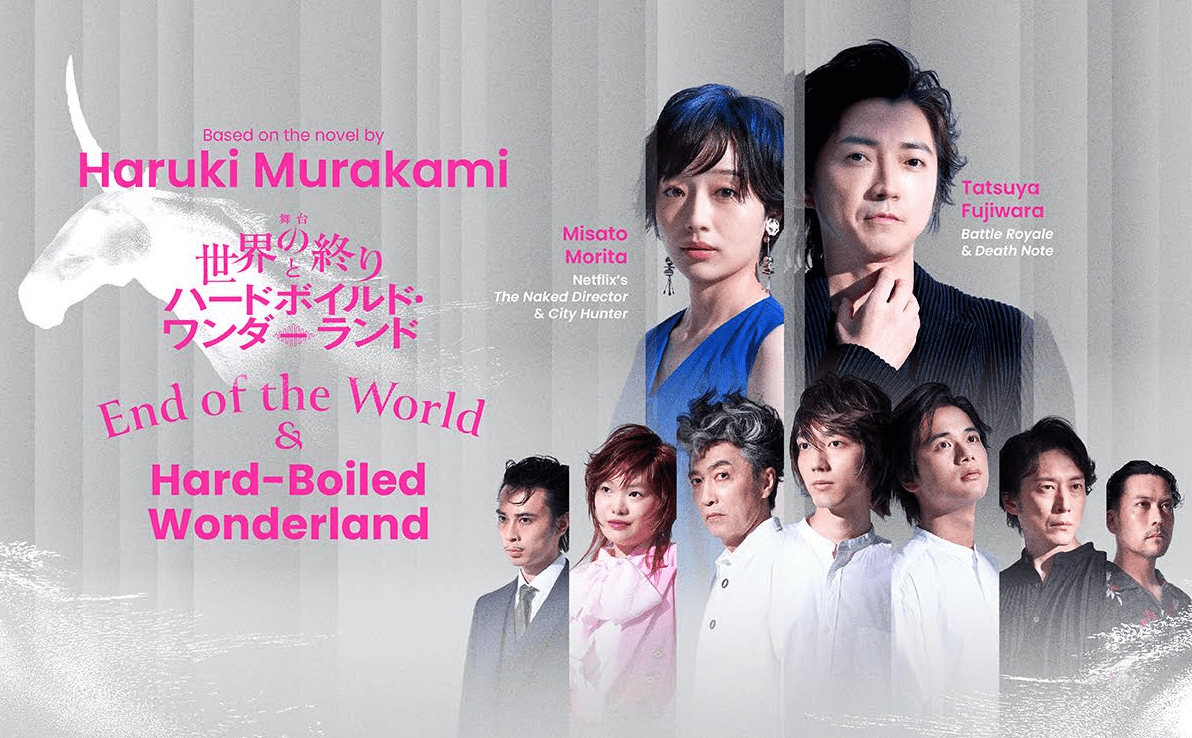

Few literary worlds are as slippery, introspective and visually elusive as those of Haruki Murakami—which makes the stage adaptation of Hard-Boiled Wonderland and the End of the World an especially intriguing proposition. Directed and choreographed by Philippe Decouflé, the production transforms Murakami’s dual narratives into a highly visual theatrical experience, where movement, colour and scenography take the place of interior monologue. Arriving in Singapore at the Esplanade Theatre this week, the work brings together a Japanese cast led by Tatsuya Fujiwara, alongside Decouflé’s signature blend of theatrical illusion, dance and poetic imagery.
For Decouflé, whose career spans everything from contemporary dance to large-scale spectacles like the 1992 Winter Olympics, this production occupies a uniquely personal space. Drawing on instinct, sketches and a lifelong accumulation of influences, he approaches Murakami’s layered universe not by explaining it, but by rendering it tangible, balancing humour, mystery and visual invention while embracing ambiguity. We speak to him about navigating Japanese culture, collaborating across languages, and crafting a work that invites audiences not just to follow a story, but to inhabit a dreamlike state beyond the logic of everyday life. Read the interview in full below:

Bakchormeeboy: Murakami’s worlds are famously interior and elusive. Was there anything you had to unlearn or reinvent in your own practice to make that inner landscape visible on stage?
Philippe Decouflé: Murakami’s world lends itself to multiple interpretations. As the production team chose me for this project, I trusted my instincts and let myself be guided by the images that came to me while reading the novel. I drew the scenes as they came to mind, and was then able to bring these images to life with the help of a wonderful Japanese team.
Bakchormeeboy: You trained across circus, mime and contemporary dance. How do those disciplines converge in your approach to this production’s physical language?
Philippe: This show is like a musical without songs. It is highly visual; each scene has its own identity, its own composition and its own colours. In terms of physical expression, it essentially blends theatre and dance, and music has a fairly significant role too.

Bakchormeeboy: What kind of research or immersion into Japanese culture or Murakami as a whole shaped your interpretation of the work, and where did you allow imagination to take over?
Philippe: It’s always hard to say where imagination comes from! It’s a real mix of everything I’ve seen and loved throughout my life. There aren’t really any limits, other than always thinking about the enjoyment I want to share with the audience. I’ve been to Japan many times, and its culture fascinates me, even though I still don’t understand much of how it works.
Bakchormeeboy: The piece navigates two parallel realities. Did you conceive them more as contrasting aesthetics, or as two sides of a single consciousness?
Philippe: These are two complementary facets of the same story. I have depicted reality in black and white and dreams in colour. But, just as the two worlds gradually merge within the story, black and white and colour also intersect.

Bakchormeeboy: You’ve created many works for large-scale events like the 1992 Winter Olympics as well as more intimate stage works. Where does this production sit for you on that spectrum of spectacle versus intimacy?
Philippe: Strangely enough, although on the one hand it is a major show aimed at a wide international audience, it is in fact quite an intimate and personal performance. I’ve put a lot of myself into it – my tastes and my passions.
Bakchormeeboy: Working with a Japanese cast, including Tatsuya Fujiwara, did you find differences in rehearsal dynamics, cultures or performance instincts that influenced the final staging?
Philippe: Tatsuya Fujiwara is exceptionally talented, and directing an actor of his stature is both an honour and a privilege. Working with a Japanese team is very different: we don’t speak the same language, we don’t share the same culture or the same sense of discipline. But at the same time, it’s the same thing: we share the same passion – theatre – and we work with the same elements: sound, light, time, space, movement, emotions.

Bakchormeeboy: Your work often balances humour, illusion and melancholy. How do you calibrate that tone in a story that moves between absurdity and existential reflection, especially one that tends to resist melodrama or emotional outpouring?
Philippe: I don’t know how to answer that question. I think this show has humor and magic, but as for the rest, come and see for yourself
Bakchormeeboy: Murakami’s writing resists clear interpretation. How then do you decide what to clarify for an audience and what to leave unresolved or ambiguous? Is there a feeling you want audiences to walk away with?
Philippe: I try to share a vision of beauty and poetry. I simply want to offer the audience a moment of joy, beyond the time and space of our daily lives.To give them something to dream about.
Photo Credit: Takahiro Watanabe
End of the World and Hard-boiled Wonderland plays from 3rd to 5th April 2026 at the Esplanade Theatre. Tickets and more information available here
 Bakchormeeboy