
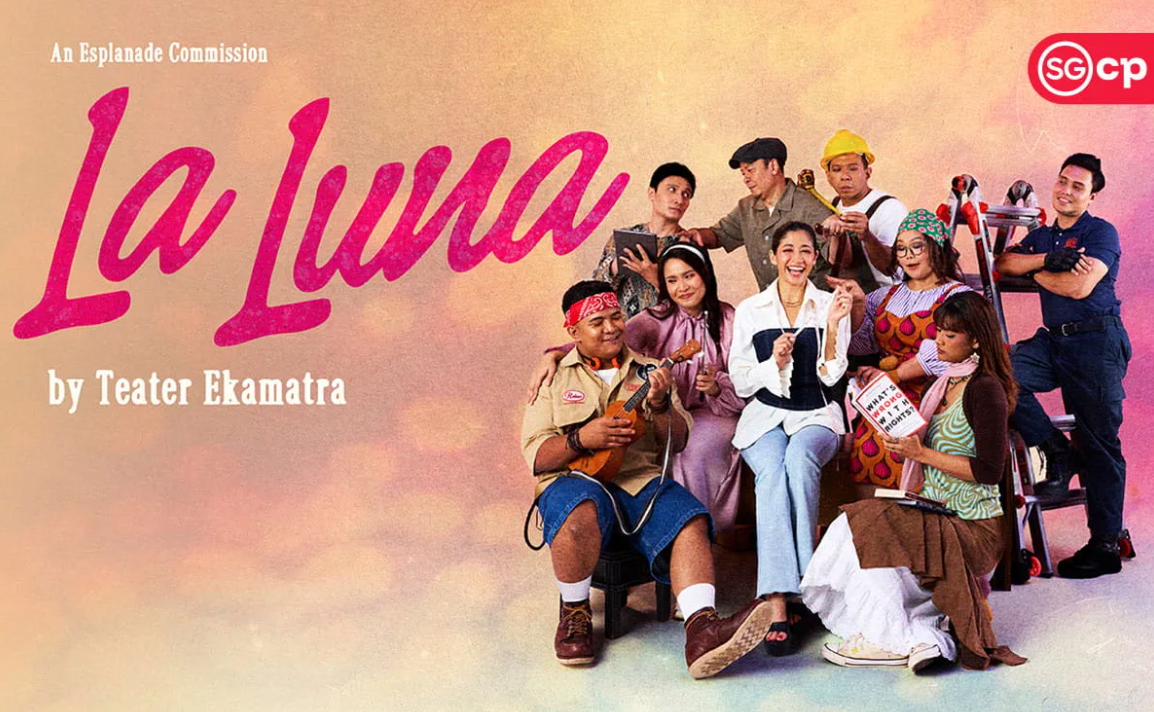
In an age where the world often feels divided and overexposed to outrage, the most compelling theatre sometimes comes from stories that remind us what it means to live, work, and confront challenges together. This year’s La Luna, making its stage debut during Pesta Raya at Esplanade – Theatres on the Bay, does exactly that: it’s a feel-good comedy that also asks audiences to look at the contradictions, hypocrisies, and humanity of a small village, and perhaps, of the world at large.
Based on the acclaimed 2023 film by M. Raihan Halim, the story is set in the fictional Kampong Bras Basah, a tightly-knit, socially conservative village. Hanie, a bold outsider, arrives and opens a women-only lingerie shop, unintentionally shaking the foundations of long-held village norms. From gossip to scandal, from moral policing to quiet rebellion, the villagers are forced to confront desires and beliefs they often keep hidden. Yet as the story unfolds, it becomes clear that the village only moves forward when its members act together, reminding everyone, onstage and off, that it takes a kampung to make change.
For Malaysian playwright Ridhwan Saidi, adapting La Luna for theatre was a new direction he had yet to explore with the company. “While previous work with Teater Ekamatra was more about translation, such as Bangsawan Gemala Malam, or having more free rein with a folk story like Bawang Putih, Bawang Merah,” he explains. “I didn’t want to just do a film-theatre word-for-word adaptation. The film has a commercial, feel-good quality, but in a stage work, the performance can be slightly wilder and more absurd, because the energy is so different. On film, it’s intimate; on stage, you can exaggerate, explore, and play around with characters more.”
He went further indeed, writing nearly 20,000 words in the first draft, building histories for each character and establishing how the village functions. “I even thought about the penghulu, the laws, the social customs, really the whole environment. Then, working with (director) Fared, we managed to cut about 7,000 to 8,000 words. It was about keeping what’s essential, letting the ensemble shine, and balancing perspectives between Malaysian and Singaporean cultures.”
One of the biggest changes Ridhwan made in adapting La Luna for the stage was also to expand the focus beyond Hanie. “I tried to focus on nine characters,” he explains. “Some only appear briefly in the film, but in the play, we fleshed them out, gave them backstories, and made each one more apparent. It’s about creating a kampung, a living, breathing community.”
This ensemble approach allows every character to contribute to the story’s rhythm and emotional impact. “The theatre version shifts perspective,” Ridhwan continues. “Instead of just the protagonist confronting village tensions, the minor characters become vital to the narrative. The mosque caretaker, Ustaz Fauzi, for instance, is more than a figure of authority, he’s a participant in village life, organising events and interacting with others. That gives the audience a more nuanced view of the kampung.”
Director Mohd Fared Jainal also notes the importance of balance onstage. “We want to feature the female characters and what they face, but also not disregard others,” he says. “Each character, every struggle, contributes to the ensemble heartbeat of the kampung. That’s what makes it authentic: it is the entire village, not just the protagonist, that drives the story forward.”
Munah Bagharib, who plays Hanie, approached the role with familiarity and reverence. “Two years ago, Siti K told me about the film, and I loved it. It’s so funny, so watchable, and so important,” she says. “When Ekamatra approached me about the stage production, I was obsessed. There’s no one better to adapt it than Ridhwan.”
But translating Hanie from screen to stage required more than imitation. “Because I’ve watched the film before, it’s natural to want to mimic it. But the stage script is an adaptation, with new characters and form, Hanie is fleshed out differently. My task is to find my version of Hanie. It’s parallel: I’m discovering her while also moving the story through other colourful characters.”
Munah emphasizes that Hanie, while central, is part of a broader ensemble. “She’s the lead, but I don’t feel like the lead of the show. Hanie catalyses the change, but the kampung is what drives it,” she says. “The story is built through everyone, from the way the villagers interact, to the way they respond to change. The minor characters give life to the kampung, and through them, the story resonates beyond one person. We can’t fix the world if we are divided, and that’s what this ensemble approach shows.”
Rehearsals, she says, were a collaborative process. “We discuss lines, intentions, what we feel. With Fared and Irsyad (Dawood, assistant director), it’s very exciting, constantly building the world from Ridhwan’s script. Even cutting material becomes a discussion: what’s essential, what do we preserve? Everyone is very giving. It’s almost precious, the way we collectively shape this kampung.”
Fared, who also doubles as production designer, speaks about the challenge of bringing the kampung to life. “It’s a make-believe Singapore, not Malaysia, but still a kampung. People aren’t familiar with kampung life here today, so I took elements and even jumbled them. The set has the essence of the kampung, its rhythm, its chaos, its humanity.”
Fared also integrated music, movement, and dance, recognising that much of the ensemble can sing. “Since the play talks about music, it felt like a natural entry point. Music helps build the world, it reflects what’s happening in the village. We combine acting, singing, movement, and dance to make the kampung feel alive.”
Reflecting on their key takeaways working on this production, for Ridhwan, comedy became both a tool and a lens through which he could explore the tensions of the village and the world beyond. “Comedy is a safe zone for a writer,” he says. “With comedy, you can touch a lot of things, exaggerate microaggressions, spark conversations. Comedy is an art form where you can discuss, exaggerate, and in that danger, it creates an environment for people to laugh, and for something real to exist underneath. Both pleasure and pain coexist, and that tension allows the audience to engage with difficult topics safely.”
“I really do like how comedy allows us to explore tensions,” he says. “Language, timing, culture, all shift meaning. You can laugh and reflect at the same time. The protagonist isn’t the only one navigating the village, it’s the kampung as a whole, everyone together, confronting, questioning, and finding resolutions.”
Munah echoes this focus on responsibility and dialogue, and what art does. “It’s always difficult to say things that aren’t often said out loud,” she reflects. “Disagreements happen, pushback happens, and that’s why we make art. You build a world where audiences can watch something entertaining, yet know there is a real message underneath. It’s meant to spark conversation, respectful conversation. Anyone can have an opinion, and sometimes it gets difficult, especially with pushback, but coming together to watch something palatable and entertaining allows people to go away with something meaningful.”
“Coming together to watch something entertaining, then going away with something important, and that’s what theatre does. It reminds you that community matters, that dialogue matters, that small actions within a collective can lead to real change,” she adds”To resist desensitisation and to challenge mindsets, not ‘if it’s your problem, it’s not mine.’ Silence affects everyone. Both the film and stage versions of La Luna build tension, reveal injustice, and invite reflection. That’s why it remains so relevant today.”
Fared, too, reflects on the lessons of creating the play, especially about sensitivity, perspective, and the responsibility of theatre-makers. “For me, what we present is a reflection of what’s happening out there,” he explains. “Different people have different ways of seeing what’s good, what’s strict, what’s loose, and ultimately, everyone is free to choose. Morality is personal, and two schools of thought always exist in the real world. We were careful in how we escalated issues and ended scenes, being sensitive to the many points of view and beliefs present.”
“I expect conversations to happen after the show, just like with the film, empathy for characters, and also awareness that we all still lead our lives and make choices in our own contexts. What struck me most is about sensitivity itself, being excited, scared, confronted. Being responsible as a company, at the forefront of presenting challenging work, requires constant vigilance and care.”
Fared sums up the sentiment for the production as a whole: “It takes a kampung. Onstage and offstage, that’s the message. Change doesn’t happen alone, and transformation is collective. Every character, every interaction, every musical interlude contributes to the ensemble’s heartbeat. That’s the real lesson of La Luna. Whether it’s Hanie’s quiet defiance or the village coming together, it shows that real impact comes when people act in concert, in empathy, in dialogue, and in courage.”
In a world hungry for connection, laughter, and reflection, La Luna offers both a mirror and a roadmap, a reminder that sometimes, it takes an entire village to make a difference, both on the stage and in reality. Watch Teater Ekamatra come together to bring that to life onstage, only at Pesta Raya 2026.
La Luna plays from 16th to 19th April 2026 at the Singtel Waterfront Theatre. Tickets available here
Pesta Raya – Malay Festival of Arts 2026 runs from 16th to 19th April 2026 at the Esplanade. More information and tickets available here
 Bakchormeeboy