
Hell is other Christians.
The Christians arrives as one of the most unexpected entries in Wild Rice’s 2026 programming, and perhaps one of its most surprisingly provocative. A company long associated with sharp political critique, queer advocacy, and a willingness to satirise conservative structures, this is a show that feels almost disarming in its restraint. Where one might expect irreverence, Lucas Hnath’s critically-acclaimed play instead asks for something far more uncomfortable: empathy.
Directed by Glen Goei, watching this production feels like peering into a sealed snow globe, a self-contained ecosystem where belief, hierarchy, and identity circulate without external interruption. Pastor Paul, having built his congregation from a modest home gathering into a thriving megachurch, chooses a moment of triumph to announce a radical shift: there is no Hell, and salvation is universal. It is a shock provocation that triggers a slow, inevitable implosion amongst the congregation, and the beginning of the end.

For audiences familiar with the scale of Singaporean megachurches like City Harvest Church or New Creation Church in spaces as large as expo halls, Wong Chee Wai’s set feels deliberately restrained, a modest sanctuary of wooden floors, a white wall, and a stark cross. Above it, a second cross hangs suspended, its presence increasingly ominous as the play progresses. The intimacy of the space works against the text’s insistence on scale; the audience is asked to imagine thousands in the seats where there are clearly dozens, and that act of imaginative “faith” does not always hold. Attempts to shift into other locations, such as a the church office or a bedroom, feel similarly under-realised, raising the question of whether the play might have been stronger had it remained set entirely within the church.
The production also hovers in an uneasy middle ground between American and Singaporean contexts. Traditional hymns like What a Friend We Have in Jesus, performed by a live choir under the lead of Candice de Rozario, evoke a gentler, more familiar mode of worship than the polished spectacle of Hillsong-style megachurches more typical of Singapore. The opening moments, where the audience is invited to clap along, briefly place us within that ritual of Sunday service. But the production never fully commits to its localisation, leaving it suspended between specificity and generality of place, though its familiar church programme will be instantly recognisable to most people.

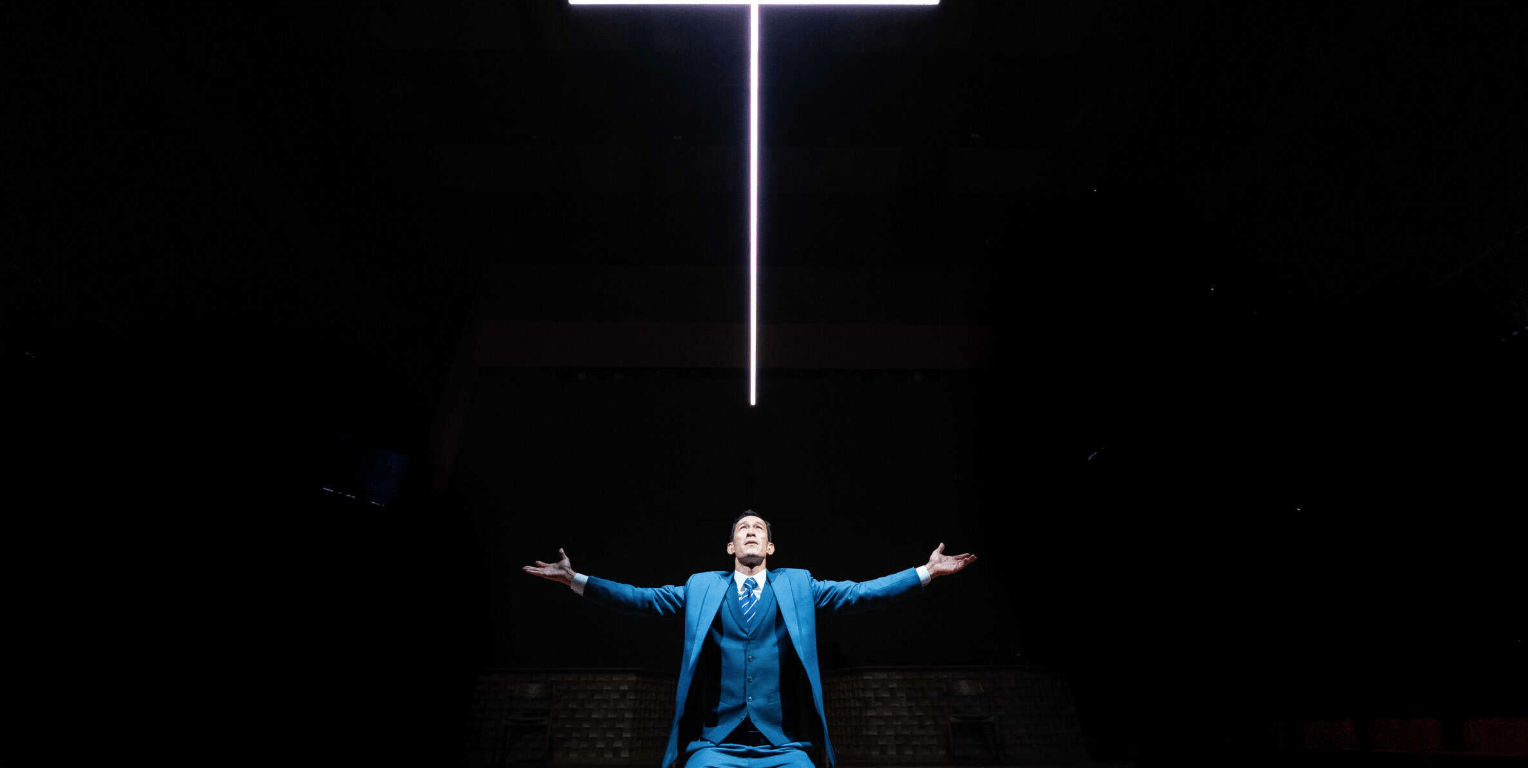
Technically, the staging is often well done. Jing Ng’s sound design allows the handheld microphones, a key feature of Hnath’s script, to feel natural and unobtrusive, with little feedback and a clarity that supports the play’s many extended monologues. More striking still is James Tan’s lighting design, which emerges as one of the production’s defining strengths. Tan moves fluidly between the soft naturalism of a Sunday service and more sculpted, theatrical states. Worship sequences carry a kinetic energy with the moving lights, while the dramatic scenes are shaped with precise isolations and controlled washes that focus attention without overwhelming it. The suspended cross becomes a particularly powerful visual element, shifting through light and shadow until, in the play’s final moments, it is fully illuminated, no longer just a symbol, but a weight bearing down on Paul. It is a simple but devastating image, crystallising the play’s central tension.
At the centre of it is Shane Mardjuki’s Pastor Paul, who commands the stage with charisma and control. Dressed in a smart, crisp blue suit and tie, his opening sermon is delivered with practised ease: anecdotal, persuasive, laced with humour, before landing on the disquieting calm of his revelation. It is a performance within a performance, and Mardjuki leans fully into that idea: this is a man trained to project certainty, hold a room, while embodying expertise and authority. Even as the world around him begins to fracture, he clings to that composure, remaining in “pastor mode” as though the role itself is inseparable from who he is.

What makes the performance land is how gradually that control slips. Mardjuki avoids any sudden collapse, instead letting small cracks emerge, such as a hesitation, a strained smile, a flicker of doubt quickly suppressed. By the final moments, stripped of his congregation and left alone with his thoughts, that carefully constructed persona finally gives way. The voice softens, the certainty drains, and what remains is a man confronting the possibility that his conviction may never have been divine truth at all. It is devastating, not because he has lost his faith outright, but because he may have lost the ability to perform it.
Opposite him, Timothy Wan’s Joshua provides a fervent counterpoint, with his and Paul’s exchanges unfolding like duelling sermons. Scripture clashes with rhetoric, certainty with reinterpretation, culminating in a congregation vote that initially feels almost absurd and entertaining in its pettiness before revealing deeper fractures. Joshua’s later return, however, proves far more affecting. In a monologue recounting his attempt to convert his dying mother, Timothy delivers one of the production’s most uncomfortable moments. The image is difficult to shake: a son pleading for his parent to convert at the edge of death, asking for a declaration he knows she does not truly hold, watching for some sign of salvation as she fades. From a distance, it is almost grotesque, coercive, even, yet his performance is so raw, so utterly sincere, tears streaming down, that it resists easy judgment. He is not presented as cruel, but as someone trapped within the logic of his faith, where the stakes are nothing less than eternal damnation. The result is deeply unsettling: we recoil, and yet we understand. It becomes a glimpse into a kind of self-imposed isolation Christians have cursed themselves with, a worldview that divides the world so starkly into saved and unsaved that it renders genuine connection almost impossible due to the insurmountable distance created between them.

Elsewhere, Oon Shu An’s Elizabeth offers a quieter but no less devastating counterpoint, her crisis of faith unfolding through restraint rather than rupture. As a leader within the church and Paul’s wife, she exists at the intersection of devotion, duty, and personal conviction, and Shu An plays this tension with remarkable control. Her anger is never explosive, but tightly contained. surfacing in clipped logic, measured questioning, and an increasing refusal to concede. There is something almost more frightening in how composed she remains, holding her ground with a calm certainty that ultimately proves more destabilising than any outburst. When she finally withdraws her support, it feels less like a dramatic break and more like an inevitable, deeply human line being drawn, in contrast to Paul’s belief that God has none.
In contrast, Julius Foo’s Elder Jay operates from a place of cool pragmatism, embodying the institutional machinery that undergirds the church. Where others grapple with theology, Jay is concerned with numbers, influence, and sustainability, a reminder that faith, when commercialised, becomes inseparable from infrastructure. Julius plays him with a measured detachment that never tips into coldness, suggesting someone who believes, but understands that belief alone is not enough to keep a system afloat. In many ways, he becomes the voice of uncomfortable reality, articulating the stakes that others avoid: debt, decline, and the very real possibility of collapse. Through him, the play gestures towards the uneasy intersection of faith and finance, grounding its philosophical debates in something far more material, and far more immediate.

The production’s emotional high point, however, belongs unequivocally to Zee Wong, whose Jenny delivers the play’s most electrifying and devastating turn. A struggling single mother, stretched thin and clinging to the church as both spiritual anchor and support system, Jenny is the kind of devotee institutions are built on: a faithful who gives not just emotionally but materially, even beyond her means. Her testimonial begins simply, almost nervously, as an expression of gratitude, but suddenly begins to unravel as her doubt spirals into anger and desperation, as she interrogates the very foundations of Paul’s theology. She lands the humour in the awkwardness of the moment, finding unexpected laughs with sharp comic timing, before turning that same energy into something deeply unsettling. Her questions about justice, suffering, and the moral implications of a world without Hell, are not abstract, but painfully lived. There is a sense that this is not intellectual debate for Jenny, but survival. By the time Zee reaches the peak of her monologue, she has completely seized the stage, pushing Paul into silence and the audience into discomfort. Her exit, taking with her the choir, the band, and much of the congregation, lands like a rupture, leaving behind a stunned emptiness that is as thrilling as it is devastating.
If the production falls short of complete cohesion, it does so in relatively minor but noticeable ways. The intermittent “he said / she said” interjections from Paul, meant to evoke the sense we are listening to a sermon, disrupt rather than deepen the framing, and the spatial limitations occasionally undercut the scale of the narrative. A slight drag in pacing also emerges in the latter half, understandable from a play that builds itself on monologues. Yet, what lingers is not these imperfections, but the discomfort the play so carefully cultivates. The audience, notably, seems unsure how to meet the play. Early laughter lands awkwardly, as if expecting satire that never arrives, before giving way to longer, more attentive silences. By the end, the response is telling: a brief pause hangs in the air before applause begins, tentative and measured, as though the audience is still deciding what it has just witnessed.

In choosing to stage this work, Wild Rice seems to extend what feels like an olive branch. It is not agreement or assimilation, but a refusal to punch down and caricature, where we are not allowed to dismiss Christian faith as mere delusion. In a Singaporean context, where tensions between Christian conservatism and more liberal communities remain deeply felt, that choice carries weight. There is something radical in the idea that a company so publicly aligned with alternative voices might programme a work that asks us to sit with, understand, and even feel for the very community that has often stood in opposition to it, and asks to accept differences and nuance in viewpoints. If anything, the gesture itself feels almost Christian: an insistence on empathy, even where it is not easily given.
The Christians is a work that ultimately suggests something quietly unsettling: that the deepest fractures in faith are not between believers and non-believers, but within belief itself. That the most insidious divisions are self-imposed, constructed from doctrine, certainty, and fear. Hell, it seems, is not other people, but constructed by other Christians, locked in binary systems of belief that leave little room for grace or doubt. Perhaps what needs saving most is not a world on fire, but themselves from each other.
Photo Credit: Wild Rice
The Christians plays from 9th April to 2nd May 2026 at Wild Rice @ Funan. Tickets available here
Production Credits:
| Playwright Lucas Hnath Director Glen Goei Cast Shane Mardjuki, Oon Shu An, Julius Foo, Timothy Wan, Zee Wong Music Director Elaine Chan Musicians Candice de Rozario (Choir Mistress), Kelly Chan, Seren Chen, Erika Goh, Sharne Sulaiman, Shaun Spencer, Sreya Sanyal, Elaine Chan (Keyboardist), Lee Lin Chow (Drummer), Russell Seow (Bassist) Set Designer Wong Chee Wai Lighting Designer James Tan Multimedia Designer Maximilian Liang Sound Designer Jing Ng Costume Designer Theresa Chan Hair Designer Ashley Lim Make-Up Designer Bobbie Ng |


One thought on “★★★★☆ Theatre Review: The Christians by Wild Rice”