
A lively but unfocused stage adaptation of La Luna struggles to balance satire and substance, losing the impact and weight of its source material.
Adapting a film for the stage is never about simple reproduction. Theatre demands transformation, with a rethinking of form, rhythm, and storytelling. But that transformation must still serve the story. The most successful adaptations do not replicate but reinterpret with purpose. The question, then, is not how much has changed, but whether those changes deepen or dilute what made the original work.
In Teater Ekamatra’s stage adaptation of La Luna, that balance proves elusive. Directed by Mohd Fared Jainal, with a script by Ridhwan Saidi, the production takes significant liberties with M. Raihan Halim’s film, but too often, those choices feel arbitrary rather than illuminating. What emerges is a work that retains the skeleton of the original, but loses much of its emotional and thematic weight in the process.

The play takes us to the fictitious, conservative Kampung Bras Basah, where outsider Hanie arrives and opens a lingerie shop, creating a private space for women while unsettling entrenched social norms. Around her, a cast of villagers, from the authoritarian headman Tok Hassan to the headstrong student Azura, grapple with shifting ideas of morality, desire, and control.
Yet where the film builds these tensions with care and accumulation, the stage version disperses them. The very first scene is set in the future, where Azura is attempting to title her thesis through wordplay, riffing on “bras” and “beras” (rice), gestures toward cleverness but ultimately feels inconsequential. It becomes emblematic of a broader issue: scenes that exist as ideas or jokes rather than as meaningful steps in a narrative progression.

This sense of diffusion is most apparent in the expanded ensemble lines and scenes. Saidi’s script clearly aims to give more characters space, but many of these threads are introduced only to be abandoned. A breast cancer subplot, tied to one of the village women, is raised and then left mostly unexplored. A youthful romance between Azura (Haziqah Hashir) and Yazid (Ali Mazrin) makes commentary on gender roles but never develops beyond surface-level flirtation in a cute number. Meanwhile, key arcs from the film, particularly those that demonstrate the tangible impact of Hanie’s shop on the women’s lives, are either minimised or removed, leaving her influence mostly abstract and vague.
More significantly, the adaptation appears to sidestep the film’s heavier themes. The removal of the domestic abuse subplot, one of the original’s most grounded and urgent threads, is particularly striking. In its place are lighter conflicts that lack comparable stakes, from inattentive husbands to vague generational tensions. Even the supposed “provocations” of the story feel muted, with surreal touches, such as earthquakes accompanying outbursts of desire, or Tok Hassan’s lingering presence after death, introduced without clear purpose or follow-through, except for throwaway jokes.

Characterisation also suffers accordingly, with many of them oversimplified in their performance. Sani Hussin’s Tok Hassan is played with gusto, but the character itself is written with little nuance in the way he displays his villainy. He becomes almost cartoonish in his motivations and growl, simplified into a revenge-driven backstory that reduces the complexity of his authority, rather than a man who genuinely believes in conservative ideals. Similarly, Fir Rahman’s Salihin is reimagined as a volunteer firefighter rather than a policeman, a change that does little to meaningfully reshape his role, raising questions about what such alterations are meant to achieve beyond novelty. As for the remaining ensemble members, characters often feel flattened, their arcs compressed into shorthand or left hanging.
There are flashes of energy and charm. Munah Bagharib brings the necessary rebellious spark to Hanie, while Siti Khalijah Zainal is a lively presence as Jenab, making strong use of her vocal strengths under the guidance of vocal coach Babes Conde. Rizman Putra, as the bumbling and loyal Mat Noh, delivers physical comedy with precision, often lifting scenes that might otherwise fall flat. Choreographer Md Al-Hafiz Hosni’s contributions, along with intermittent musical moments, add some texture, though the production neither fully commits to being a musical nor fully playing these for comic effect, leaving these elements feeling more ornamental than integral. But as a whole, the chemistry across the cast feels uneven, not for lack of effort, but because the characters are rarely given the space to develop meaningful relationships. Emotional beats arrive without sufficient buildup, and confrontations stretch on without significantly advancing the narrative.

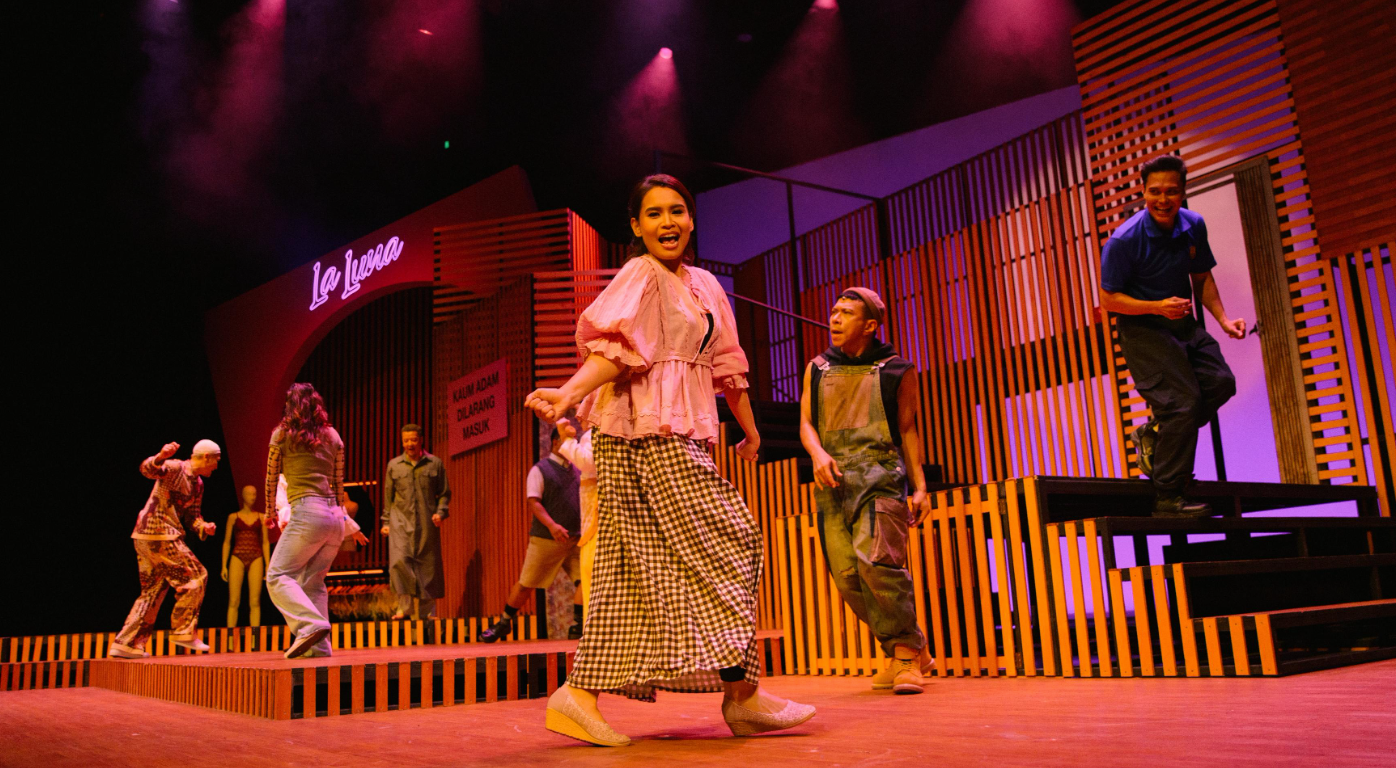
Visually, the production offers moments of interest. Director Fared’s set, with its carved wood textures and multi-level staging, is detailed and aesthetically pleasing, and the La Luna shop itself is clearly defined, particularly in its climactic destruction filled with smoke, while lighting by Adrian Tan and sound design by Safuan Johari support the shifting moods. However, the set ultimately reads more as a single, contained structure than a sprawling kampung. Despite attempts to divide action across levels, the sense of a wider village community, so central to the story, never fully materialises. The world feels too compressed, its scale at odds with the narrative’s ambitions.
All this speaks to an overall tonal uncertainty. The production leans heavily into humour and absurdity, but without the underlying structure to support it. Comedy becomes less a lens for insight than a distraction from the story’s core tensions. What was once sharp and subversive becomes, at times, oddly tame or even banal. The result is a production that feels pulled in multiple directions, without a clear dramatic centre. Instead of enriching the story, the additional material often dilutes it, creating the impression of a work still searching for its final form, evident also in its pacing that often drags out scenes and moments and constantly moving us away from the main narrative, one that almost seems like it knows it needs to deliver an important ‘message’, but is more interested in having fun and making light moments than building up to it.

Teater Ekamatra has, over the years, developed a distinctive approach to its Pesta Raya offerings, with accessible, ensemble-driven works that balance humour with social commentary. But in La Luna, that balance tips too far toward lightness. In softening the material, the adaptation also strips it of urgency, leaving behind a story that gestures at important ideas without fully engaging with them. None of this is to suggest that a stage adaptation must mirror its source exactly. On the contrary, the most compelling adaptations transform their material boldly.
But those transformations must feel necessary and rooted in a clear vision of what the story gains in its new form. With La Luna, too many changes feel like substitutions rather than reimaginings, flattening characters, loosening narrative threads, and ultimately reducing the story’s impact. What remains is a production that is intermittently entertaining but rarely affecting, a version of La Luna that feels curiously weightless, despite the richness and originality of its premise. In the end, this is a village without a centre. And while it may take a kampung to tell a story, it also takes clarity, focus, and conviction to make it matter.
Photo Credit: Haiqal Anwar
La Luna played from 16th to 19th April 2026 at the Singtel Waterfront Theatre. More information available here
Pesta Raya – Malay Festival of Arts 2026 runs from 16th to 19th April 2026 at the Esplanade. More information and tickets available here
Production Credits
| Playwright Ridhwan Saidi Director/Set Designer Mohd Fared Jainal Cast Munah Bagharib, Fir Rahman, Sani Hussin, Siti Khalijah Zainal, Farhana M Noor, Fauzie Laily, Rizman Putra, Haziqah Hashir, Ali Mazrin Assistant Director Irsyad Dawood Lighting Designer Adrian Tan Sound Designer Safuan Johari Vocal Coach Babes Conde Choreographer Md Al-Hafiz Hosni Make Up Artists Jane Shah, Aliff Khan Producer Shaza Ishak Production Managers Khairina Khalid, Anais Adjani Technical Manager A Kumarran Stage Manager Wann Nurul Asyiqin Assistant Stage Managers Natalie Titus, Jasmine Khaliesah Production Assistant Putri Prizaiwati Surtitlist Sharmin Norman Wardrobe Master Theresa Chan Dressers Noor’Ain Afiqah, Maya Husna Azman Make Up Artist Bobo Mic Operator Khairatun Nadhirah Lighting Programmer Paul L |

