
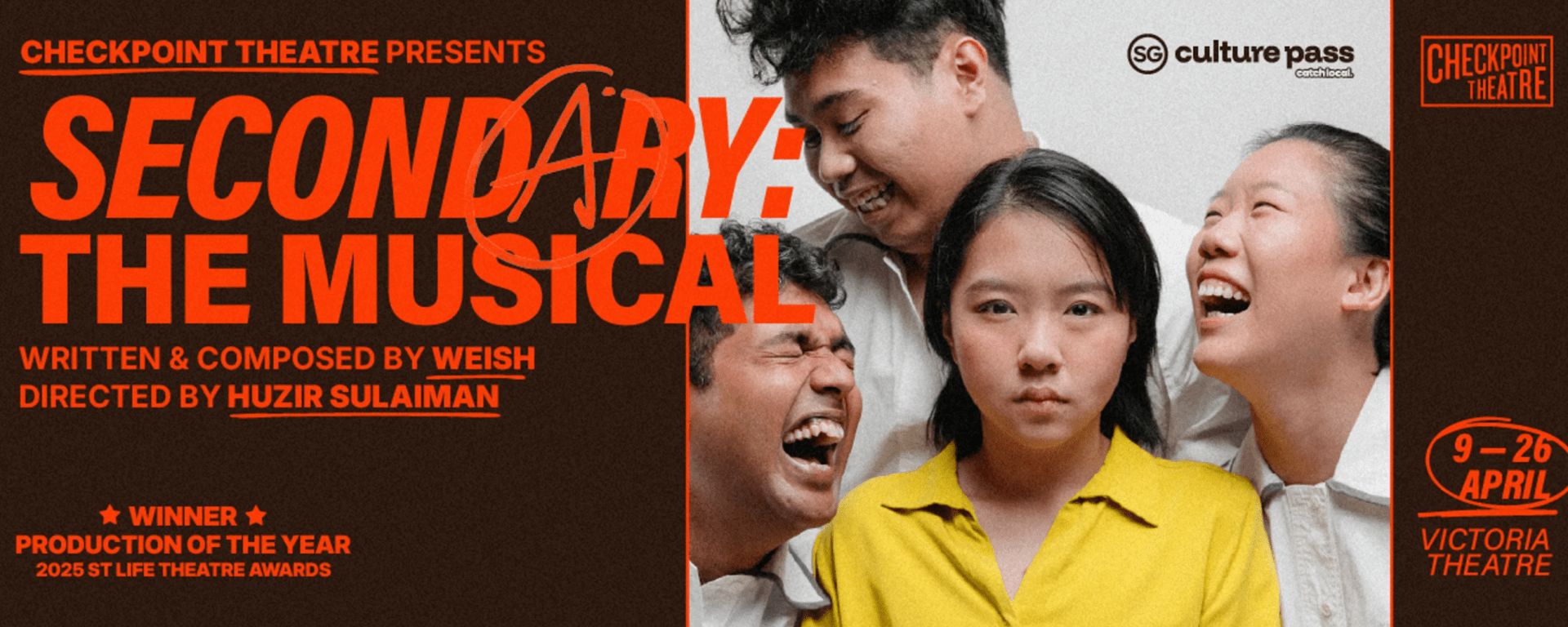
Note: the performance reviewed featured understudies in the following major roles: Risa Ann Wong as Lilin, Nadya Zaheer as Mandy, Izzul Irfan as Omar, Fahim Murshed as Reyansh, Coco Wang as Ensemble (Discipline, Rong, Vice-Principal, Hui Ling), Nurulhuda Hassan as (Ensemble: Humour, Nadrah, Welfare, Amira, Cik Sya)
weish’s Secondary: The Musical returns with a surer, more confident restaging, deepening the emotional resonance of an already incisive work.
When Secondary: The Musical first premiered in 2024, it distinguished itself not by breaking new ground in subject matter, but in its sincerity. In a landscape where stories about Singapore’s education system are plentiful, weish’s debut musical stood apart for its careful balance of perspectives: students, teachers, and administrators alike — and its insistence that the real conflict lies not within individuals, but within the system itself. Paired with a distinctive sonic voice and grounded, deeply human performances, it was an easy A.
Two years on, the musical returns largely unchanged, but not untouched. If anything, this restaging feels more assured, as though time has allowed both cast and direction to settle more fully into its rhythms. Once again directed by Huzir Sulaiman, the musical brings us back to Huxley Secondary School, a pointed reference to Brave New World and its rigid social hierarchies. The school’s name looms over the production both literally and metaphorically, reflected in Petrina Dawn Tan’s polished set: smooth wood flooring, a commanding spiral staircase, and a lone tree offering a hint of life amidst institutional sterility. It is recognisably Singaporean, in both aesthetic and atmosphere.
Set in the mid-2010s, the story follows English Literature teacher Lilin in her final term before a potential posting to MOE HQ. As she navigates the mounting pressures of the job, administrative demands, departmental expectations, and the emotional labour of teaching, she must also contend with the lives of her Sec 3 class, 3F, a group of students widely written off as the worst in the cohort.
As its title suggests, Secondary also gestures towards the question of what and who is made secondary within the system. At its core lies a central tension: do teachers prioritise their own well-being, risking the futures of their students, or do they place students first, at the expense of their own already overwhelming administrative and emotional load? It is a dilemma with no easy resolution, and one that the musical returns to again and again with quiet urgency.
Performed on an understudy night, the cast offers interpretations that feel distinct rather than diminished. As Lilin, Risa Ann Wong may lack some vocal power, but compensates with striking emotional sensitivity. Her performance feels deeply lived-in, capturing the quiet toll of a teacher constantly negotiating between care and authority. Moments where she is forced to discipline her students carry visible weight, her restraint making these fractures all the more affecting, especially when set against the lingering trauma of a past student’s suicide, a shadow that informs her every decision.
Among her colleagues, Teoh Jun Vinh once again proves a standout as ‘Matts’ teacher Charlie Chu. Effortlessly comedic, his deadpan delivery and impeccable timing turn even the worst puns into crowd-pleasers. Yet beneath the humour lies a deeply recognisable figure, a teacher worn down by the system, who has learned to survive it by keeping just enough distance to care, but not enough to break, choosing detachment as a form of self-preservation. His gradual shift, nudged by Lilin’s persistence, becomes one of the production’s most quietly moving arcs.
Understudy Nadya Zaheer’s Mandy impresses vocally, particularly in her solo, but lacks the full gravitas required to make the character truly formidable. As a result, her presence feels less imposing than intended, softening the tension she is meant to bring as both antagonist and product of the system.
The students of 3F, Ming, Reyansh, and Omar, remain the emotional core of the musical. Fahim Murshed’s Reyansh leans convincingly into rigidity and awkwardness, his performed stiffness aligning well with the character’s need for structure and certainty. Izzul Irfan’s Omar captures the character’s bravado and underlying resentment, though without quite pushing its emotional extremes. At the centre is Ming, reprised by Tricia Tan, whose performance remains quietly devastating: foul-mouthed and defensive on the surface, but carrying a deep well of responsibility and vulnerability beneath.
Running parallel to all this is the literary text studied in class, a science-fiction short story about clones replacing humans. It serves as a clear allegory for a system that demands conformity, offering students and the audience a lens through which to interrogate their own place within it.
What continues to set Secondary apart from other plays about education is weish’s writing, which remains remarkably assured for a debut musical: intelligent, restrained, and deeply observant. There is a quiet confidence in how she resists over-explaining, trusting both her material and her audience. Characters are sketched with just enough detail to feel fully real, allowing audiences to recognise them instantly: the disengaged student, the overworked teacher, the quietly struggling child. Yet what is most impressive is her generosity as a writer; no character is reduced to caricature or villainy. Even at their most flawed, they are afforded dignity and understanding. There is no cruelty in these portrayals, only a gentle, unflinching honesty that reflects lived experience, and invites audiences to see themselves, and each other, with greater empathy.
As a composer, weish’s voice remains unmistakable. The opening number, Aiya, is a subdued, almost dreamy lament, an unconventional choice that sets the tone for a musical more introspective than bombastic. From there, the score expands in range. Stand in Line adopts a militaristic quality, evoking the regimented conformity of school life, while Drip injects energy and playfulness, giving the students space to revel in youthful bravado.
Comedy peaks in Because Why, where Teoh Jun Vinh’s unwavering seriousness heightens the absurdity of its vogue-inspired choreography. Elsewhere, emotional depth takes centre stage: Mandy’s My Own Life reframes her rigidity through personal struggle, Buang Aku captures Omar’s conflicted anger with raw intensity, and Ming’s House unfolds from a simple poem into a quietly heartbreaking folk-inspired piece.
Particularly striking is On Paper, a technically ambitious sequence that transforms exam scripts into choreography, seamlessly transitioning from students to teachers, capturing the mechanical, almost transactional nature of assessment. The musical closes with a reprise of Aiya, returning to its central idea, that while the system may remain unchanged, the people within it continue to try. Taken together, the score prioritises emotional texture over spectacle, favouring authenticity and specificity over show-stopping excess, a choice that ultimately defines the musical’s identity.
Visually, the production remains cohesive and assured. Lighting shifts fluidly between realism and abstraction, bathing the stage in dreamlike hues during Lilin’s internal conflicts and isolating characters in stark spotlights during moments of emotional intensity. Costuming is equally effective: students in familiar uniforms, teachers clearly defined through attire, from Mandy’s structured severity to Charlie’s practical informality, while Lilin’s inner voices appear in oversized, almost childlike ensembles, embodying the overwhelming chaos of her inner world.
If the musical falters at times, it is in its length and occasional lack of restraint. Some scenes feel overly extended, and certain ideas are articulated more explicitly than necessary. Yet even in these moments, the emotional truth remains intact. When the students receive their results, and those who fail begin to crumble, the impact is undeniable, a stark reminder of what is at stake.
What makes Secondary endure is its continued relevance. Even as Singapore’s education system evolves with initiatives like subject-based banding offering greater flexibility, the fundamental pressures remain. The emphasis on grades, the relentless workload, and the emotional strain placed on both students and teachers persist, creating an environment where survival often takes precedence over growth. The system may have evolved in structure, but its emotional logic remains largely unchanged.
Which is why it’s bold that Secondary: The Musical does not attempt to resolve these systemic tensions. It admits it cannot resolve these systemic tensions, but instead offers an alternative: recognition, of the students who struggle, the teachers who try, and the countless moments in between that rarely make it into official narratives. It is this shared understanding, deeply Singaporean, yet universally human, that resonates most strongly. Change may or may not come, but within this lived reality, there remains care, effort, and the stubborn hope that it is enough.
Secondary: The Musical plays from 9th to 26th April 2026 at Victoria Theatre. It is sold out. More information on Checkpoint Theatre’s upcoming season here
Production Credits
| Cast Genevieve Tan, Rebekah Sangeetha Dorai, Teoh Jun Vinh, Tricia Tan, Krish Natarajan, Ramzie lahar, Johanna Van, Tiara Yap, Adeeb Fazah, Nadya Zaheer, Aaron Ee, Lim Shi-An Understudies Risa Ann Wong, Nadya Zaheer, Aaron Ee, Misha Paule Tan Fahim Murshed, Izzul Irfan, Coco Wang, Misha Paule Tan, Fahim Murshed, Nurulhuda Hassan, Matthias Teh Playwright, Composer, and Music Director weish Director and Dramaturg Huzir Sulaiman Choreographer Hafeez Hassan Set and Lighting Designer Petrina Dawn Tan Lighting Co-Designer and Programmer Tai Zi Feng Sound Designer (Technical and Sound Mixer) Shah Tahir Sound Designer (Content), Music Arrangement and Production Ian Lee Costume Designer Max Tan Assistant Director Marc Gabriel Loh, Vishnucharan Naidu, Krys Yuan Vocal Coach emmeline Hair Designer Leong Lim Make-Up Designer Bobbie Ng Creative Captioning Consultant Joanna Ong |

