
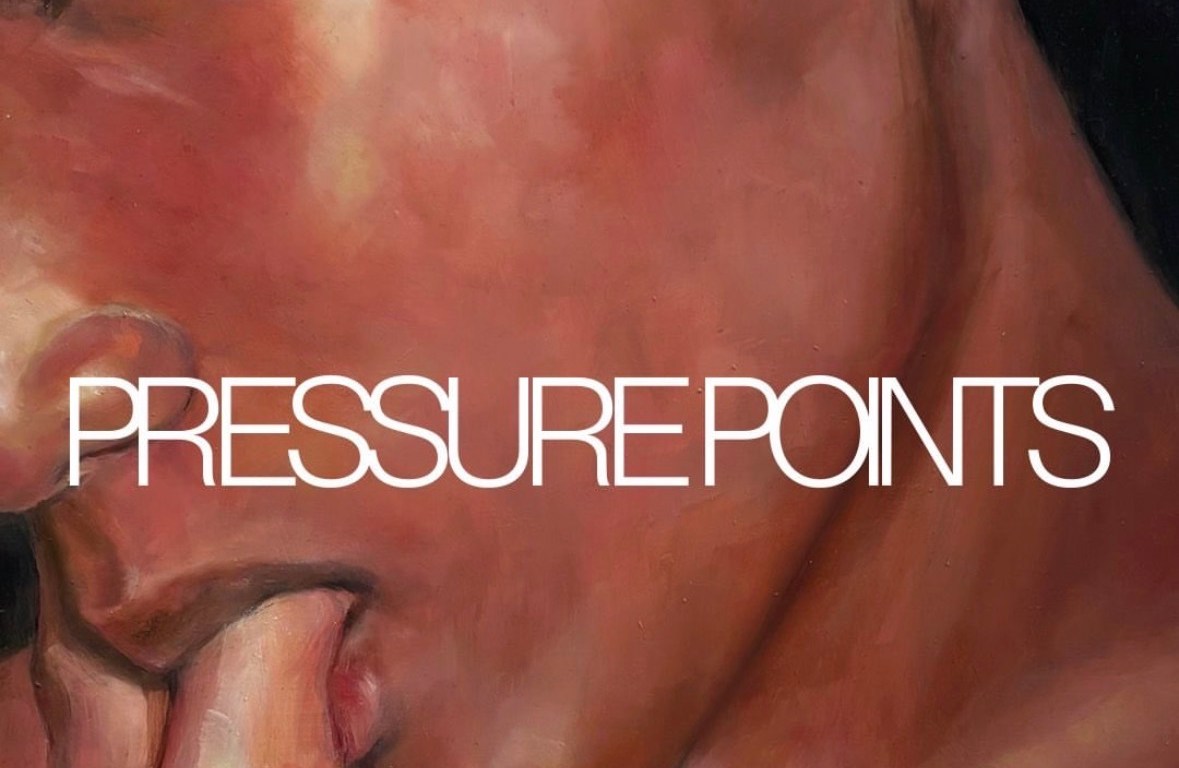

Lucas Tan paints as if trying to hold something just a moment longer, capturing an expression, a touch, a glance that might otherwise slip away. In his debut solo exhibition Pressure Points, the Singapore-based painter offers a body of 14 works that is at once intimate and composed, grounded in lived experience yet carefully constructed into images that linger.
It’s a wildly successful work for a first solo, with 10/14 of the works already sold. Perhaps they are drawn to his subjects, perhaps they can already see the potential in how Pressure Points encapsulates the portrait of a young artist coming into his own, becoming realised emotionally, materially, and with striking clarity of voice. “For this first solo, I think that I said what I really wanted to say as a gay man in my 20s,” Tan reflects, as we sat down to talk before his opening over the weekend. That statement carries through the works: scenes of closeness and distance, of longing and restraint, each one calibrated with a sensitivity that feels both personal and widely resonant.

Tan’s figures are often young men rendered with softness and precision, but these are not straightforward portraits. They function instead as carriers of feeling. “I use my friends and my models as muses and vessels to illustrate the idea visually,” he explains. In earlier works, these muses were more directly tied to his own relationships. Here, however, a shift has taken place. “I decided to take a step back from that relationship aspect and make it more my own story, and not a lot of them are about the models anymore. It’s very much about what I want to say.”
That turn inward gives Pressure Points its cohesion. The paintings read almost like entries in a visual diary, though far more deliberate in their making and intent. “Each painting feels somewhat like a journal entry,” Tan says. “It took longer than writing, but it’s a chance to finally say something.” What emerges is a constellation of emotional states: yearning, tenderness, ambition, doubt. “There’s always this desire for something more,” he adds. “Always seeking that connection, that hope.”

This emotional register is perhaps best described in his own words as “melancholic” and “sentimental.” Even in moments of physical closeness, there is a subtle distance, a quiet tension that runs through the works. It is not simply romantic longing, but something broader, often rooted in the pressure of becoming, of wanting, of not yet arriving. “I think people can tell that I’m hungry,” Tan says. “There’s always a part of me that wants more.”
That sense of hunger is embedded in the exhibition’s title. “For me, the play on the word Pressure Points is about varying levels of emotion and intensity,” he explains, “and also a nod to the physicality of it all.” The body, after all, is central to Tan’s practice, not only as subject, but as a site of feeling, memory, and projection.

One of the exhibition’s most subtly affecting works, Initiation, turns this inward gaze toward the artist’s own past. Based on a photograph of his childhood baptism, the painting depicts a moment of familial embrace, his parents holding him in an act of faith and belonging. “I titled it Initiation, and it captures this innocence of not knowing what I really signed up to,” Tan says. Rooted in his family’s beliefs and values, the work carries a layered tension: tenderness alongside uncertainty, devotion alongside distance. It extends the exhibition’s concerns beyond desire and intimacy into questions of inheritance, identity, and the structures that shape us before we can name them.
If the emotional core of Tan’s work feels instinctive, his process is anything but. With a background that includes fashion media and image-making, he approaches each painting with a strong sense of composition and intent. “My process is very much conceptualising the idea,” he says. “I plan decks like a proposal that I send to my models.” Consent and clarity are central to this method. “I don’t want the lines to be blurred. I need everything to be out in the open and transparent.”
From there, the works are staged with a cinematic sensibility. “I see myself as somewhat of a director in a painting form,” Tan notes. “I like to stage it like a play, just for that one single shot.” At times, however, spontaneity intervenes. He recalls photographing two strangers he encountered at a club: “They just had that dynamic. I told them to stay, just freeze.” Later translated into paint, such moments retain their immediacy while being subtly transformed. “I tweak their likeness a little bit to protect their identities,” he adds, underscoring the balance between observation and construction that defines his practice.

The act of painting itself becomes an extension of this intimacy. “I spend a long time rendering their figures, their faces, and especially their expressions,” he says. “The process is quite an intimate action.” This sustained attention produces images that feel hushed, almost suspended. “Even when it’s conceptually loud, the visual is very silent. It’s very still.”
Sound and mood play a role as well. “I’m very inspired by audio-visuals,” Tan shares. “I listen to songs that relate to the concept; if it’s sexual, I listen to very sexual songs. I also listen to a lot of Chinese music because they tend to be very emotional.” These layered inputs, visual, sonic, emotional, coalesce into works that are both deliberate and deeply felt.
For all their sensitivity, Tan’s paintings are not inward-looking to the point of exclusion. Their strength lies in their ability to resonate. Viewers recognise something of themselves in these quiet scenes: a gesture, a hesitation, a familiar emotional register. It is this balance between specificity and openness that gives the work its broader appeal beyond the queer gaze.

At the same time, Tan is acutely aware of the context in which he operates. “I get inspired by what I see, from pop culture to surrealism,” he says. “What I digest daily affects the visuals.” Yet he is careful not to lose his voice within that flow of references. “I try to cater to what is successful, but also not alienating what feels true to me. It’s always a balance.”
This instinct to remain authentic while understanding the rhythms of contemporary image culture positions Tan as a particularly compelling figure within a new generation of painters. His works are immediate without being simplistic, emotionally legible without losing nuance. They are, crucially, images that hold attention: visually striking, thematically current, and grounded in a point of view that feels both distinct and sincere.
Tan himself frames it more simply. “I want them to view me as unafraid, maybe a little bit fearless and unapologetic.” There is, however, a quiet counterpoint to that statement. In person, he describes himself as “an ambivert… leaning more towards the introvert side.” Painting, then, becomes the space where what cannot be easily spoken takes form. “This is the medium that helps me express what I find hard to say,” he reflects. “Whatever I can’t say, I try to express visually.”

That is a tension, the one between outward confidence and inward reflection, that runs through Pressure Points and gives it its emotional charge. It is also what makes the exhibition feel like more than a debut. It is a declaration of arrival certainly, but also an invitation into a practice that is still unfolding, and into a sensibility that is already sharply defined.
Looking ahead, Tan is aware that this is only a beginning. “I’m already interested in what I would paint when I’m 30,” he says. “Your pressures grow as you grow.” For now, Pressure Points captures a specific moment in time, one marked by urgency, curiosity, and a willingness to confront the self with honesty.
It is this combination of technical sensitivity, conceptual clarity, and emotional openness that marks Lucas Tan as an artist to watch. His paintings do not shout, but they pierce you, and stay with you. And in a landscape saturated with images, that quiet persistence may be his most powerful gesture yet.
Pressure Points runs from 25th April to 14th May 2026 at Haridas Contemporary, 37 Keppel Road, Tanjong Pagar Distripark, Unit 04-01 F, Singapore 089064 (Access via Passenger Lift A). More information available here

